
From the Toysit archive
Learn to Dress Cube
Practice buttons, snaps, zippers and other fastenings one step at a time, with help that leaves the final movement to the player.
The play at a glance
Choose one fastening and one small movement
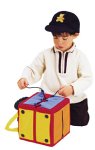
The Learn to Dress Cube brings several clothing fastenings onto a soft object that can sit in front of the player. The original coverage describes buttons, snaps, hook-and-loop fastenings, laces, a zipper and a buckle.
Pick one face of the cube and settle it on a table or lap. Opening and closing one fastening is enough for a first turn.
Steady, line up, finish
Before working the fastening, notice what needs to stay still. One hand can hold the fabric while the other moves the button, flap or zipper pull. If the cube rolls away, a partner can steady it so the player can concentrate on the closure.
Separate preparation from finishing. A partner might line up a snap and leave the press to the player, or start a button through its opening and leave the last pull. Say which part you are helping with.
After closing, open the fastening again if it moves easily. Resetting gives the player another attempt without needing to switch to a harder face of the cube.
Choose a manageable part
- Hook-and-loop flap
- Lift an edge to open it, then bring the two matching surfaces together and press. A helper can hold the base fabric.
- Snap
- Find the two halves and align them before pressing. Begin with them already lined up if that makes the last movement easier.
- Button
- Find its opening and turn the button edge toward it. A helper can begin the movement while the player finishes drawing it through.
- Zipper
- Steady the fabric and move the pull along an already joined zipper. Starting a separating zipper is a different task, and may not be part of this cube.
- Laces
- Begin by passing a lace through one opening or crossing two ends. A complete bow does not need to be the first goal.
- Buckle
- Identify how this particular closure opens and joins. Buckles differ, so demonstrate the actual one rather than assuming a shoe or belt uses the same movement.
Use only the fastenings present on the actual cube. Stop if a part catches or needs force; look at the alignment and fabric before trying again.
Offer help without taking the whole turn
Ask which part the player wants to do. Holding the fabric, finding the opening and finishing the closure can be separate shared jobs. Swap one job at a time as the player becomes interested.
Keep the pace conversational. A useful description is “you held the fabric still while you pulled,” because it names an action that can be tried again. There is no required number of repetitions or age by which every fastening must be mastered.
End on a chosen action, even if a helper completed other steps. Leaving the cube ready for next time is a reasonable finish.
Connect the practice to pretend play
Look at a doll’s clothing or a familiar garment laid flat. Find a fastening that resembles the one on the cube, then notice what differs: size, stiffness, direction or the way the fabric moves.
Try a short dressing scene, such as fastening a doll’s jacket before an imaginary outing. Small doll closures may be harder than the cube, so choosing an easier garment can keep the scene enjoyable. Success on one object does not automatically transfer to every piece of clothing.
Before another session, check seams, attached parts and laces, and follow the actual product’s age and care label. The preserved washing claim below does not establish a cleaning method for every cube sold under a similar name.
The historical record
Original Toysit coverage
The complete original description and later dressing-skills paragraph are preserved below. Their learning promises and machine-wash/dryer statements remain historical claims. Care should follow the label on the actual cube rather than this archived description.
Buttons, snaps, zippers, and ties
Children can lace, snap, velcro, button, zip and buckle to their heart's content. This teaching device is an 8 inch colorful cube with easy care. Machine washable and dryer safe. Learning to dress (with buttons, snaps, zippers, and ties) can be a source of frustration for an eager preschooler. The Learn to Dress Cube is a marvelous tool--and a fun toy--that teaches children all-important dressing skills. Each side of the cube has a different type of closure--there are snaps, clasps, Velcro fastenings, buttons, laces, and a zipper. The cube's colorful fabrics are sure to be stimulating as well, and the snaps, buttons, and laces can be counted, sized, and categorized. With its convenient handle, the cube can be easily carried to a friend's house or to school. And Grandma will enjoy watching a how-to-dress demonstration.
Toys designed to teach dressing skills offer a tactile and interactive way for children to master the art of fastening buttons, zippers, Velcro, snaps, and buckles. These educational toys typically come in the form of soft dolls or boards adorned with a variety of clothing fasteners. As kids manipulate these elements, they develop essential fine motor skills, hand-eye coordination, and problem-solving abilities. These toys also encourage independence by giving children the confidence to dress themselves, a crucial developmental milestone. Additionally, the tactile nature of these toys can provide sensory stimulation, and the challenge of mastering each new skill can instill a sense of achievement and self-efficacy. Overall, these multi-faceted educational toys serve as both a fun activity and a valuable learning experience, setting the groundwork for a lifetime of practical skills.
Sources and editorial notes
Reviewed October 16, 2026 against the original source and photograph. A 2005 ToyDirectory listing describes an eight-inch Learn to Dress Cube from Let’s Learn & Play Toys; it supports the period product description but does not confirm the photographed unit’s manufacturer label or care instructions. The suggested activities are ordinary play prompts, not a developmental assessment or therapy program. No physical cube was tested.
- ToyDirectory: Learn to Dress Cube, May 2005 — Historical trade listing with the six fastening types; secondary evidence, not a care manual for the photographed cube.
Images and descriptions are retained as historical material. How Toysit covers toys.
Created for Toysit by Tabbloza — the artwork in our header.