
From the Toysit archive
Little Tikes Big Building Blocks
Explore low walls, corners and toy-sized entrances with the older red, yellow and blue Little Tikes peg-connected building blocks.
The play at a glance
Large pieces make the layout easy to see
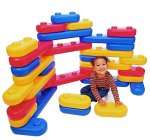
The older Little Tikes set in this archive uses chunky, elongated pieces with peg connections. Its scale makes a corner, an opening or a change of direction easy to see across a play area.
Begin with a low arrangement and one purpose: mark a little courtyard, turn a wall around a corner, or leave a route for a toy figure. A compact build can offer plenty to change without using every piece.
Give the build a clear patch of floor
Choose a level area with room to move around the outside of the arrangement. Set out a small selection of matching pieces so the shapes and connections are visible, leaving the rest out of the walking route.
Look at one connection before planning the whole structure. Find the peg and the receiving opening, and follow the instructions for the actual set when joining them. If parts do not seat normally, stop and check that they belong together; a similar color or size does not establish compatibility.
The suggestions here use low structures viewed and reached from outside. They do not call for climbing, standing on blocks or crawling under a roof.
Try a wall, then give it a corner
Make a short, low wall. Before adding height, decide where its end should go. Turning the next section changes the footprint and creates an inside and an outside; it also changes where someone must reach to place another piece.
For a simple story, let the wall mark the edge of a toy animal’s yard. Leave one opening as an entrance. Move the toy along the outside and through that opening, watching whether any projecting piece blocks the route.
Change the layout by taking it apart and reconnecting it as the set permits. Do not assume that a joint should rotate while loaded merely because the original description celebrates building at different angles.
Make one useful revision
- Opening
- Choose where a toy figure enters. Leave the top open so the route can be reached easily.
- Corner
- Compare a straight boundary with an L-shaped one. Notice which space becomes enclosed.
- Reach
- Keep the parts you want to adjust within comfortable reach from outside the build.
- Footprint
- Look down at the space the structure occupies before adding another section.
A useful question is “What needs to move so the visitor can get in?” It gives the revision a purpose. Adding more pieces is only one possible answer; removing a section may solve the problem.
Two builders can take different roles: one arranges the boundary while the other describes the route. Exchange roles after a short attempt rather than assigning one person all the construction work.
Keep the older set identifiable
The historical photograph shows long peg-connected pieces, not the square notched panels sold under the Big Waffle Blocks name. Keep the product label and any matching instructions with the pieces, particularly when combining material from storage boxes.
After play, dismantle the low arrangement and group the pieces by shape. Check for damage before the next session. The old account’s storage-box suggestion is useful only if that box still suits the actual pieces and their condition; a missing original box is not a reason to guess the model from a newer product name.
The historical record
Original Toysit coverage
The complete earlier account is retained below, including its 33-piece description and broad indoor/outdoor and developmental claims. Those claims do not establish the condition, permitted loads or instructions of a surviving set.
Awesome giant building blocks.
This 33-piece giant block set is a versatile playroom must-have. Its large red, yellow, and blue pieces are made of soft, hollow plastic and are lightly textured for better gripping by small hands. The blocks come in two sizes for creative stacking and building options. And, just like smaller interlocking blocks, these huge pieces feature pegs that allow kids to build structures with a diversity of angles and extensions. The set's sturdy cardboard box can be kept and used for storing the blocks after play. If kids can imagine it they can build it life size with these giant interlocking blocks! Durable yet lightweight, kids can use these indoor/outdoor squishable blocks to build castles, robots or forts and then knock them down with ease. Pegs allow blocks to rotate around and assemble at any angle.
Giant interconnecting building blocks offer a larger-than-life twist on traditional building sets, making the construction process an immersive and highly engaging experience for children. The oversized dimensions add a tactile, almost life-sized component to playtime, allowing kids to literally step inside their creations, be it forts, tunnels, or towers. This sense of scale elevates the imaginative possibilities, from building an elaborate castle to creating a maze that fills the entire room. Besides the fun aspect, these blocks also offer developmental benefits, encouraging spatial awareness, problem-solving, and fine motor skills as kids figure out how to interlock the blocks in various configurations. When playing with others, the blocks also promote teamwork and social interaction. The sheer size of these blocks can make every build feel like an adventure, adding a level of excitement and accomplishment that's hard to match with smaller sets.
Sources and editorial notes
Reviewed October 16, 2026 against the original Toysit description, ASIN B00005BYW3 and 150 × 140 photograph. The older 33-piece peg-connected set was not securely matched to a manufacturer instruction sheet. Little Tikes’ current manual library was checked; its Waffle Blocks entries are not documentation for this different construction format. No dimensions, age range, load capacity or cleaning specification has been inferred. These low-building activities are editorial suggestions; no physical pieces were tested.
- Little Tikes: instruction manual library — Manufacturer route for identifying instructions from an actual product label; no exact manual for this older set was established.
Images and descriptions are retained as historical material. How Toysit covers toys.
Created for Toysit by Tabbloza — the artwork in our header.