
From the Toysit archive
Love to Walk Baby Pooh
Follow Love to Walk Baby Pooh’s walking, talking and sound-prompted play, with manufacturer guidance and an original three-landmark outing map.
The play at a glance
A few little steps toward a new adventure
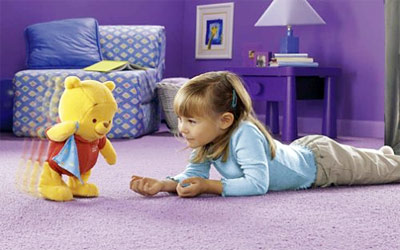
Pooh stands in his familiar red shirt with a blue cloth tucked beside him. Toysit’s photograph catches a face-to-face play scene, with the bear and a child close to the floor. Love to Walk Baby Pooh gives that encounter a rhythm: a greeting, a few steps, a pause and another invitation to move.
A greeting, a walk and a listening pause
Squeezing Pooh’s left hand starts his walking and talking at the slowest speed. When he finishes, he waits for another hand squeeze or a sound. The guide describes four speeds, with later prompts moving the play along more quickly, and occasional changes of direction during a walk.
The sound prompt belongs to the pause between walks. A clear voice or a clap from three to five feet away can start the next movement. That gives a player a simple turn to take: watch Pooh’s little journey, wait for the pause and offer the next greeting.
A small journey with a caring moment
If Pooh falls, his legs stop and he asks for help getting up. After being picked up, he asks for a hug; he also asks for hugs at intervals during play. These responses bring the walking scene back to a familiar moment of care.
For walking, Mattel recommends a hard, flat surface. Choose a clear area for the toy’s movements and keep story drawings beside that space. The original photograph shows a carpeted setting; the guide supplies the practical surface advice for using the walking feature.
Let the player choose the destination in the story
Imagine Pooh setting off to visit a friend beyond a tree, a bridge and a little hill. The toy provides the steps and recorded responses, while the player narrates the journey around them. A pause could become a moment to admire the view or greet a visitor.
Try giving each landmark one memorable detail. The tree might have a particularly shady spot, the bridge could cross an imaginary stream, and the hill might offer a view of a picnic. These places live in the story and can change each time Pooh sets out.
Draw a three-landmark outing map
- Draw a tree, a bridge and a hill on paper, with a path connecting them.
- Name a friend waiting at the end of the journey.
- Keep the map beside the clear play area and point to each landmark as you narrate.
- Invent one greeting or discovery for every stop.
- Finish by telling the friend what happened along the way.
This original activity also works with an ordinary plush bear moved by hand or a traveler drawn on paper.
The historical record
Original Toysit coverage
The original product description and its later general Winnie-the-Pooh passage are retained below.
Walking, talking, musical, programmable, sound-activated, interactive toy from Fisher Price
My First Steps Baby Pooh is learning to walk just like a real toddler. To get him started just squeeze his hand. Baby Pooh will slowly begin to walk, pause, then walk a little faster, after another pause he will walk even faster. He will say cute phrases that show he is learning to walk. Baby Pooh can also be sound activated. Each time the child talks to Pooh or claps he will begin to walk in one of the four different walking speeds or to the left or to the right. Baby Pooh will know when he falls down and ask for help in getting up. He also knows when you pick him up and when you hug him and let you know by saying additional adorable phrases. Baby Pooh says over 30 phrases in all and plays a great walking melody too.
Winnie the Pooh, created by A.A. Milne, has become an iconic character beloved by young children around the world. With his gentle and whimsical nature, Pooh Bear captures the hearts of children through his adventures in the Hundred Acre Wood. The stories, filled with valuable lessons on friendship, kindness, and curiosity, resonate with children's innate sense of wonder and imagination. The timeless appeal of Winnie the Pooh is further enhanced by the delightful illustrations and memorable characters like Piglet, Tigger, Eeyore, and Owl, making the tales of Pooh and his friends a cherished part of many childhoods.
Sources and editorial notes
Mattel’s B9043 record identifies Love to Walk Baby Pooh and uses My 1st Steps wording in its description. Its product photograph and complete one-page B9043-0920 guide were reviewed. The guide documents hand and sound prompts, four speeds and occasional automatic direction changes; those are the controls described here. Follow the matching guide for batteries and setup. The map is an original editorial activity. Physical testing was outside this document-based renovation.
- Mattel: Love to Walk Baby Pooh, B9043 — Manufacturer record, product description and photograph.
- Baby Pooh instruction sheet — Complete one-page guide reviewed for movement, pauses, sound prompts and play surface.
Images and descriptions are retained as historical material. How Toysit covers toys.
Created for Toysit by Tabbloza — the artwork in our header.