
From the Toysit archive
Malarky
Explore Malarky’s spoken explanations and hidden answers, then invent curious uses for a drawing of a mystery gadget.
The play at a glance
Every explanation gets a hearing
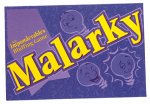
The purple Malarky box puts a large yellow title across a collection of expressive faces. Around the table, the expression belongs to the storyteller: each person offers an explanation for an everyday mystery while everyone else listens for the answer they believe. The real explanation travels through the round in a concealed folder.A question with several storytellers
Malarky draws its questions from David Feldman’s Imponderables books. A host reads a question, and concealed folders distribute the printed answer to one player while the others receive instructions to invent an explanation. Everyone has a little time to prepare before speaking in turn.
The answer holder puts the explanation into their own words, and the bluffers try to make their inventions sound equally convincing. Colored voting chips keep choices private until the reveal. A player might favor the simplest account, while another is persuaded by an unexpected detail. The rules reward attracting votes and identifying the supplied answer.
Having a second explanation ready adds another playful twist: the rules call for distinct answers, so an earlier speaker can send someone back to their imagination. The booklet explains what happens when a bluff happens to match the printed answer.
Try a mystery object workshop
In this original Toysit activity, all the explanations are invented. One designer draws a curious tool with three visible features—a spoon-shaped end, a striped wheel and a little window, for example—and privately writes down its purpose.
- Show the drawing and give everyone time to imagine a use that accounts for all three features.
- Take turns explaining the tool. A partner can point to its parts while the speaker describes them.
- Choose the explanation you would most enjoy seeing in action, then let the designer reveal the original idea.
- Revise the drawing using a favorite suggestion. Add a name and a tiny instruction label.
The finished collection can become a workshop catalogue of impossible inventions, with each contributor credited for their idea.
The historical record
Original Toysit coverage
The original product account and commentary are preserved below as historical coverage.
Malarky Game by Patch
Just how good are you at fooling your friends and family? Test your powers of deception with Malarky, the game in which players try to bluff answers to such questions as What is the 'cottage' in cottage cheese? and opponents try to determine the real answers from the ones that are simply malarky. It's based on David Feldman's Imponderables series, which includes the books Imponderables: The Solution to the Mysteries of Everyday Life, Do Penguins Have Knees? An Imponderables Book, and How Do Astronauts Scratch an Itch: An Imponderables Book. The game asks the questions that everyone wonders about from time to time. After a question is read aloud, one player (unbeknownst to the others) reads the correct answer, while the other players present bluff answers--as convincingly as they can--and then each player votes for the answer they think is correct. Points are awarded when your bluff answer receives votes or if you vote for the correct answer.
Bluffing games at parties revolve around deception, strategy, and social interaction. The basic concept involves players attempting to mislead or deceive others while trying to figure out the truth themselves. In these games, players may be given roles, tasks, or information that they must keep secret or manipulate to achieve a specific goal. Bluffing becomes a key tactic as players work to convince others of something that may or may not be true. The excitement and challenge lie in reading other players' behavior, making calculated decisions, and maintaining a convincing facade. Bluffing games often lead to lively discussions, laughter, and intense moments as players try to uncover the truth or successfully deceive their opponents. These games are particularly popular at parties as they encourage engagement, collaboration, and often reveal amusing and unexpected aspects of players' personalities.
Sources and editorial notes
The six-page Patch guide, copyright 1998, and the two-page 2009 guide both support the concealed-answer and spoken-bluff mechanism. Their card totals differ (314 and 295), and their scoring details also vary; neither printing is conclusively identified by the small original box photograph. Follow the booklet in the set for exact contents and scoring. The historical questions and book titles are preserved; their factual answers were not independently investigated. The mystery-object activity is original fiction, and no physical testing was performed.
- Original Toysit image — Existing same-site photograph reviewed and retained unchanged.
- Patch Malarky instructions, 1998 printing — Complete six-page manufacturer booklet preserved on a lending-library attachment host; all pages reviewed.
- Patch Malarky instructions, 2009 printing — Both pages reviewed on PlayMonster’s site to distinguish the later printing’s contents and scoring.
- Original Toysit coverage — Complete original product account and historical commentary preserved.

Images and descriptions are retained as historical material. How Toysit covers toys.
Created for Toysit by Tabbloza — the artwork in our header.