
From the Toysit archive
Mario Party 4
Mario Party 4 turns a board into a chain of small surprises, with an original party-square invitation to draw and share.
The play at a glance
A gathering around a starry board
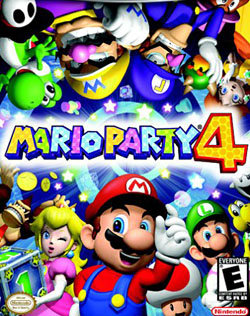
Faces fill the original Mario Party 4 artwork: Mario reaches forward, Peach and Luigi stand nearby, and the title sits among bright stars. It feels like the moment when everyone arrives at a celebration. Inside the game, a board gives that gathering a route, with small contests and surprises along the way.
Each space can change the party
Party Mode combines movement around a board with mini-games and a competition for stars. Up to four people can take part, with computer characters filling empty places. Story Mode gives a single player a different route through the boards, earning presents from their guides.
The Mini-Mega system changes a character’s size for a turn. Small characters can pass through little openings; large ones travel with extra dice but pass by events and stars. The booklet also shows an instruction screen for each mini-game, with a practice option before the contest. Those pauses make room to learn what the next little game is asking.
Draw a party-square invitation
Fold a sheet of paper into a card and draw a path of six large spaces across the inside. Put a front door at the beginning and a party table at the end. Choose three spaces for gentle creative challenges: invent the name of a shop, draw a creature who might attend, and make up a short celebration sound.
Walk through the path together by pointing to one space at a time. Each person adds one contribution to the shared party. The shop might bring cloud-shaped buns; the creature might arrive wearing a very tall hat; the sound might announce that the guests have reached the door.
Use the remaining spaces for scenery and greetings. Let someone describe an answer while another person draws it, or let everyone make a separate version of the same creature. When the route reaches the table, choose a party theme that connects the contributions. Write it on the front as the invitation’s title.
Make room for the next guest
Leave a small blank square on the back of the card. A future visitor can add one more detail: a dish, a decoration or an imaginary guest. The completed invitation becomes a record of the party everyone helped picture.
The historical record
Original Toysit coverage
The complete earlier product account and commentary are preserved below as historical coverage.
The latest in the best multiplayer game series ever.
The Mario Party games popularized the trend of board game bonanzas with an assortment of varied activities. Each shindig was like having dozens of games in one, and Mario Party 4 is the wildest multiplayer get-together Nintendo has ever thrown. Mario, Luigi, Yoshi and an all-star cast of Mushroom Kingdom regulars have been invited, and there's never a dull moment as one to four players compete in 50 all-new minigames. With varied styles of play including racing, target shooting and games of chance, Mario Party 4 gives partygoers more reasons -- and ways -- to celebrate.
The history of Mario Party began in 1998, when the inaugural title was released for the Nintendo 64, launching a series that would redefine multiplayer gaming in the Mario universe. Developed by Hudson Soft and later by NDcube, under the supervision of Nintendo, Mario Party took the concept of a board game and digitized it, adding in mini-games featuring beloved characters like Mario, Luigi, Peach, and Yoshi. The central idea was simple yet captivating: players would move their characters around a game board, collecting coins and stars, while participating in various mini-games at the end of each turn. These mini-games ranged from quick reflex tests to puzzle-solving challenges, providing a fun and unpredictable element to the gameplay. The game was designed with social interaction in mind, making it a popular choice for parties and gatherings.
Subsequent releases expanded the series across various Nintendo consoles, including the GameCube, Wii, Wii U, and Nintendo Switch, each time adding new layers of complexity and variety. Innovations have included new types of boards, a wider array of mini-games, and additional characters from the expansive Mario universe. Special editions like 'Mario Party DS' for the Nintendo DS and 'Mario Party: Island Tour' for the 3DS also took advantage of the unique capabilities of handheld consoles. The franchise also embraced technological advancements, incorporating motion controls in 'Mario Party 8' for the Wii and integrating a unique two-screen experience in 'Mario Party 10' for the Wii U. By 2021, the series had sold over 50 million copies worldwide and had amassed a dedicated fan base. Despite its lighthearted nature, Mario Party has been the battleground for many a fierce competition among friends and family, solidifying its status as a beloved staple in the world of multiplayer video games.
Sources and editorial notes
The complete 29-page scan of Nintendo’s US booklet 49233A was visually reviewed, including controller, Mini-Mega, board and mode diagrams. Nintendo’s older overview supplies publisher context; its displayed release date and promotional game count are not used as a new chronology or definitive inventory. The preserved series essay discusses later games as well as this one. The invitation activity is an original Toysit suggestion, not a game mode. No physical testing or universal accessibility claim is made.
- Original Toysit image — Existing same-site image reviewed and retained unchanged.
- Nintendo Mario Party 4 instruction booklet (PDF) — Complete 29-page US scan, product 49233A, visually inspected; hosted by Jeith with an archive mark on the cover.
- Nintendo: Mario Party 4 — Historical publisher overview; date and promotional count qualification above applies.
- Original Toysit coverage — Complete historical account retained, including its original claims and wording.

Images and descriptions are retained as historical material. How Toysit covers toys.
Created for Toysit by Tabbloza — the artwork in our header.