
From the Toysit archive
Mario Party 5
Mario Party 5 gives its boards a dream-world setting, inspiring an original weather-desk story on paper.
The play at a glance
A party where the scenery can dream too
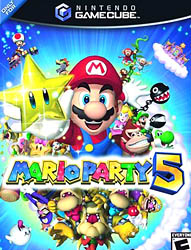
A bright yellow star floats beside Mario on the original cover, while a whole crowd of characters gathers against blue, sparkling scenery. Mario Party 5 gives this gathering a dream-world setting. It invites a pleasing question for an imaginary board: what could happen at the next stop if the landscape were allowed to change?
A board full of changing occasions
The original GameCube game follows Mario and friends through Dream World boards, collecting stars and coins amid mini-game contests. Nintendo’s description emphasizes the ability to change the locations of event spaces. A place on the board can therefore matter for what happens there as well as for where it leads.
The publisher also distinguishes a story challenge against three Koopa Kids who take their turns together. Keep that story premise separate from the shared party around the television. The game’s different ways to play give the dream setting more than one kind of journey.
Open a dream-board weather desk
Draw a paper path linking a cloud house, a moon garden and a picnic clearing. Add a few ordinary spaces between them so there is room for the story to travel. This is an invented board: give it a name such as “The Valley of Wandering Umbrellas.”
On three separate slips, write gentle weather messages. “A cloud shades the garden.” “A breeze carries the picnic invitations.” “Moonlight makes the house glow.” Choose one slip and let it change just one stop on the board. Draw the change, then tell how the travelers respond to it.
Move a pencil-point traveler along the path and retell the journey with the new detail included. Someone else can become the weather reporter for the next turn, choosing another message or inventing a fourth. A cloudy stop need not spoil the outing: perhaps the guests discover a covered porch, or the garden begins a quiet evening concert.
Finish by making a tiny forecast poster for the valley. Give tomorrow one new possibility and leave the travelers deciding what to pack. Pictures, spoken reports and short captions all work.
Let one detail transform the setting
Changing only one place at a time makes the paper world recognizable from one telling to the next. Keep an earlier drawing beside the new one and notice how a different sky changes the mood of the same path.
The historical record
Original Toysit coverage
The complete earlier product account and commentary are preserved below as historical coverage.
Mini games and courses
Mario and his closest friends are trying to restore peace to Dream World by racing around a collection of all new game boards and tons of surprises await. Mario Party 5 sports new game boards, more than 60 new mini games, new playable characters, an expanded one-player mode, and, of course, the multi-player madness that made it famous in the first place. This sequel extends Mario Party's reign as the king of the party game. New game boards and over 60 new mini games put your button mashing skills to the test. Players duke it out in traditional, new duel, or everyone vs Bowser mini-games. A new system changes the location of event spaces, adding a whole new dimension to the game boards. More of your favorite characters are coming to the party. New and expanded roles for Toad, Koopa Kid, and others. The single-player Story Mode unfolds much faster than before. You'll play against the Koopa Kid Brigade-a trio of Koopa Kids who take their turns simultaneously, cutting down significantly on the wait time and letting you get back to the action more quickly.
Mario Party stands as a quintessential party video game, successfully blending accessibility, competition, and sheer fun into an experience that transcends age and gaming skill. One of its most compelling features is its pick-up-and-play nature. With simple controls and easy-to-understand objectives, the game welcomes players of all levels, from novices to seasoned gamers. The core gameplay involves navigating game boards in search of stars and coins, akin to a digital board game, but it's the mini-games sprinkled throughout that truly elevate the excitement. These mini-games are bite-sized challenges that range from reflex tests to puzzles, ensuring that every player has a chance to shine regardless of their specific skill set.
The game is designed to accommodate multiple players, making it perfect for social gatherings, family game nights, or casual hangouts with friends. Its competitive spirit is complemented by elements of chance, such as random events on the game board or the unpredictable nature of some mini-games, adding a layer of suspense that keeps everyone engaged. The Mario universe's familiar characters and settings offer an extra layer of charm, making players feel instantly connected to the game.
The series has continuously evolved to include new features like unique game boards, collaborative team modes, and even online multiplayer options, ensuring that the gameplay remains fresh and engaging. Overall, Mario Party epitomizes what makes a great party video game: it's easy to get into but hard to put down, it levels the playing field for players of all ages, and most importantly, it turns every gathering into an uproarious, memorable event.
Sources and editorial notes
Nintendo’s historical publisher page supports Dream World, moving event spaces, one-to-four-player scope and the Koopa Kid story premise. A complete matching booklet was not recovered; detailed capsule rules and bonus-mode instructions are therefore not asserted here. The original over-60 wording and broader retrospective remain historical coverage. The weather desk is a Toysit invention, not an included rule or mode. No physical testing was performed.
- Original Toysit image — Existing same-site image reviewed and retained unchanged.
- Nintendo: Mario Party 5 — Publisher description and player scope reviewed; game-booklet limits are stated above.
- Original Toysit coverage — Complete historical account retained, including its original claims and wording.

Images and descriptions are retained as historical material. How Toysit covers toys.
Created for Toysit by Tabbloza — the artwork in our header.