
From the Toysit archive
Mario Pinball Land
Meet Mario Pinball Land’s round hero, themed tables and star doors, then draw a postcard pinball park with a story along its route.
The play at a glance
Mario becomes the ball that explores the world
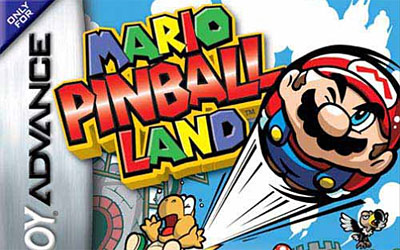
The original artwork turns Mario into a compact ball, with his cap and mustache still instantly recognizable. In Mario Pinball Land, the hero’s journey happens through flippers and ricochets: a shot crosses a little scene, hits an enemy or object, and helps open the way to another part of the adventure.
A flipper shot becomes a journey
The booklet’s stages give the ball changing scenery: a fun fair, snowy country, grassy places and a desert. Stars open numbered doors, so aiming at an enemy or object can also be a way to reach somewhere new. The same little scene can feel different when a newly available doorway becomes the next destination.
Left and right flippers keep Mario moving; the original controls allow L or left on the Control Pad for the left flipper, and R or A for the right. Adventure Mode links exploration and collecting, while Time Attack becomes available after defeating a boss. The booklet’s Save & Quit option preserves an Adventure stopping point; loading it erases that saved continuation, so save again before ending the next session.
A player might follow the ball with a story in mind: across the snow, past a curious object, through the door and into the next scene. That way of noticing the scenery is also a good starting point for a paper design.
Try a postcard pinball park
Draw a tall rectangle as a postcard from an imaginary park. Add two flippers at the bottom, three landmarks above them and a gate near the top. Everything happens on paper; a pencil line supplies the ball’s journey.
- Name the landmarks. A cloud fountain, a sleepy windmill and a striped tent make a different park from a moon station, a crater and a greenhouse.
- Trace a route from a flipper past all three landmarks to the gate. Use arrows to show its direction.
- Add one sentence at each stop. Perhaps the fountain showers the traveler with glittering mist, or the tent keeper asks for a secret password.
- Move one landmark on a fresh drawing and trace a new route. Decide how that change alters the story.
Write the postcard’s final message beneath the park: “My favorite stop was…” A partner can send a return postcard with a different route through the same landmarks. Keep both drawings to see how a small change in a playfield becomes a new adventure.
The historical record
Original Toysit coverage
The complete earlier product account and commentary are preserved below as historical coverage.
Fast-paced alternative to the real arcade with 3D graphics and challenging play for Nintendo Game Boy Advance SP
Mario makes his debut as a human pinball in a game that mixes all the action and adventure you've grown to expect from Mario with the fast-paced flipping excitement that pinball fans love. Nintendo went straight to the experts at the Professional Amateur Pinball Association to make it official: Mario Pinball Land packs all the excitement of a big bulky pinball machine right into your hands. Jacob, fifth-grader and reigning Pinball Junior World Champion called on his years of pinballing experience to give Nintendo his expert review of Mario's latest adventure. Jacob praises the 3D graphics and challenging game play, and recognized Mario Pinball Land as the best alternative when a traditional pinball machine is out of his reach. Just in time for the holidays, Mario Pinball Land is the perfect stocking stuffer; wherever the holidays take you, Mario Pinball Land will entertain Mario fans anytime, anywhere.
Pinball, a beloved arcade game with roots tracing back to the 18th-century French table game called "bagatelle," has evolved dramatically over the years to become a staple of modern gaming culture. The game took on its more recognizable form in the early 20th century in America, with companies like Gottlieb and Bally transforming it into a coin-operated entertainment machine featuring flippers, bumpers, and flashing lights. During the 1940s and 1950s, pinball faced legal challenges in various U.S. cities due to its association with gambling, but the invention of the flipper in 1947 helped shift its perception from a game of chance to a game of skill. The 1970s and 1980s marked the golden age of pinball, coinciding with the rise of video arcade games, and introduced iconic machines like "The Addams Family" and "Black Knight." While the advent of home video game consoles in the late 20th century led to a decline in arcade gaming, pinball has seen a resurgence in the 21st century, benefitting from technological advancements, passionate fan communities, and the rise of "barcades" that celebrate retro gaming. Today, pinball remains a captivating blend of art, engineering, and gameplay, continuing to thrill players of all ages.
Sources and editorial notes
Nintendo’s US Mario Pinball Land booklet was visually reviewed across all 15 PDF scan pages. Its controls, star-door progression and saving instructions support the new context. The older Nintendo/PAPA promotion, endorsement and pinball-history essay remain as historical coverage, not current recommendations. One chronology correction: The Addams Family pinball machine dates to 1992, as documented by the Museum of the Game, rather than the 1970s–1980s paragraph in the retained essay. The paper park is an original Toysit activity; no physical testing was performed.
- Original Toysit image — Existing same-site image reviewed and retained unchanged.
- Nintendo: Mario Pinball Land instruction booklet (PDF scan) — Complete 15-page scan visually reviewed, including printed pages 8–23 for controls, saving, progression and stages. Original manufacturer booklet hosted by The Game Is Afoot Arcade.
- Museum of the Game: The Addams Family — Machine record dates Bally Midway WMS’s pinball game to 1992; supports the chronology correction to the preserved historical essay.
- Original Toysit coverage — Complete historical account retained, including its original claims and wording.

Images and descriptions are retained as historical material. How Toysit covers toys.
Created for Toysit by Tabbloza — the artwork in our header.