
From the Toysit archive
Matchbox Hero City Ice Mountain
Follow Matchbox Hero City Ice Mountain B2132 from lift to rescue, with documented route gates, pretend ice effects and a story-sequencing activity.
The play at a glance
A mountain route that becomes a rescue story
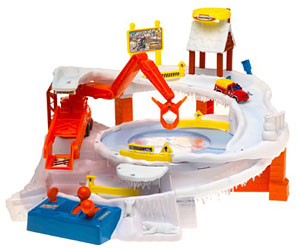
Ice Mountain begins with a car ascending a powered lift. The downhill route leads toward a rotating ice-themed platform, where gates, collapse effects and a rescue crane let the child decide what happens next.Follow the route before adding the emergency
Mattel describes cars entering the motorized lift at ground level, rising to the top and rolling downhill toward the spinning ice turntable. This makes the lift a useful starting landmark: it explains how the vehicle gains height before the downhill portion.
The B2132 guide shows gates that select a vehicle’s path. Its ice platform can collapse under several vehicles or be operated with the left control lever. The right lever releases the toy avalanche, while the crane supplies a way to stage a recovery. These are separate actions in a constructed scene, not a simulation of how real ice or avalanches behave.
Match the layout and the model
The B2132 guide marks the toy 3+, warns about small parts and requires adult assembly. Its drawings show the circular track, lift, crane, gates and controls visible in the original photograph. Mattel also has a G6973 record with the same Ice Mountain name; check the number on an actual set before choosing instructions.
Assembly matters to the rotating track. Follow the matching guide’s connections and reset drawings. If the mechanism will not work, seek model-specific support rather than defeating a switch or trying an improvised powered repair. The snow and ice are part of the toy’s scenery; this page is not an instruction to add real ice, snow or water.
Try a three-scene rescue
This original Toysit story prompt can be told from the photograph or acted out with a complete, checked set used according to its instructions.
- Journey. Choose where the car is going and describe the lift ride. Before it reaches a gate, predict which route that setting selects.
- Problem. Pick one story event, such as a stopped car or the pretend avalanche. Keep the first story to one event so it is clear what needs to be solved.
- Response. Name the vehicle or crane action that would help in the toy story. Say when the road is ready for the next car.
Retell the story in order: first the car travelled, then something interrupted it, finally someone helped. On a second round, change the destination or route choice while keeping the same problem. That gives the child a different ending without requiring every effect at once.
A useful focus for secondhand inspection
A mountain silhouette alone does not establish completeness. Compare the loose track sections, gates, crane and control pieces with the exact model’s parts drawing. An absent route piece can change what stories are possible even if another powered feature still moves.
For a child interested in arranging rescues, the appeal lies in choosing a route, noticing an interruption and finishing a response. There is no need to make a race out of every trip up the lift. A quieter version can use a paper map and spoken dispatches while the historical set remains on display.
The historical record
Original Toysit coverage
The original playset description and separate Matchbox brand-history paragraph are preserved below. The new profile concentrates on the documented B2132 playset rather than adopting that broader historical account as newly checked fact.
Hero City Ice Mountain
Kids get to be the hero and rescue matchbox cars in a winter-land setting. Cars enter the motorized lift at the group level and go to the top of the hill. Cars roll down toward the spinning ice turntable. It's slippery and the ice could break. Send out the rescue vehicles. Watch out for the avalanche.
Matchbox cars, miniature die-cast vehicles that have fascinated children and collectors alike since the 1950s, were originally the brainchild of British manufacturing company Lesney Products. The name "Matchbox" was inspired by the toy's packaging, which closely resembled a matchbox to make it easier for children to take their little cars anywhere. Introduced in 1953, the first model was a replica of Queen Elizabeth II's Coronation Coach, but it was the scaled-down version of a green and red road roller that really kick-started the brand's popularity. Over the years, the Matchbox series expanded to include a wide array of vehicles, from everyday cars and trucks to specialized machinery and fantastical designs.
Sources and editorial notes
The layout in the original image corresponds to the B2132 instruction diagrams. Mattel also lists a G6973 Ice Mountain variant; model-specific guidance here is tied to B2132, whose record lists a 2003 release and 2008 discontinuation. The story prompt is editorial, with no physical testing. This is pretend winter scenery, not a real-water or ice activity.
- Mattel product record: Ice Mountain B2132 — Lift, turntable, rescue theme and historical product details.
- Ice Mountain B2132 instructions (PDF) — Six-page assembly and play diagrams, route gates, collapse and avalanche controls.
- Mattel product record: Ice Mountain G6973 — Separate variant, listed to help readers avoid assuming every Ice Mountain has the same model identity.
Images and descriptions are retained as historical material. How Toysit covers toys.
Created for Toysit by Tabbloza — the artwork in our header.