
From the Toysit archive
Matchbox Radio Rescue
Understand Matchbox Radio Rescue 97036: amplified speech, sound buttons and manually operated rescue scenes, with a dispatch-and-response story activity.
The play at a glance
The child supplies the voice and the action
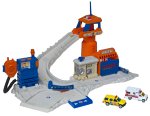
Radio Rescue adds an amplifying microphone and sound effects to a miniature town. A child makes the announcement, tips the vehicle ramp and moves the story through the bank and jail; the toy is not listening for spoken commands.What the microphone actually does
Mattel describes a removable microphone-and-speaker unit that makes the child’s voice louder. Separate buttons produce sound effects. The unit can detach from the playset for carrying, but that does not make it a pair of walkie-talkies or a remote control for the vehicles.
The documented function is amplification. The sources do not establish recording, speech recognition, wireless range or contact with real emergency services. In the play story, a call for help is something another player can hear and answer; a car moves because a child operates the scene.
The town provides the next action
The manufacturer’s scenario starts with a break-in at the bank. Tipping the tower ramp releases the police vehicle, while the jail bars and roadblock give the chase places to end or change direction. The guide shows how to reset the jail for another round.
Those features are useful story cues rather than a rigid script. A child can decide which announcement comes first and when to release a vehicle. The instruction sheet lists one included Matchbox vehicle and cautions that some Matchbox vehicles are unsuitable. Treat the original Toysit paragraph’s ambulance as part of its story, not proof that every package contained one.
Try a dispatch-and-response story
This original Toysit prompt works with the toy’s microphone or simply with ordinary speaking voices.
- Give one useful message. The dispatcher names a pretend location and a problem: “A delivery is blocking the bank entrance.”
- Repeat the job. The responding player says where they are going and what they will do. They can ask for a missing detail before moving a car.
- Act out one response. Choose a route and move the appropriate vehicle. Keep announcements separate from the hand action so both players understand what caused the movement.
- Close the call. Report the result: “The entrance is clear.” Then exchange roles and invent a new situation.
A misplaced parcel, a closed road or a visitor needing directions can provide alternatives to the bank-robbery plot. The interesting challenge is making a message clear enough for a partner to use, not speaking as loudly as possible.
Use the matching guide for setup and care
The 97036 instructions require adult assembly and warn about small parts for children under three. They show three AA batteries, a play switch position distinct from the demonstration setting, and the microphone button used for amplification.
The guide recommends moving the microphone away from the speaker if feedback occurs. Cleaning is with a damp cloth after brushing away loose dirt; it says not to immerse the toy. For an older set, compare its parts and controls with the guide before use and check that the battery cover and connections are intact. The small original photograph is retained at a restrained size, rather than enlarged into detail it cannot show.
The historical record
Original Toysit coverage
The original rescue scenario and later Matchbox brand commentary are retained below. References to broadcasting and collector value are historical wording, not claims of wireless communication or current investment value.
Playset with real radio microphone.
For daredevil children and rescue lovers, this easy-to-assemble playset offers excitement at every turn. As soon as a would-be robber crashes into the side of the bank, breaking it open, kids can get on the horn and call for help. A microphone in the radio allows children to broadcast their voices. And the chase is on! The die-cast police SUV speeds down the incline from the tower above the bank, while the ambulance hurries to the scene from the main road. Two more buttons on top of the radio sound out the bank's alarm and the siren of the police car. Should the robbers attempt to get away, never fear. They'll soon drive over the door of the jailhouse, which then flips up to trap them behind bars.
In the 1960s, Matchbox cars were at the peak of their popularity, competing closely with other brands like Hot Wheels, introduced by American toy maker Mattel. The brand underwent various ownership changes and innovations, including the addition of "Superfast" wheels in the late 1960s to compete with Hot Wheels' speed-centric features. Acquired by Mattel in 1997, the brand continued to thrive, expanding its range to include various themes and collections. Matchbox cars have become more than just toys; they are cultural icons that evoke nostalgia, inspire creativity, and even serve as valuable collector's items. Their lasting impact is a testament to the universal appeal of small-scale, realistic vehicles that allow for endless imaginative play.
Sources and editorial notes
Mattel’s 97036 record and scanned instructions document local voice amplification and manually triggered play features. The record lists 2002 for release and discontinuation. Its guide describes one included vehicle, so the older story’s other vehicles should not be read as a verified package inventory. The dispatch activity is original editorial guidance; no physical testing was performed.
- Mattel product record: Radio Rescue 97036 — Microphone and speaker arrangement, sound effects, ramp, jail and roadblock.
- Radio Rescue instructions (PDF) — Three scanned pages visually reviewed for assembly, controls, reset, batteries and cleaning.
Images and descriptions are retained as historical material. How Toysit covers toys.
Created for Toysit by Tabbloza — the artwork in our header.