
From the Toysit archive
Meade Polaris 60AZ-D Telescope
Meet the Meade Polaris 60AZ-D refractor and start a Moon-edge sketchbook, recording a visible outline, one observed detail and a separately imagined place name.
The play at a glance
A quiet observation station for the night sky
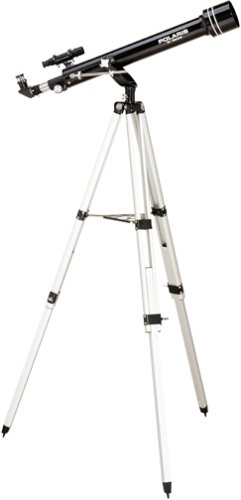
The long dark tube marked POLARIS sits above a silver tripod, with a small finder alongside it and an eyepiece at the rear. This shape makes an inviting observation station: a place to look carefully, step back and draw what was visible. Imagine beginning a little Moon notebook with a single curved edge and one detail that caught your attention.
Find a scene, then spend time with it
The 60AZ-D is a refractor: its long tube gathers the view through a front lens. Its mount turns horizontally and tilts vertically, while the small finder helps locate a subject. The manufacturer’s guide starts finding and centering with the supplied low-power 25 mm eyepiece. An adult should first match the equipment, assemble it securely and follow the complete focusing and finder-alignment instructions.
Never point the telescope or its finder at or near the Sun. Children need adult supervision throughout observing; keep eyes away from either eyepiece while repositioning the instrument. For this activity, choose a nighttime session with the Moon visible. The guide recommends it as an initial target. Let the view available that evening determine the drawing.
Try the Moon-edge sketchbook
This original Toysit activity turns a short observing session into a small dated record. It also works with an astronomy photograph.
- Give the page two spaces: a large observation box and a smaller imagination box. Add the date and, for a real session, the time.
- After an adult has located and focused the Moon, take a brief look. Step away from the telescope and draw the outline you actually saw.
- Look again if you wish, then add one visible detail. A pale patch, a darker shape or the boundary between light and shadow is enough. Leave uncertain areas simple.
- In the separate box, invent a name for a place in the drawing: perhaps “Curved Bay” or “The Quiet Shore.” Mark the name as imaginary.
- On another evening, make a new dated sketch. Compare the two records and describe a difference, including any change in how clear the view seemed.
For an indoor version, choose a lunar picture and label the page “From a picture.” Keep the picture’s date or caption if supplied. Each drawing then records its own source honestly.
Let the notebook stay modest
A rough curve and a sentence can be a satisfying entry. Take turns describing the drawing before reading the imaginary name. One player may notice a shape another passed over, giving the next look a small, specific purpose.
The historical record
Original Toysit coverage
The complete earlier product account and commentary are preserved below as historical coverage.
Meade Polaris 60-AZ-D Telescope
A quality refracting telescope for land or sky viewing. It is perfect for observing celestial objects like Saturn, Jupiter, and the moon. It has an attractive design and fits in any room. The Polaris 60 AZ-D is a cost-efficient telescope for the beginner.
Telescope: A Window to the Universe
A telescope is more than just an instrument; it's a gateway to the cosmos that can ignite a child's passion for science and exploration. Here's how a telescope can enrich a child's sense of scientific curiosity and wonder:
- Exploration of Celestial Objects: Telescopes allow children to observe planets, stars, and galaxies, transforming abstract concepts into tangible experiences.
- Understanding of Astronomy: By observing celestial phenomena, children can develop a deeper understanding of astronomical concepts such as orbits, constellations, and the life cycle of stars.
- Connection to History and Culture: Telescopes provide a link to the history of astronomy and the cultural significance of celestial objects, fostering a broader appreciation of human knowledge and heritage.
- Development of Critical Thinking: Using a telescope requires precision and problem-solving, helping children develop critical thinking and observational skills.
- Stimulation of Imagination: Gazing at the night sky can spark a child's imagination and inspire questions about the universe, life, and our place in the cosmos.
- Encouragement of Outdoor Activity: Telescopes encourage children to spend time outdoors, connecting with nature and the night sky, away from screens and electronic devices.
- Introduction to STEM Fields: Early exposure to telescopes can foster an interest in STEM (Science, Technology, Engineering, Mathematics) fields, potentially leading to educational and career opportunities.
- Family Bonding: Stargazing with a telescope can be a shared family activity, creating memorable experiences and encouraging communication and collaboration.
- Appreciation of Beauty and Scale: Observing the vastness and beauty of the universe can instill a sense of awe and wonder, enhancing a child's appreciation of the world around them.
A telescope is a powerful tool that can inspire a lifelong love of science, exploration, and discovery. It offers children a unique opportunity to connect with the universe, fostering curiosity, creativity, and a sense of wonder that extends beyond the classroom.
Sources and editorial notes
Meade’s 2003 Rev. C 0603 eight-page 60AZ-D manufacturer manual was reviewed through mirrored text and its page illustrations. The tube, side finder and altazimuth mount match the photographed design; an owner still needs to check the exact equipment and eyepieces. The earlier planetary-view and general inspiration claims remain historical wording. Old warranty, software and service details are not represented as current support. No physical testing or recall clearance is claimed.
- Original Toysit image — Existing same-site image reviewed and retained unchanged.
- Meade: Polaris 60AZ-D instruction manual, mirrored copy — Eight-page 2003 Rev. C manufacturer document; all page text and available background illustrations reviewed. Model layout, low-power starting eyepiece and Sun warnings checked.
- Original Toysit coverage — Complete historical account retained, including its original claims and wording.

Images and descriptions are retained as historical material. How Toysit covers toys.
Created for Toysit by Tabbloza — the artwork in our header.