
From the Toysit archive
Mega Bloks Dragons Man-o-War (9895)
Visit the decks of the Mega Bloks Dragons Man-o-War, meet its blue dragon, and create a harbor ledger for an imagined voyage.
The play at a glance
A dragon ship with a whole world on deck
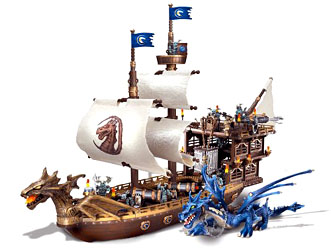
A broad brown hull, pale sails and blue flags make the Man-o-War look like a floating storybook fortress. A dragon’s head reaches from the bow, while a separate blue dragon waits beside the crew. The ship’s layered decks offer places for a lookout, a captain’s meeting and the arrival of an unexpected visitor—all before the player announces a voyage.
Build the places where the story happens
The ship’s appeal comes partly from its many levels: sails above, crew spaces below and a distinctive dragon-shaped bow at the front. The matching booklet shows a detachable rear section used as a raft, a separate dragon with moving wings and a magnetic claw, and a Power Crystal feature that lights the ship’s dragon head.
Each location can have a job in a player-created story. A lookout spots a visitor, a deckhand prepares a welcome and the captain decides where the next cargo belongs. The blue dragon might be a friendly harbor guide who knows a shortcut to the next imaginary island.
Try a dragon-port harbor ledger
An original Toysit activity: draw a dock beside a simple ship outline. Make a three-line cargo list: maps, lanterns and picnic baskets. Beside each entry, leave room for a crew member’s name and a destination on the drawing.
- Choose who welcomes the visiting dragon and write one question the crew would like to ask it. Give the dragon an answer that adds a new destination to the voyage.
- Assign each cargo to a place on the ship drawing. Explain why it belongs there: maps near the captain, lanterns by a meeting point or picnic baskets ready for an island visit.
- Write a friendly captain’s log with three sentences: what arrived, what the dragon said and where the crew will go next.
For a return visit, add a new cargo entry and let a different crew member keep the ledger. A paper ship and dragon can carry the complete story.
Use a dry tabletop, as the booklet directs for operating the model. Follow its assembly and accessory guidance; an adult should handle its button-cell batteries and check that magnetic and other small components remain secure. Keep the harbor story separate from projectile play.
The historical record
Original Toysit coverage
The complete earlier product account and commentary are preserved below as historical coverage.
Build a land of mystery and conquest on land and sea
This deluxe set includes all parts needed to construct the massive battleship of the Norvagen army. The Man of War is over 30 inch long and features working cannons, harpoon launcher, prisoner cage, detachable attack raft and real cloth sails. Includes 12 detailed warrior figures, shields, weapons, a giant sea dragon and a light up Power Crystal.
In Norwegian folklore and mythology, dragons—often referred to as 'orm' or 'serpent'—occupy a distinct space filled with both awe and dread. Unlike the fire-breathing dragons of other cultures, Norwegian dragons are often associated with the sea and are sometimes even indistinguishable from sea serpents. They are frequently depicted as immense, serpentine creatures that coil around ships or dwell in deep caves, guarding treasure hoards. These dragons are not just malevolent beings but also symbols of chaotic natural forces that one must respect and navigate carefully.
One of the most famous stories is that of Jormungandr, the Midgard Serpent, a creature so large that it encircles the Earth, holding its tail in its mouth. While not explicitly a dragon, this giant serpent shares many similarities with the dragons found in other Norwegian stories. Jormungandr is a child of Loki, the trickster god, and its presence marks the boundary between the ordered world of humans and gods and the chaotic realms beyond. The creature is destined to release its tail and rise against the gods during Ragnarok, the end of the world, reflecting the dual nature of dragons in Norwegian lore as both protectors and destroyers.
These myths and stories have endured through centuries, shaping Norway's cultural narrative and inspiring literature, art, and even ship designs—the famous Viking longships often featured dragon heads as figureheads, intended to strike fear into the hearts of enemies. In modern times, dragons continue to be a part of Norwegian cultural expression, from festivals to modern media, ensuring that these legendary creatures continue to captivate imaginations today.
Sources and editorial notes
The complete 36-page manufacturer booklet for set 9895 was reviewed through an archive mirror: two books covering inventory, assembly, dragon, Power Crystal, raft and operating guidance. The cover identifies 250 pieces and ages eight and up. The earlier thirty-inch measurement remains an attributed historical claim, not a new measurement. Norvagen is the toy’s fantasy setting; the preserved Norwegian-dragon essay is wider historical commentary, not evidence that the model depicts a real Norse vessel. No physical testing was performed.
- Original Toysit image — Existing same-site image reviewed and retained unchanged.
- Mega Bloks 9895 manufacturer booklet — archive mirror — Complete 36-page PDF visually reviewed, including both books, inventory, construction, dragon features, raft, Power Crystal and dry-area/battery/projectile guidance. Hosted by an independent archive.
- Original Toysit coverage — Complete historical account retained, including its original claims and wording.

Images and descriptions are retained as historical material. How Toysit covers toys.
Created for Toysit by Tabbloza — the artwork in our header.