
From the Toysit archive
Musini Music Toy
Compare gentle movement, musical styles and featured instruments with Neurosmith’s floor-responsive music toy.
The play at a glance
Move near the music maker
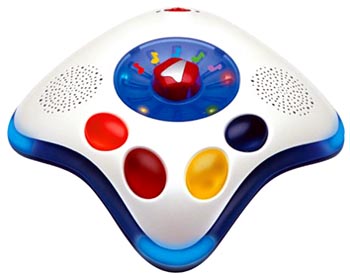
Musini connects movement with a musical response. The Neurosmith instructions describe taking steps or tapping the floor near the unit, letting floor vibrations become part of the interaction.
This is an important correction to the old paragraph about dancing “on the sensor.” The photographed Musini is the music-making unit beside the player, not a platform to stand or stomp on.
Find a response before making a bigger movement
Leave clear space around the floor-standing unit and begin with a gentle step or tap nearby. The Neurosmith guide directs the user to adjust the side sensitivity dial for the surface: higher for thick carpet, lower for hard flooring. Steadily lit blue base lights indicate excessive sensitivity.
Try one repeatable movement before asking a second person to join in. If the response is unclear, check the setup rather than immediately stamping harder. Compare a movement and a pause, then describe what happened without expecting every gesture to produce an identical result.
Change one musical choice at a time
The manual assigns five musical styles to the top style dial and changes the featured instrument with the four colored buttons. Keep one style while trying the buttons; then keep a favorite button choice while exploring another style.
Give each choice time to be heard. A simple paper note—style, button color, movement—can help you remember an interesting combination. It records your experiment, not a recording saved by the toy.
Make room for a partner
One player can choose a musical setting while the other makes a small movement nearby. Swap roles. On another turn, take turns moving and staying still, with enough space that neither player steps on the unit.
The useful question is how your choices affect the experience. The archived material does not establish voice recognition, internet access or a modern conversational AI system; movement response alone is not evidence of those features.
Keep sensitivity and volume separate
Sensitivity concerns the movement response. Loudness has separate controls: the manual places an adult low/high range setting in the battery compartment and a volume dial on top. Have an adult set up the unit and secure the compartment before play.
When finished, use the bottom power switch. The guide notes that inactivity sleep can end when new vibrations arrive. Its expansion-pack references describe historical accessories, not items needed for the basic comparison above or a promise of present-day availability.
The historical record
Original Toysit coverage
Both earlier paragraphs remain below as the historical record. Their instruction to tap, stomp or dance on the sensor is superseded by the manufacturer’s directions to move or tap the ground near the unit. Promises about unique compositions and developmental benefits were not independently tested.
Musini - MagicSensor by Neurosmith
Neurosmith's revolutionary Musini magically converts your child's energy into music and creativity! Musini's patented MagicSensor transforms any room into a musical playground where every step, turn, touch, and tap activates a unique musical response. Children simply select their favorite musical styles and instruments and start moving! Musini does the rest - sensing the strength and speed of each vibration and responding with a totally personal and unique musical composition. Mini-maestros explore tempos, rhythmic patterns, and musical structures and they'll never make the same masterpiece twice! Musini encourages physical expression and creativity, rewarding each movement with inspiring music. Children can also explore various musical styles, instruments, tempos, and structures, cultivating a deeper understanding and lifelong appreciation of music.
The Musini MagicSensor music toy from Neurosmith is a groundbreaking invention that brings the joy of musical creation to children in an accessible, intuitive way. By capturing even the subtlest of touches and taps, the sensor transforms everyday movements into harmonious melodies or rhythmic beats. This interactive play experience offers immediate auditory feedback, allowing children to understand the correlation between their actions and the resulting sounds. It encourages experimentation, as kids can tap, stomp, or dance on the sensor to discover a multitude of musical arrangements. The MagicSensor serves as an excellent educational tool, not only introducing children to musical concepts like rhythm and tempo but also enhancing their fine and gross motor skills. It makes learning through play a reality, cultivating a sense of musicality and rhythm in young minds. The immediate gratification of producing music fosters self-confidence and provides a sense of accomplishment. The Musini MagicSensor is a unique blend of technology and creativity that empowers children to become composers in their own right, making music both fun and accessible.
Sources and editorial notes
The retained photograph was compared with the illustrated Neurosmith Musini instructions on October 15, 2026. This manufacturer-authored manual is preserved on a third-party Weebly host. It supports the base-unit design and controls described here, not the availability of old expansion packs or support services. No physical Musini or musical output was tested.
- Neurosmith: Musini instructions (PDF) — Archived manufacturer manual on a third-party host, including placement, controls and sensitivity adjustment.
Images and descriptions are retained as historical material. How Toysit covers toys.
Created for Toysit by Tabbloza — the artwork in our header.