
From the Toysit archive
Nintendo DS — Two-Screen Launch Story
Nintendo DS pairs a scene with a second view, inspiring an original paper mystery with a room picture, a floor plan and three clues.
The play at a glance
The scene above, the route below
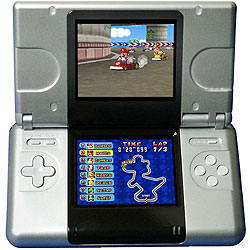
The original picture shows two views of a race: the action on the upper screen and a map beneath it. Together they suggest an appealing question: what can a second picture reveal that the first one leaves out? The hinged silver body holds both views in one place, with controls arranged around the lower screen.
Two pictures can tell one story
One view can show a character’s immediate surroundings while another reveals the shape of the whole place. A room and its floor plan, a close-up and a wide view, or a route and a destination can each tell complementary parts of a story. The DS launch announcement invited developers to explore such combinations.
The retail DS manual documents a touch-sensitive lower screen, a stylus and a microphone used by supporting games. Each game gives those features its own role. It also distinguishes Nintendo DS cards from Game Boy Advance cartridges: supported GBA play is single-player, and original Game Boy and Game Boy Color cartridges are excluded.
Check a surviving charger
Nintendo’s Japanese adapter exchange notice covers certain Japan-supplied DS and DS Lite adapters bearing the JRC mark on the plug-side label. It lists DS shipments from January–June 2006 and DS Lite shipments from July–October 2006. A matching adapter can overheat, smoke or cause burns after a fault. Stop using a matching item and consult Nintendo’s identification and exchange instructions; confirm the current procedure with Nintendo before shipping. This is a specific adapter issue, not a finding about the console pictured here. The paper mystery below uses no powered equipment.
Try a two-view mystery
Divide a sheet of paper into an upper and lower panel. In the upper panel, draw an imaginary room as a visitor might see it: a tall window, a round table and a bookcase with a small door beside it. Below, draw a simple plan of the same room viewed from above.
Choose a place for an imaginary lost object, such as the moon librarian’s silver bookmark. Write three clues that use both pictures. “Start at the tall window. Look beside the round table. Find the door that is closest to the bookcase.” A partner can compare the views and explain where they would look.
Then let your partner redraw the room from your clues before seeing the answer. Compare the versions. Add one new clue wherever the two drawings leave room for different interpretations, and swap roles for a fresh mystery. These are your own paper rooms and stories, not a built-in DS mode.
Pictures and messages close by
PictoChat lets nearby DS users exchange drawings and text over local wireless communication. It is not Internet chat. Nintendo’s guide asks adults to help children with setup and to keep personal details out of shared nicknames and messages. The separate Nintendo Wi-Fi Connection Internet service for supported DS games ended in 2014; the old announcement’s nationwide possibilities are not a promise of an operating service today.
The historical record
Original Toysit coverage
The complete earlier product account and commentary are preserved below as historical coverage.
Portable game machine with two screens, a touch-screen input, voice recognition, and wireless instant messaging
As of 2004, for 15 years Nintendo's Game Boy line had been dominating the hand-held video game market. But on May 12 of that year, at the Electronics Entertainment Expo (E3), the new Nintendo DS creates a whole new category by radically altering the way people will play games. Nintendo DS remains on track to launch in Japan and North America before the end of the year, and in Europe the system would launch during the first quarter of 2005.
With its two screens, Nintendo DS instantly shows its innovative face. But capabilities like a touch-screen input, voice recognition and wireless communication set it apart from every other game device, and again demonstrate Nintendo's passion for groundbreaking originality.
"When Nintendo came down and presented the DS platform to us, I think everyone was in shock," says Will Kassoy, Activision's vice president of global brand management. "It was amazing. Our technical guys were drooling at the abilities and wanting so much to dive into programming for the system."
Aptly code-named Nintendo DS, this "Developers' System" provides developers a newfound canvas not only to create new games today, but also shape the future of the entire industry. Developers -- and the public -- need only use their imagination to see how the DS promises to transform the portable game industry by changing the way gamers relate to their games -- and each other. Two screens offer two perspectives on the action at once. The touch screen could make accessing items, moving characters or navigating menus as easy as a tap or drag on the screen. Voice recognition could let players simply tell the game what they want it to do. Chat software will let users transmit text messages, handwriting and even drawings to one another. And wireless functions could link players in the same room -- or across the country.
"This has a huge potential," says Yoichi Haraguchi, Namco's vice president and executive officer. "It is very nice that we can create games using DS that were not even possible before."
Nintendo DS also will include two processors, 3-D capabilities on both screens, 16-channel sound and a rechargeable battery that features a low-energy-consumption design. One media bay handles new DS game cartridges that hold one gigabit of information and more. The second media port allows for compatibility with Game Boy Advance games, as well as a host of possible future accessories.
"While others plan to let you go a little faster down the same roads you have always traveled, Nintendo plans to take you down incredible avenues you've never seen before," explains Reggie Fils-Aime, Nintendo of America's executive vice president, sales and marketing. "We understand the hand-held market better than anyone else, and Nintendo DS paves a new path of originality and success."
Indeed, Nintendo invented and perfected the hand-held video game market with its unrivaled Game Boy line. And Nintendo has always been known for introducing innovations that radically reinvent the industry. It was the first company to install ports for four controllers, the first to create a rumble pack, the first to move from joysticks to modern controllers and the first to enable characters to roam freely in true 3-D environments. The unique features of the Nintendo DS build on that tradition and hold a wellspring of potential for the future. Game players will be wowed.
"Once again Nintendo is taking another leap by providing totally new game-play experiences," says Jay Cohen, Ubisoft's vice president of publishing. "Very characteristic of a Nintendo maneuver."
More than 100 companies worldwide have received software development kits and are planning games for Nintendo DS. Games in development by Nintendo include a new Super Mario game, a Metroid game, a WarioWare game and PictoChat, software that lets players send instant text and picture messages. Third-party publishers also have announced games in development, including a Spider-Man 2 title from Activision, a Rayman game from Ubisoft, a SpongeBob SquarePants title from THQ, a Yu-Gi-Oh! game from Konami, a Sonic title from Sega, a Bomberman game from Hudson Soft, a Need for Speed game from Electronic Arts and a Pac-Man title from Namco.
"THQ has been a strong supporter of Nintendo's hand-held systems over the years, and with great success," said Peter Dille, senior vice president of worldwide marketing, THQ. "We look forward to the many innovations they are planning for the DS."
THQ developed, published and distributed interactive entertainment software worldwide for a variety of platforms.
Nintendo manufactures and markets hardware and software for its popular home and portable video game systems.
Sources and editorial notes
This page preserves Toysit’s May 12, 2004 announcement coverage. Nintendo’s corresponding English E3 release is dated May 11; Toysit’s recorded publication date remains unchanged. The pictured body resembles Nintendo’s E3 concept artwork; exact provenance of this racing composite remains unconfirmed. The retail C/NTR-USA-1 manual (55877C), all fifteen PDF sheets reviewed, is later hardware context, not proof that the early image shows a retail unit. Launch promises and broad “first” claims remain attributed historical material. No physical testing was performed.
- Original Toysit image — Existing same-site image reviewed and retained unchanged.
- Nintendo Japan: DS and DS Lite adapter exchange notice — December 15, 2006, updated September 1, 2014. Specific Japan-supplied JRC-marked adapters; exact label/region matching is required. No adapter appears in Toysit’s original picture.
- Nintendo’s May 11, 2004 E3 announcement — Contemporary primary release supplies announcement and quotation context; promotional market-first claims were not independently established.
- Nintendo’s E3 DS concept page — Early body artwork visually compared with Toysit’s image; exact provenance of the racing composite remains unresolved.
- Nintendo DS instruction booklet (PDF) — C/NTR-USA-1, 55877C: retail components, game compatibility, local wireless and PictoChat privacy. Full supplied English booklet and diagrams reviewed; no DS Lite or DSi features transferred.
- Nintendo: Wi-Fi Connection termination — Confirms May 20, 2014 closure of the specified DS/DSi and Wii online features. The notice’s other historical service listings are not treated as a current availability guide.
- Original Toysit coverage — Complete historical account retained, including its original claims and wording.

Images and descriptions are retained as historical material. How Toysit covers toys.
Created for Toysit by Tabbloza — the artwork in our header.