
From the Toysit archive
Nutty Elephant
Meet a blue elephant on a circus stand, discover the colored hand feeders and try an original ringmaster introduction activity.
The play at a glance
A blue elephant waiting for a peanut
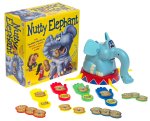
Nutty Elephant stands above a bright circus-patterned base with broad blue ears and a long curved trunk. Around him are colorful hand-shaped feeders and little peanut game pieces. The yellow box presents the elephant as the center of a miniature show.
The play revolves around that trunk: prepare a peanut on a feeder, watch Nutty turn toward you and offer the piece as his trunk comes down. Music and speech give the rotating elephant a lively presence at the table.
Prepare a feeder and watch Nutty turn
In the documented game, each player chooses a hand feeder and matching peanut discs. Haystack-shaped partitions mark the players’ areas around the stand. Keep the feeder on the play surface within your area as the elephant approaches.
When Nutty takes a disc, ready another for his next trip around. The first player to feed all their peanuts wins, then presses the peanut-shaped button to hear a trumpet celebration. Use the supplied game discs as Nutty’s pretend food.
Try circus introduction cards
Before a round, become the announcer for a very small show. This original Toysit activity supplies the words and personalities; Nutty supplies the game’s recorded sounds.
- Draw the elephant on a large card and invent a stage name, such as Nutty of the Rainbow Ring.
- Write or dictate two short introduction lines. One can describe the elephant’s blue ears; the other can announce an imaginary favorite picnic spot.
- Give each feeder a cheerful introduction of its own, perhaps a color and a made-up team name.
- Take turns announcing the cast before starting the ordinary game. Afterward, draw a poster showing everyone gathered around the stand.
Paper peanuts and a drawn elephant make a separate storytelling version. Slide the drawings across the page and let a partner supply the elephant’s grateful reply.
Arrange the little ring
The guide labels the game for two to four players, ages three to six. It requires adult supervision and keeping hair away from moving parts. Have an adult follow the assembly and battery instructions; place the stand on a level surface within easy reach.
The historical record
Original Toysit coverage
The original product account and commentary are preserved below as historical coverage.
The who can feed him first game.
Nutty Elephant is a spinning, talking, musical elephant with flopping ears and a trunk that moves up and down. Nutty is always hungry for peanuts. See if he will take one from your hand. As Nutty lifts his trunk up, up goes your peanut. Be the first to get all of your peanuts in Nutty's mouth and you win.
Kids are often fascinated by elephants due to their immense size, unique features like trunks and tusks, and their playful and gentle nature. The trunk, in particular, is a source of endless fascination, as it is used for various functions like picking up objects, trumpeting, and even splashing water. Elephants are also frequently anthropomorphized in stories, cartoons, and movies as wise, friendly, and family-oriented creatures, which adds to their appeal. Furthermore, the way elephants are often depicted in popular media, like Dumbo or Babar, endears them to children as they can relate to these characters emotionally. Their role in mythologies and fairy tales around the world also adds a layer of mystique and adventure, captivating the young minds. So, it's not just the animal itself but the cultural and emotional aura around elephants that make them so loved by children.
Sources and editorial notes
Hasbro’s 2000 Nutty Elephant guide, 40924, was reviewed as two scanned spreads containing four printed panels. Its stand, feeders, partitions and peanut discs match the photographed design. The guide supports the feeding sequence; the broad elephant-appeal discussion below remains historical commentary. The ringmaster cards are an original Toysit activity. No physical testing or condition assessment of an individual toy was performed.
- Original Toysit image — Existing same-site photograph reviewed and retained unchanged.
- Milton Bradley / Hasbro: Nutty Elephant instructions — 40924, 2000; both scanned spreads visually reviewed, covering setup, feeding, winning and supervision.
- Original Toysit coverage — Complete original product account and historical commentary preserved.

Images and descriptions are retained as historical material. How Toysit covers toys.
Created for Toysit by Tabbloza — the artwork in our header.