
From the Toysit archive
Pass the Pigs
Decide whether to bank the turn or roll again, with a clear example separating turn points from the recorded total.
The play at a glance
One more throw puts the current turn at risk
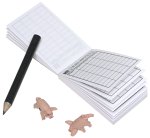
Pass the Pigs turns two small pig-shaped dice into a decision: keep the points from this turn, or throw again and try for more. Their landing positions determine the score.
Keeping the turn subtotal separate from the recorded total makes the choice easier to follow. It also clears up the original account’s loose description of losing “all” your points.
Keep two numbers on the page
Write the recorded total in one place and track the current turn separately. In the Winning Moves rules, you may stop and record the turn’s points or continue throwing. A Pig Out ends the turn with no points from that turn; an Oinker loses the accumulated game score.
The chart defines Pig Out as opposite side markings and Oinker as the pigs touching. Use the diagrams rather than judging from a remembered nickname. The linked rules aim for 100 points.
Work through one decision
Suppose you have 35 points recorded and have earned 12 points this turn. Stopping would record a total of 47.
If you throw again and get a Pig Out, the turn’s 12 disappears and your recorded 35 remains. If the result is an Oinker, the game total falls to zero. These are different consequences, even though both end a promising turn.
Say both numbers aloud before deciding: “Thirty-five saved, twelve this turn.” That small habit helps a new player see what is at stake without needing anyone else to choose for them.
Use the chart for awkward landings
In the linked chart, Double Trotter is worth 20 points, agreeing with the old example. Do not assume every paired position simply doubles a single-pig score. Consult the illustrated chart for doubles, mixed positions and unusual outcomes.
Leave the pigs where they landed while everyone checks the result. Agree on how to handle a throw that leaves the playing area before starting. Keep the surface and throwing space consistent; this guide does not assign equal probabilities to the different physical landing positions.
Learn the basic decision before adding Hog Call
The publisher presents Hog Call as a separate variation for players other than the thrower. It adds predictions and score transfers, so use its full directions rather than adding an informal bonus for shouting a guess.
For a first session, play the basic version and let each person decide when to stop. If the group wants a shorter practice game, agree on a lower target as a house rule. Keep the pigs and their scoring reference together when packing up so the next game does not depend on memory.
The historical record
Original Toysit coverage
Both original paragraphs remain below, including the Double Trotter example, mention of Hog Call and general pig-themed essay. The new explanation distinguishes Pig Out from Oinker using the publisher’s scoring chart; the original phrase about losing all points is ambiguous.
Great gift for someone who likes pigs.
Go hog wild with the pig-tastic game, Pass the Pigs. Players attempt to rack up points by rolling the pig dice but if they're not careful they might Pig Out and lose all their points. Pass the Pigs is the sizzlin' fun, shakin' bacon game! Instead of dice, you roll two cute pink piglets, and you gain or lose points depending on how the critters land. For example, if both land on all fours, called a double trotter, you get 20 points; if they land lying opposite each other, called a Pig Out, you gain no points and cede your turn. There are a number of other rules as well as a variation called Hog Call.
Pigs in toys and games often capture the imagination of both children and adults, serving as whimsical and entertaining characters. Whether it's plush pig toys, figures in video games, or even board games like "Pass the Pigs," these adorable farm animals add a playful and jovial tone. The caricatured features of pigs—like their curly tails, round bodies, and snouts—are visually engaging and often evoke humor and delight. Additionally, the portrayal of pigs as messy yet clever animals can lend itself to entertaining gameplay mechanics or storytelling themes, such as treasure hunts in the mud or problem-solving adventures. Pigs can serve as relatable characters for children, who find joy in the animal's playful antics and whimsical nature, creating a memorable and engaging play experience.
Sources and editorial notes
Reviewed October 15, 2026 against the original source, image and Winning Moves’ standard Pass the Pigs instructions, bearing a 2010 copyright. The photo does not establish a production revision. This guide names the rule reference rather than treating it as proof of every older set’s instructions. The worked example is original; no physical pigs, landing probabilities or strategy outcomes were tested.
- Winning Moves: Pass the Pigs rules and scoring chart (PDF) — Standard two-pig rules; page 2 illustrates landing positions and distinguishes Pig Out from Oinker.
Images and descriptions are retained as historical material. How Toysit covers toys.
Created for Toysit by Tabbloza — the artwork in our header.