
From the Toysit archive
Phonics Writing Desk: letters, a small screen and a tethered pen
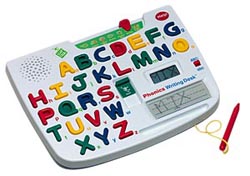
A field of colorful alphabet buttons, a small display and a tethered pen make this LeapFrog desk a place to choose a letter and give it a picture.
The play at a glance
From an alphabet button to a written shape
Rows of colorful letters cover most of the white desk. At the right are a small display and a writing area; a red pen sits beside them on its yellow tether. The layout brings a chosen letter, its displayed form and a place to try writing into the same compact space.
The original Toysit account describes uppercase and lowercase letters, phonics prompts and short writing exercises. A player can spend time with a single letter, noticing its lines and curves before making something of their own on paper.
Let one letter lead the way
The alphabet buttons make letters into visible choices. The desk’s small display and writing area then bring attention to how a shape is formed: a straight stroke, a bend, a curve or a crossing line. An adult can join the player in describing what is visible and following an activity available on that particular desk.
The letter can also suggest a picture. A round O might lead to an orange; a B might start a drawing of a boat. These are ideas supplied by the player and their companion, with room for favorite names, objects and stories.
Try a letter postcard
An original Toysit activity: turn one letter into a small message on paper.
- Choose a letter together. Use a familiar letter activity on the desk according to the matching instructions, watching the displayed form and trying it with the supplied pen.
- On a separate sheet of paper, draw something whose name begins with that letter. An adult can help choose and say the word.
- Add a large version of the letter and a short caption, such as a boat carrying a greeting.
- Give the paper postcard to someone in the room and tell them the story of the picture.
The paper postcard is made by hand. You can also do the whole activity with a drawn alphabet and a pencil, choosing the letter from your own sheet.
Give the writing hand room
Place the desk where the player can reach the writing area comfortably and the pen’s tether lies freely. An adult can help position it for the hand the player uses. Keep ordinary pens and crayons on the separate paper; use the desk’s own writing tool for its writing surface.
The historical record
Original Toysit coverage
The original product account and commentary are preserved below as historical coverage.
LeapFrog learning toy
Phonics Writing Desk by LeapFrog - This laptop-sized desk emphasizes writing skills, but it is also an effective phonics tool. Children can learn letter recognition and identification tasks, phoneme identification and recognition tasks through an introduction to short vowel sounds embedded in three-letter words. Many electronic games have poor sound quality, making auditory letter discrimination difficult, but the sound in the phonics writing desk is crisp, clear, and full of repetition and inflection. The writing exercises are short, simple, and fun. The child composes the lines and circles that form letters using an appropriately sized plastic "pen," which helps improve fine motor skills and builds self-confidence. The computerized writing style offered may not be the style taught in school, but the phonics writing desk provides a foundation for future learning. Left-handed students may find the position of the cord-anchored pen cumbersome. This is one of the few hands-on phonics tools that includes both lowercase and uppercase letters in its repertoire. Identifying lowercase letters is an essential part of learning to read, as most text is printed with lowercase letters.
The Phonics Writing Desk from LeapFrog offers an interactive and multifaceted approach to teaching children about letter recognition and phoneme identification. The desk is designed with tactile buttons, a writing area, and audio-visual aids to engage children in a multisensory learning experience. When a child presses a button corresponding to a letter, the desk not only displays the letter visually but also enunciates the phonetic sound associated with it. This auditory reinforcement is invaluable for teaching children to associate letters with their respective phonemes. The writing area allows children to practice forming letters, enhancing their motor skills alongside their phonetic learning. This hands-on involvement significantly aids in memory retention. Furthermore, the desk often comes with built-in games and activities that are geared toward reinforcing the learning process in an enjoyable way. The interactive nature of the Phonics Writing Desk encourages children to explore letters and sounds at their own pace, making it an exceptional tool for both foundational literacy and independent learning.
Sources and editorial notes
The original image and both historical discussions were reviewed. A matching original manual was not recovered from the searched LeapFrog support listings. Exact mode counts, later cursive features and model-specific operating details remain unconfirmed. The earlier judgments about sound quality, pen reach and learning effects are historical commentary, not new tests. The January 2, 2004 publication date and September 4, 2023 update are retained.
- Original Toysit image — Existing same-site photograph reviewed and retained unchanged.
- Original Toysit coverage — Complete original product account and historical commentary preserved.

Images and descriptions are retained as historical material. How Toysit covers toys.
Created for Toysit by Tabbloza — the artwork in our header.