
From the Toysit archive
Play Fruit and Vegetables
Name, sort and shop with the produce basket in Toysit’s archive, then carry its pretend ingredients into a kitchen story.
The play at a glance
A basket can become a market stall
Lay out a few pieces of pretend produce, give the basket to a shopper and decide what is on today’s list. The same collection can become a market display, ingredients for an imaginary meal or a group of shapes and colors to sort.
The old description lists twelve produce pieces plus the basket, which accounts for its stated thirteen-piece total. It includes two strawberries among the twelve foods.
Give the shopper a small list
Start with two or three items: a carrot, an apple and a strawberry, for example. Draw them on a scrap of paper if written names are not useful yet. The shopper finds each one, puts it in the basket and checks the list with the seller.
For another round, change one request: two strawberries, something green or an ingredient for pretend soup. Let the seller suggest a substitute when the requested item is missing.
Sort the same foods in different ways
Group the pieces by color, compare long and round shapes, or arrange them into the ingredients for two imaginary meals. Ask the player to explain a choice rather than insisting on a single correct grouping.
The archive’s list is apple, pear, banana, two strawberries, cucumber, green pepper, carrot, tomato, red onion, celery and lettuce. That is a description of the old offering, not proof that any particular used basket contains every piece.
Whole-food play and cutting play
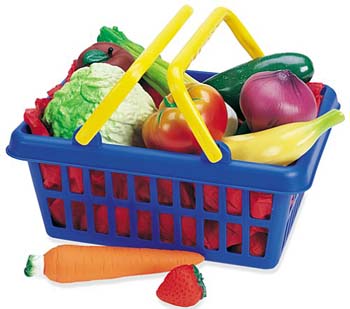
The pictured basket is useful for selecting, carrying and serving pretend foods. It does not show a verified join or cutting mechanism. Do not force a piece apart because the old general paragraph mentions slicing.
The Cutting Food Box is the separate archive entry devoted to food sections that come apart and rejoin. Keeping the two types distinct makes it easier to choose an activity that the actual pieces support.
Carry the story from shop to kitchen
Finish the market visit with a pretend checkout, then use the basket to deliver ingredients to a play cook. A pan, bowl or drawn place setting can provide the next scene. At cleanup, count the pieces back into the basket so the next shopper has a ready display.
Use the set’s own care directions when available; the photograph alone cannot tell you whether the pieces can be immersed or how they should be cleaned.
The historical record
Original Toysit coverage
The original basket description and general play-food paragraph remain below. The later paragraph mentions slicing, but the retained photograph and basket description do not establish that these particular pieces separate. The suggested activities above use them as whole pretend foods.
Play fruits and vegetables for play kitchens
Fruits and Veggies Play Food Basket is a 13 piece set that includes an apple, pear, banana, 2 strawberries, cucumber, green pepper, carrot, tomato, red onion, celery, and a head of lettuce all in a sturdy plastic shopping basket.
Play fruits and vegetables offer children a delightful way to engage in imaginative play while also educating them about healthy eating habits. These colorful and tactile toys can be 'sliced,' 'cooked,' and 'served,' allowing kids to mimic what they see adults do in the kitchen. Whether they're hosting a pretend dinner party, running a make-believe grocery store, or just exploring different types and colors of food, the options for creative play are virtually endless. Additionally, play fruits and vegetables can serve as educational tools to help children identify different types of produce, enhancing their vocabulary and cognitive skills.
Sources and editorial notes
The original text and photograph were reviewed on October 15, 2026, including the arithmetic of the listed contents: twelve produce pieces and one basket. An exact manufacturer or model was not established. Materials, washing instructions and an age label are not inferred from appearance. No physical set was inspected.
Images and descriptions are retained as historical material. How Toysit covers toys.
Created for Toysit by Tabbloza — the artwork in our header.