
From the Toysit archive
Play It Now Personal Digital Music Player
Play It Now combines a pocket music player and small-screen games. Make an original three-sound postcard using its documented audio input.
The play at a glance
A pocket-sized listening journey
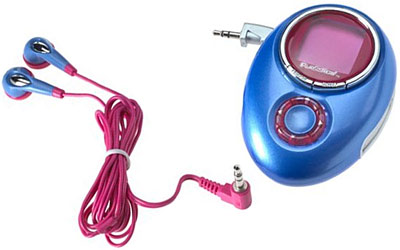
Play It Now puts a little display above a round control pad on a blue oval body. The original photograph pairs it with matching earbuds on a pink cord. Its pop-out audio plug takes sound from another device’s headphone output, ready to play back as a personal listening sequence.Record, name and arrange
Both documented versions capture incoming audio through the pop-out plug and use Enter to start and stop a recording. Their menus let the listener name recordings, change the playing order and check remaining memory. A side dial changes playback volume. Match the controls and menus on a particular unit to its guide before using these features.
The small screen also hosts games and activities, including a growing-worm game, a racing game and the dancing Wayniak character. The four-way pad gives the player another role while music plays: steering, catching or choosing dance movements.
Try a three-sound postcard
Imagine sending a short sound message from a made-up destination. On a separate suitable recording device, make three original clips: say the place's name, tap a gentle rhythm for its atmosphere, and speak a farewell. “Pebble Harbor,” a few light taps and “See you at the next tide” could become a tiny seaside visit.
If that source provides a compatible headphone output, an adult can help transfer the clips using the unit's matched instructions. Start and stop each recording separately, give the clips short names, then arrange them into a beginning, middle and end. Keep the source recordings so the postcard can be remade. Start playback quietly and use the volume dial to keep listening comfortable.
For a paper postcard, draw three symbols across a sheet and perform their sounds in order. Swap the middle symbol to change the place's mood: a soft clap might become a gentle hum. The same three-part journey works aloud.
The historical record
Original Toysit coverage
The original product account and commentary are preserved below as historical coverage.
Digital audio recorder lets you record music from any headphone jack - just plug, record, and play - no computer needed
Digital sound recorder from Tiger Electronics lets you record up to thirty minutes of any music you want from any headphone jack and take it with you on the go. Record off anything - your CD player, your computer, even your television. Includes six fun arcade style games for you to play on the go. Organize and arrange your playlist any way you like. Its sharp black-and-white screen is clear and easy to read. Comes with instructions, a belt clip, and earbud headphones.
Over the years, digital audio recorders have undergone significant advancements, making them more versatile, reliable, and user-friendly. Initially, digital recorders were bulky, expensive, and had limited storage capacity. However, today's models are incredibly compact, often fitting into the palm of your hand, and come with an array of features like high-resolution audio formats, multiple input/output options, and Wi-Fi connectivity for easy file transfer.
Storage capacity has increased exponentially, thanks to advancements in flash memory and microSD card technology. Some devices now offer multiple gigabytes of storage, allowing for hours of high-quality audio recording. Battery life has also improved, with some models offering rechargeable lithium-ion batteries that can last for an extended period of time.
Software integration has brought about features like automatic transcription, real-time editing, and easy sharing options, making these devices much more than just simple recording tools. The quality of built-in microphones has also seen significant improvements, with some models featuring multi-directional mics and advanced noise-cancelling technologies. Overall, the evolution of digital audio recorders has made it easier than ever to capture high-quality sound in a variety of settings, from professional interviews to live music sessions.
Sources and editorial notes
Both complete Hasbro guides for assortment 71865 were reviewed, including their control drawings. The Recorder guide (2004, P/N 634890000; eight PDF spreads) describes up to 30 minutes and 20-character track names. The Player guide (2005, P/N 634890100; 16 PDF pages) describes up to 60 minutes, revised menus and 25-character names. The original 30-minute account aligns with the Recorder guide; the photo alone cannot establish internal revision. Both document six games/activities, analog recording and playlist ordering. Modern Wi-Fi, transcription, storage-card and microphone features in the general historical essay are not established for this device. No physical testing; the sound postcard is original editorial play.
- Original Toysit image — Existing same-site photograph reviewed and retained unchanged.
- Hasbro: Play It Now Recorder guide — Complete 2004 guide, eight PDF spreads containing the booklet: 30-minute version, recording, naming, ordering, games and controls.
- Hasbro: Play It Now Player guide — Complete 2005 guide, 16 PDF pages: 60-minute description and revised menus. Compared visually because this scan has no extracted text.
- Original Toysit coverage — Complete original product account and historical commentary preserved.

Images and descriptions are retained as historical material. How Toysit covers toys.
Created for Toysit by Tabbloza — the artwork in our header.