
From the Toysit archive
Cutting Food Box
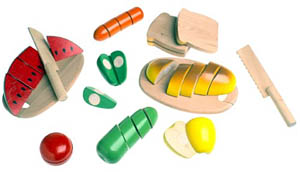
Separate pretend food into sections, match it back together and serve a make-believe meal with the set pictured in Toysit’s archive.
The play at a glance
Take the food apart, then find what belongs together
The pictured set makes preparation part of the kitchen story: sections of pretend food separate, then join again for another turn. Matching the shapes is as much a part of the activity as serving the finished meal.
The original page calls this a Cutting Food Box and describes wooden pieces, toy knives and cutting boards. That is a more useful description of the toy than its old general title, Play Kitchen Super Set.
Start with one food
Choose one assembled food and place it on the toy board. Look for the joins, separate the sections with the intended toy knife and lay them where both players can see them. Match the sections by their shape and surface detail, then put the food together again.
The original discussion describes hook-and-loop connections. Melissa & Doug’s comparable Cutting Food design uses self-stick tabs. Inspect the connections on the actual set rather than assuming every similar food toy joins in the same way.
Count foods and sections separately
A whole pretend loaf can be one food made from several sections. Count it before taking it apart, then count the separate pieces. Ask what stayed the same and what changed.
Use words such as whole, piece and part as they fit the activity. For fractions, first check that the pieces represent equal portions: two unequal pieces are not automatically two halves. This is an invitation to compare, not a test of what a child should already know.
Make a small order
A guest can request a piece of bread and some pretend vegetables. The cook finds the foods, prepares the sections and places them on a dish. A helper can reunite the remaining pieces so the next order begins with recognizable foods.
Use the toys’ own knives and intended play surfaces. The pieces are props for make-believe preparation; the old description’s material or finish language is not a current food-contact assurance.
Put complete foods back together before storing
Reassemble each food first, then gather the tools and boards. This makes a missing section easier to notice than simply counting everything in the box. Store loose parts together without forcing pieces whose joins do not match.
The historical package description remains useful context, but its 29-piece total cannot certify a loose set as complete. A later manufacturer package may count or supply components differently.
The historical record
Original Toysit coverage
Both original paragraphs are preserved below. The first describes two boards, two knives, eight food items and 29 pieces; those quantities and its finish claims have not been independently confirmed for the pictured edition. The second discusses rejoining food and possible educational uses in general terms.
Cutting Food Box.
Kids love hearing the realistic crunch as they slice their way through this value-packed food set. This smooth-sanded, solid wood set in beautiful, non-toxic colors features 2 cutting boards, 2 knives and 8 food items with 29 pieces! Items store neatly in the sturdy wooden storage case with see-through lid.
The allure of play food that can be "sliced" apart and reassembled with Velcro is manifold, offering children a tactile and interactive experience that is both educational and enjoyable. This kind of toy engages kids on multiple levels: it fuels their imagination as they pretend to be chefs or grocery shoppers; it provides sensory satisfaction through the act of "cutting" and hearing the Velcro separate; and it teaches basic concepts of part-whole relationships and fractions. The reassemblable nature of these toys also adds an element of puzzle-solving, as children figure out which pieces go together. Additionally, the action of cutting and sticking the Velcro back together can enhance fine motor skills. Overall, this simple yet ingenious twist on traditional play food sets offers a richer, more engaging playtime experience.
Sources and editorial notes
The original photograph and text were reviewed on October 15, 2026 alongside Melissa & Doug’s Cutting Food listing, item 487. That manufacturer source confirms a comparable self-stick, separable-food design but does not establish that its current package is identical to the earlier Toysit set. No precise edition, piece inventory, coating or care specification is assigned from that comparison. No physical set was tested.
- Melissa & Doug: Cutting Food, item 487 — Manufacturer comparison for self-stick food sections; its current package should not be used as the inventory of the archived set.
Images and descriptions are retained as historical material. How Toysit covers toys.
Created for Toysit by Tabbloza — the artwork in our header.