
From the Toysit archive
Play-Doh Dr. Drill ’n Fill
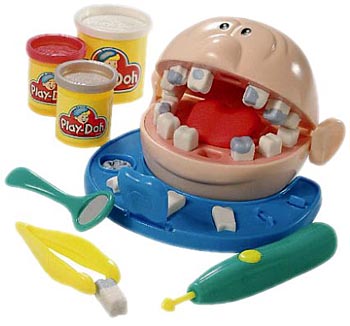
Make a model patient’s pretend teeth, tell a short appointment story and remake the scene with the older Dr. Drill ’n Fill set.
The play at a glance
Make the patient, then make the story
Dr. Drill ’n Fill turns modeling compound into a pretend dental scene. The player makes teeth for a model head and decides what happens during its appointment. The making and remaking are as much a part of the toy as the dentist role.
Keep all tools and compound on the model patient and out of real mouths. The historical essay below suggests treating friends and family; use people as storytellers, never as the toy’s patients.
Give the model a small set of teeth
Use the intended molds and compound to make pretend teeth for the model head. Start with a few pieces rather than filling every position immediately. Look at the shapes, decide where they belong and name the model patient if that helps begin the story.
One player can make the pieces while another narrates the patient’s arrival. Both roles are useful, and they can switch without restarting. The patient is always the plastic model.
Choose one event for the appointment
The original description includes making a pretend filling, removing a model tooth with the toy pliers and forming a tongue. Choose an action supported by the actual set and its matching instructions, then give it a beginning and an ending.
For a simple story, the model arrives with an unfinished smile and leaves with the newly made teeth in place. A child can also be the receptionist or the narrator. No one needs to act out fear, pain or a real procedure to take part.
Remake a piece and compare
After the scene, choose one compound tooth to remake. Try a slightly different shape, then compare it with the first attempt. Ask what changed and which version fits the intended place in the model.
These are suggestions for modeling and storytelling. They do not establish that the toy reduces dental anxiety or teaches dental care. Questions about an actual appointment belong with the child’s dental professional, not with the toy’s tools.
Identify the edition before operating the drill
Several Dr. Drill ’n Fill editions share the name. Hasbro’s 17345 reference describes an electronic drill and gold-colored compound; this older Toysit image and description do not establish that exact package. Check the product number on the actual set before using an instruction sheet for power, assembly or replacement parts.
Keep the intended accessories together and follow the matching directions for cleanup and compound storage. Do not infer motorized operation from the toy’s name, substitute real dental tools or put the play tools in anyone’s mouth.
The historical record
Original Toysit coverage
The original product description and dental-play essay remain below, including the silver filling compound, three-can description and claims about anxiety and dental health. These are preserved historical statements, not demonstrated benefits. The reference to treating friends and family must not be followed literally: tools and compound belong only on the toy model.
The idea is to mold white teeth out of Play-Doh, press them into the gums of the patient, and then play dentist.
Parents may remember this silly drill and fill Play-Doh set from their childhood. The idea is to mold white teeth out of Play-Doh, press them into the gums of the patient, and then play dentist. Teeth can be drilled with the plastic pretend drill and then filled with the silver Play-Doh compound, or teeth can be extracted with the dental pliers. In addition to the play factor, children can work out their dentist anxieties by reversing roles--they're the ones holding the equipment and working on the patients. It's also very entertaining, especially when children make the Play-Doh tongue squeeze out of the mouth. Set includes three dental tools and three cans of Play-Doh in colors to represent teeth, silver filling, and a person's tongue.
A dentistry playset can serve as a fun and educational way to introduce children to the world of oral care and the role of dentists. Armed with toy dental instruments, teeth models, and other dental accessories, children can play the role of a dentist, "treating" their toy patients or even their friends and family. This imaginative play can help demystify the experience of going to a dentist, potentially alleviating any anxiety or fear a child might have about dental visits. Moreover, it creates an opportunity for parents to educate their children about the importance of regular dental check-ups and good oral hygiene. By taking on the role of a dentist, children not only gain a greater understanding and appreciation for the profession but also become more responsible and proactive about their own dental health.
Sources and editorial notes
Reviewed October 15, 2026 using the original image and text and Hasbro’s Dr. Drill ’n Fill electronic-drill reference, product 17345. That reference describes gold compound and an electronic drill; the archived Toysit text describes silver compound and the pictured older tools are not an exact confirmed match. The linked source establishes the broader model-patient activity, not the pictured version’s battery requirements, contents or assembly. The story ideas are editorial suggestions; no physical set was tested.
- Hasbro: Dr. Drill ’n Fill, product 17345 — Official electronic-drill edition reference and download; its gold compound and power details must not be transferred to this older pictured set.
Images and descriptions are retained as historical material. How Toysit covers toys.
Created for Toysit by Tabbloza — the artwork in our header.