
From the Toysit archive
Play-Doh Creativity Table
Explore a Play-Doh Creativity Table with a work surface and places for tools and cans, then arrange a tiny sculpture exhibition with name cards.
The play at a glance
A little worktable for shapes and stories
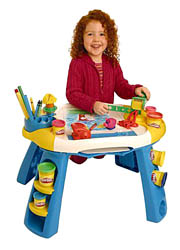
The original photograph shows a yellow-and-white tabletop on blue legs, with cans stored down the sides and making tools gathered above. A child stands at the work surface, where small shapes and materials have room to become the next creation.
Toysit’s earlier description emphasizes that combination of workspace and storage. The Creativity Table gives modeling play a place to begin and a place to return to: choose a material, make a shape, arrange a scene and put the tools back when the session ends.
A surface with several ways to make
The older Creativity Table instructions illustrate a central work area with a carousel for drawing tools, shelves for compound cans and attachments for pressing and rolling shapes. Drawing and modeling can sit beside one another: sketch an idea on paper, then try giving it a rounded body, a long tail or a patterned edge.
A player might keep one part of the surface for making and another for a finished display. The visible storage spaces provide a useful ending to the session, too, as tools and cans return to their places. Follow the matching instructions for assembly and use of the particular table.
Try a tiny sculpture exhibition
This original Toysit activity turns three small creations into a show with its own theme and labels. Gather paper for the name cards.
- Choose a theme, such as an imaginary garden, a collection of funny hats or visitors from a tiny planet.
- Make three small shapes that belong to the theme. Give each a different outline or surface detail.
- Draw or write a name card for each piece. Add one sentence about what a visitor should look for.
- Invite someone to tour the exhibition and ask a question about a creation. The maker can answer with a detail about its shape or an invented story.
- Close the exhibition, save the cards if you like, and return tools and materials to their storage places.
For a paper exhibition, draw the three creations or fold broad pieces of paper into standing shapes. A visitor can still compare outlines, read the labels and ask the maker a question.
Let one shape lead to the next
Choose a detail from the first sculpture and repeat it in the second: a curl, a row of dots or a wide flat base. Then change something else. The resulting pair can look related while giving each piece its own character.
The manufacturer’s older instructions also show returning compound to its cans and sealing the lids at cleanup. Check the materials’ current package guidance when setting up the table for a new session.
The historical record
Original Toysit coverage
The original product account and commentary are preserved below as historical coverage.
Play-Doh Table
Great for storing and working with playdough. Makes working with soft clay an artistic endeavor.
Having a variety of Play-Doh colors and textures provides children with a rich palette for creative expression, much like a painter having a range of paint colors. The more options available, the more nuanced and detailed their creations can become. This fosters cognitive development by encouraging kids to think outside the box, mix colors, and even create textures. The tactile nature of Play-Doh also helps in the development of fine motor skills as children knead, roll, and shape the dough into their desired forms. Moreover, the activity can become a social experience when children work together to create something, promoting skills like collaboration, communication, and sharing. It also opens the door for educational moments, where parents and caregivers can introduce concepts like shapes, sizes, and even basic arithmetic as children divide or combine different Play-Doh pieces. Overall, the versatility of having different kinds of Play-Doh amplifies the scope for imaginative play, problem-solving, and learning.
Sources and editorial notes
The original Toysit text and photograph are preserved. Hasbro’s item 23070 page and all four pages of its 2003 illustrated manual were reviewed; their table, shelf and tool arrangement is consistent with the photograph. Exact package completeness is unconfirmed. A separate bonus-edition 22613 manual has different quantities, which are not imported here. The original developmental claims remain historical commentary. The sculpture exhibition is an original editorial suggestion; no hands-on testing is claimed.
- Original Toysit image — Existing same-site photograph reviewed and retained unchanged.
- Hasbro: Creativity Table, item 23070 — Manufacturer page and linked four-page manual, copyright 2003, reviewed for the table arrangement, making tools and storage; not a complete inventory of the pictured package.
- Original Toysit coverage — Complete original product account and historical commentary preserved.

Images and descriptions are retained as historical material. How Toysit covers toys.
Created for Toysit by Tabbloza — the artwork in our header.