
From the Toysit archive
Playskool Go-Bots: a red car and robot
A red Playskool Go-Bot carries the shape of a car into a chunky robot. Invent a delivery that needs both a road journey and a friendly robot greeting.
The play at a glance
One traveler, two ways to arrive
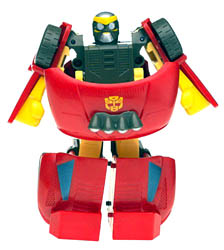
Black wheels sit at the shoulders, a red car front curves across the middle, and broad red feet give the pictured Go-Bot its chunky outline. Yellow arms and a yellow-topped head add bright accents. The vehicle details remain visible in robot form, making this a good starting point for a story in which the same character travels down a road and then stands up to greet someone.
Follow the car details into the robot
Begin by spotting the wheels, the car-front shape and the large lower-leg panels. These features connect the robot with its vehicle identity. A player can decide which details help a friend recognize the traveler after its form changes: perhaps the red body or the familiar front lights drawn into the design.
The original account describes conversion between robot and vehicle. For a physical example, use its matching instructions and the movements it is designed to make; this story does not require guessing a folding sequence. Two drawings—one red car and one red robot—can carry the same character through both parts.
Try a delivery with a personal greeting
- Choose a message. Imagine that a neighbor is opening a new workshop and needs an invitation delivered. Say who sent it and who should receive it.
- Draw a simple road. Connect the sender’s home to the workshop on paper. Add one recognizable landmark, such as a striped gate or a round pond.
- Tell the car journey. Guide the vehicle along a flat route, or move the car drawing. Pause at the landmark and say how the traveler knows it is going the right way.
- Arrive as a robot. Use the toy’s familiar, instructed conversion or switch to the robot drawing. Give the character a greeting and deliver the imagined invitation in its own voice.
- Bring back a reply. The recipient adds one detail to the message: an opening time, a request for music, or a welcome for another guest. Return by the same road and report the reply.
Keep the invitation imaginary or beside the route; nothing needs to fit inside the toy. One player can supply both voices, while two players can take turns as sender and recipient.
Make recognition part of the story
On the next delivery, let the recipient know only one clue about the visitor. “Look for the red traveler with black wheels” works in both forms. Draw a small portrait of each arrival and put the message between them. The transformation becomes a change in how the character meets the world, while its name, purpose and friendly greeting stay the same.
The historical record
Original Toysit coverage
The original product account and commentary are preserved below as historical coverage.
Playskool Go-Bot
Easy 1,2,3 conversion lets kids change figures from robot to vehicle and back again - all by themselves. Colorful, durable figures for hours of exciting play. Chunky styling makes it easy for preschoolers to hold and stand up.
Young children are often fascinated by robot toys for a variety of reasons. These toys tap into a child's innate curiosity about the world and how things work, offering interactive and dynamic experiences that static toys simply can't provide. With buttons to push, lights that flash, and even basic artificial intelligence features, robot toys engage multiple senses, enhancing motor skills and hand-eye coordination.
Many of these toys also come with educational benefits, teaching basic coding concepts or reinforcing learning in subjects like math and spelling. They can offer problem-solving challenges that can be both fun and educational. Robot toys often appeal to children's imaginations, providing endless possibilities for role-play and storytelling. Whether it's imagining the robot as a friend, a pet, or a superhero sidekick, children are able to explore various scenarios and express their creativity.
Additionally, the interactive nature of robot toys helps children with socialization skills. These toys can encourage group play and teamwork, as well as the development of emotional intelligence by simulating care-giving scenarios or offering responses that require empathetic interaction. Overall, robot toys offer a multi-dimensional, enriching playtime experience that many children find incredibly engaging.
Sources and editorial notes
The original Toysit photograph and product paragraph establish a chunky robot-to-vehicle toy. Collector identification points to the 2002 Big Adventures Speedbot, but a matching original conversion leaflet was not recovered; no step sequence or exact model-specific age is supplied here. The archive’s later discussion of lights, artificial intelligence, coding and educational effects concerns robot toys broadly, not demonstrated features of this pictured toy. The delivery is original Toysit pretend play, with voices supplied by players; no physical testing was performed.
- Original Toysit image — Existing same-site photograph reviewed and retained unchanged.
- Original Toysit coverage — Complete original product account and historical commentary preserved.

Images and descriptions are retained as historical material. How Toysit covers toys.
Created for Toysit by Tabbloza — the artwork in our header.