
From the Toysit archive
LEGO Roadside Repair
Explore LEGO Roadside Repair set 6434 as a workshop and vehicle-story setting, then create a help-tow-repair route and a pretend service ticket.
The play at a glance
Build the workshop, then give it a job
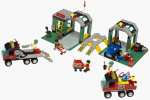
LEGO Roadside Repair combines a service-center scene with vehicles and people who can use it. The gray-roofed buildings, green panels, yellow door and recovery vehicles in Toysit’s small original image correspond to LEGO’s instructions for set 6434.
Once the scene is built, the question becomes a story: who needs help, how will they reach the workshop, and what happens when the job is finished?
Separate the building task from the story
Instructions answer how the supplied pieces form the models. Story play asks what the people and vehicles do afterward. Keeping those questions separate leaves room for an invented job without presenting it as an official play mode.
The manufacturer PDF groups the set into numbered model sections. Find the section matching the model you are assembling instead of assuming the first building’s steps also describe every vehicle.
Give the workshop an arrival and a departure
Choose a place where a vehicle waits for help, a route to the workshop and a place to return when the story’s repair is complete. Leave enough space around the entrance to move figures and vehicles without rebuilding the whole scene.
A tow vehicle can have a role even before anything moves: its driver asks where help is needed and decides which route to take. Use the actual model’s documented connections if joining vehicles; a story does not require a forced attachment.
Explain the repair in words or pictures
A customer might report an imaginary rattle or ask for a pretend inspection. The mechanic can draw the plan and describe what was checked. Different people can take the customer, driver and workshop roles, or one person can tell the entire story.
The model represents a service setting. It does not establish that a child has learned to diagnose or repair a real vehicle. An invented fault can be solved in the story without taking apart functioning toy components.
Help, tow and repair
- Draw three places on paper: a waiting area, a workshop and a destination. Connect them with a route.
- Draw a vehicle and write or tell why its driver asks for help.
- Make a service ticket with three prompts: “What the driver noticed,” “What we will pretend to check,” and “What happens next.”
- Trace the route and tell the story in order. Change one event and see whether the route or the ticket needs to change too.
This independent Toysit activity can use drawings alone. It is not a manufacturer assembly instruction or a real roadside procedure.
The historical record
Original Toysit coverage
The complete original description and vehicle-repair essay remain below. The essay’s claims that play develops practical mechanics, engineering skills and confidence are historical assertions, not results established by this renovation.
Great for kids who like cars and legos.
A repair center that is a great addition to any Legos set up. Includes towing vehicles and garages, it is a real work center that will make kids feel that they are participating in the world of fixing cars.
Children's playsets that include repairing vehicles offer a unique and engaging play experience that goes beyond mere entertainment. These playsets tap into a child's natural curiosity and desire to understand how things work, fostering a sense of accomplishment and usefulness. Here's how:
- Hands-On Learning: By working with tools and vehicle parts, children engage in hands-on learning. They explore mechanics, engineering, and problem-solving, developing practical skills that can be applied in real life.
- Role-Playing: These playsets often encourage role-playing, where children can take on the roles of mechanics, engineers, or helpers. This role-playing experience allows them to imagine themselves in responsible and skilled positions, enhancing their self-esteem and sense of purpose.
- Understanding Cause and Effect: Repairing vehicles in playsets teaches children about cause and effect. They learn that specific actions lead to particular outcomes, such as fixing a broken wheel to make a car move again. This understanding fosters logical thinking and a sense of control over their environment.
- Collaboration and Teamwork: Many vehicle repair playsets are designed for cooperative play. Children learn to work together, share tools, and collaborate on solutions, promoting social skills and the value of teamwork.
- Creativity and Innovation: The open-ended nature of vehicle repair playsets encourages creativity and innovation. Children can experiment with different solutions, invent new ways to fix problems, and express their creativity through customization and design.
- Emulating Adult Roles: By mimicking the actions of adults who repair vehicles, children feel a connection to the adult world. They see the importance and value of fixing things, nurturing a sense of responsibility and usefulness.
- Building Confidence: Successfully repairing a vehicle in a playset builds confidence. Children feel a sense of achievement and pride in their abilities, reinforcing the belief that they are capable and useful.
Children's playsets that include repairing vehicles provide multifaceted learning and developmental opportunities. They inspire children to feel useful by engaging them in meaningful tasks, fostering practical skills, encouraging creativity, promoting teamwork, and building confidence. These play experiences contribute to a child's overall growth and development, shaping them into responsible, capable, and confident individuals.
Sources and editorial notes
LEGO’s official 6434 instruction PDF was downloaded and visually compared with Toysit’s original GIF. The file contains sections labeled 1/6 through 6/6; the workshop and vehicle artwork supports the set identification. The first workshop’s assembly and illustrated model views were checked; this article does not reproduce a build sequence or assert a complete inventory. No set, towing connection or repair mechanism was physically tested. The route and service-ticket activity is an independent editorial addition.
- LEGO set 6434 building instructions — Official PDF containing six numbered model sections; used to match the original buildings and vehicles.
Images and descriptions are retained as historical material. How Toysit covers toys.
Created for Toysit by Tabbloza — the artwork in our header.