
From the Toysit archive
Escape from Eden: Puzzle Maze Game
Explore Lost in a Jigsaw: Escape from Eden through assembly and route finding, with a spoiler-free notebook and an independent paper-maze activity.
The play at a glance
Build the garden and investigate the route
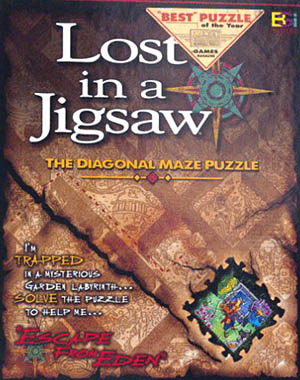
Escape from Eden combines a jigsaw image with a path-finding problem. The original Toysit review describes an explorer trying to leave a garden labyrinth, while Buffalo Games’ period catalog identifies the product as Lost in a Jigsaw, item 801. Assembling a convincing garden and tracing a usable route are two different questions to keep in view.
Separate picture clues from route clues
Color, repeated garden details and piece edges can suggest an assembly choice. A visible passage raises another question: where does it lead? Keeping those questions separate can help explain why an attractive-looking section may still leave a route problem to investigate.
The package calls this a diagonal maze puzzle. That label does not supply its complete placement rules. This guide does not assume that every edge fit is legal or invent a cluster-rearrangement rule; use the instructions for the actual edition.
Record a hypothesis without marking the puzzle
Keep a separate notebook for tentative routes. Use landmarks you can recognize in the picture, such as a fountain or a distinctive flower bed. Write what you tried and where the passage stopped.
Mark a note as “observed” or “still to check.” That distinction can prevent a guess from turning into a rule as you return to a complicated section. It also lets another person follow the investigation without being shown a complete solution.
Match the title before seeking a hint
The period catalog lists Escape from Eden separately from Lost in a Jigsaw II: Survival of the Fittest. A solution for the sequel is not a guide to this garden. Check the title and artwork before consulting a hint sheet.
The award badge is visible on the retained package, and the manufacturer catalog repeats an award claim. That is documented promotion, not independent confirmation from the awarding publication. Likewise, conflicting counts should prompt an edition check rather than a declaration that an old box is incomplete.
Draw a garden maze with one useful dead end
On squared paper, draw a start, a finish and a continuous corridor between them. Add a branching corridor that ends before reaching the finish. Draw walls around the routes and decorate the remaining space as a garden.
Ask someone to trace the maze and explain where they had to return to a junction. Revise one branch and try again. This independent Toysit activity has its own simple rules; it neither reproduces Escape from Eden nor reveals its solution.
The historical record
Original Toysit coverage
The complete original review and maze-puzzle essay remain below. The old count of 515 pieces, dimensions, difficulty rating and award attribution are retained as historical statements. The period catalog uses different series specifications, and this page does not silently replace one set of numbers with the other.
Diagonal Maze 515-piece Puzzle: Escape from Eden
This elaborate puzzle was named Best Puzzle of the Year in 1998 by Games Magazine, and it's easy to see why it's received such rave reviews. More than a puzzle, the game is an ongoing plot in which puzzle builders take on the persona of an explorer trapped inside an intricate garden labyrinth. Before you can begin your perilous journey home, you must assemble the very maze you're trapped within, say the instructions. Puzzle pieces depict an illustrated garden full of exotic fountains, lush flower beds, exquisite sculptures, and numerous dead ends. The trick is to create a linking passageway through this treacherous labyrinth. (No, you may not jump over hedges.) The puzzle pieces are about 1 inch square. Once the garden scene is completed, it measures 19.5 by 17.5 inches. On a scale of fun-challenging-difficult-expert, this 515-piece puzzle is rated difficult.
Maze-themed puzzles captivate both the mind and imagination, offering endless hours of fun and intellectual stimulation. The intrigue of finding the correct path from start to finish engages problem-solving skills and taps into a primal sense of accomplishment. As players navigate through the twists, turns, and dead-ends, they are challenged to think ahead and strategize, honing their spatial awareness and logical reasoning. The excitement builds with each successfully completed section, culminating in the exhilarating moment of finally reaching the end. These puzzles can be enjoyed solo or as a group activity, making them versatile entertainment. Whether it's a simple paper maze or a more complex 3D structure, the maze-themed puzzle is a timeless form of fun that appeals to all ages.
Sources and editorial notes
The original package identifies Escape from Eden. Buffalo Games’ 2001 catalog text identifies item 801 and distinguishes the sequel, Survival of the Fittest. Its spread lists 525 pieces and 19 by 19 inches, differing from Toysit’s 515 pieces and 19.5 by 17.5 inches. Direct archival PDF downloads returned 403, so the spread’s visual layout and an exact edition match remain unresolved. No full rule/solution sheet or independent award record was verified. No physical puzzle was tested.
- Buffalo Games 2001 product catalog — Manufacturer catalog on an archival host; Lost in a Jigsaw spread. Text inspected; direct download returned 403.
Images and descriptions are retained as historical material. How Toysit covers toys.
Created for Toysit by Tabbloza — the artwork in our header.