
From the Toysit archive
RAD 4.0 Robot
Explore RAD 4.0’s voice-command tree and radio control, preserving the original robot profile and adding a paper command-design activity.
The play at a glance
A spoken command follows a defined path
RAD 4.0 combines radio control with recognition of a defined set of spoken commands. Toymax’s manual organizes voice interaction as a tree: address the robot, select a group, then give a command within that group.
This is real command recognition, but it is not unrestricted conversation. The useful question is what the robot is listening for at that point in the exchange.
Separate the inputs and outputs
- Spoken input
- The guide calls for the controller to be stored in the head for voice-command mode.
- Radio input
- The removed controller provides a separate way to direct the robot.
- Spoken output
- The robot’s replies help the user follow the exchange; a reply is not itself evidence of understanding arbitrary language.
The guide describes more than fifty voice commands. A large command list still has boundaries: the available choices depend on the current part of the tree.
Think in branches
One documented path is RAD → PLAY → SING. Each step narrows what follows. The manual also calls for pauses and a quiet setting; the robot cannot listen while it is talking.
A command tree is like a menu that unfolds in stages. A word that makes sense in ordinary conversation may be unavailable at the current stage. That explains a design constraint without assuming the toy is thinking like a person.
Describe what a mode actually does
The guide’s listening feature routes sound through the controller, and its guard mode reacts to a loud sound with a password-and-alarm routine. These documented functions do not establish internet access or dependable monitoring.
When comparing old robot toys, identify the input, the expected response and the limits of the source. Avoid using a dramatic mode name as a substitute for a description.
Design a tiny command language
- Draw a fictional robot and give it a name.
- Create two command groups, such as STORY and MUSIC.
- Give each group three choices that can be acted out with words or drawings.
- Ask a partner to follow the tree exactly, one choice at a time.
- Try a word outside the tree. Invent a helpful response that explains the available choices.
This is an independent language-design exercise, not a way to reprogram RAD 4.0. Discuss whether the instructions became clearer when the available choices were visible.
The historical record
Original Toysit coverage
The complete original product description and broader voice-robot commentary remain below. The “latest” technology wording, gift assumptions and battery-inclusion statement belong to that historical description. The manual documents a bounded command system; broad claims about understanding anyone’s speech or performing every function by voice should not be read as guarantees. Guard and listening modes are toy features, not verified security performance.
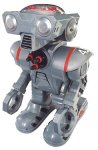
This voice-command, radio-control robot is made of tough gray plastic with red stripes on his shoulders.
It's hard to think of a cool, big present for older boys, but the RAD 4.0 Robot will solve that dilemma with style. This voice-command, radio-control robot is made of tough gray plastic with red stripes on his shoulders. He has a traditional humanoid robot shape with a broad-chested body, wide-set eyes, a black mouth with speaker, digital lights and sound, and articulated arms with hands that can hold an object. The RAD Robot moves in two drive speeds and his radio controller conveniently stores atop his head. He also has artificial intelligence (the 4.0 model has command of a 50-plus word vocabulary) and the latest in voice-recognition technology with the ability to respond to anyone's voice to perform a full-function range of motor and non-motor responses. The RAD Robot has a defense system, too, as he can fire three foam missiles from the cannon on his chest. He's also able to eavesdrop on conversations or watch over your stuff when set in guard mode. The RAD Robot requires a 6-volt battery and charger, and a 9-volt battery, none of which are included.
A voice-command, radio-controlled robot offers a captivating experience that feels like a step into the future. Kids and adults alike are thrilled by the ability to control a robot not just through a remote, but with their own voice. Commands like "move forward," "turn left," and even more complex instructions bring the robot to life, making the interaction feel incredibly personal and immersive. It's not just a toy; it's like having a small, mechanical companion that listens and responds to you. These robots often come with a variety of functions and features, from LED lights to built-in games, enhancing the sense of wonder. The technology integrates learning and play, potentially sparking interest in robotics, programming, and engineering among young users.
Sources and editorial notes
The complete six-page Toymax RAD 4.0 manual scan was visually reviewed, including its title, controller placement, voice-mode instructions and command tree. It is the 4.0 guide, not a nearby RAD 2.0 document. The 98 by 150 pixel original photograph is retained without promotional enlargement. No speech recognition, radio range, listening mode or battery system was tested.
- Toymax RAD 4.0 instruction manual — Manufacturer scan preserved by The Old Robots; voice-command tree and radio-control modes.
Images and descriptions are retained as historical material. How Toysit covers toys.
Created for Toysit by Tabbloza — the artwork in our header.