
From the Toysit archive
Shape and Color Sorter
Choose what belongs together, change the grouping and explore the peg-and-shape sorter from Toysit’s archive.
The play at a glance
The same pieces can belong to different groups
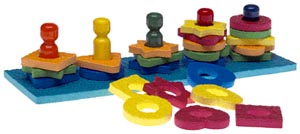
A red circle can go with the other red pieces or with the other circles. That small change gives this sorter its interest: the objects stay the same while the reason for grouping them changes.
The archive photograph shows pieces that slide over upright pegs. It is consistent with the Lauri Shape & Color Sorter pictured on packaging in a firsthand owner’s account, although the exact production revision has not been established.
Choose one reason to put pieces together
Set out a few of the toy’s own pieces and choose a feature that is easy to notice. For example, make one group of circles and another of stars, leaving the other shapes for later.
The pieces can be grouped beside the base before going onto the pegs. This separates two choices: deciding where something belongs and lining up its hole with a peg. A player can enjoy either part without completing every stack.
Change the rule together
Take those pieces off and group them by color instead. Notice which former neighbors move apart and which new neighbors appear. NAEYC’s sorting guidance describes changing the chosen characteristic as a way to explore similarities and differences.
Say what you notice rather than turning every move into a quiz: “Those are both red, even though their shapes are different.” Invite the child to choose the next group. If they invent a different rule, ask them to show you how it works.
Let the pegs become parking places
For a small pretend game, imagine each peg is a parking place for one family of shapes. One player chooses a passenger; the other finds its place. Swap jobs after a few turns.
Leave room to lift a piece off again. If a stack becomes awkward, use fewer pieces rather than making a taller tower the goal. Putting a piece on, taking it off and trying again can be the whole game.
Keep the invitation manageable
Bring out more shapes when they add interest, and gather the set’s own pieces when finished. Use the actual toy’s markings and care directions for its age range, materials and cleaning; the packaging comparison does not establish those details for every old set.
The useful observation is what the player chose to do today. Sorting by color, experimenting with a peg or making a mixed stack need not become a score or a developmental judgment.
The historical record
Original Toysit coverage
Both original paragraphs remain below. Their developmental timetable, material descriptions and claims about quiet play or learning benefits are historical statements, not a test of this particular set or a timetable every child must follow.
Learn classification skills by stacking soft rubber shapes on wooden pegs
With the Shape and Color Sorter, young learners will be drawn to the motor challenge of stacking soft rubber shapes on wooden pegs, and sorting them by shape, color, or texture. And so begin the classification skills that continue to build in subtlety and complexity for as long as learning lasts. Why are sorting toys (and a good variety) such an asset to a child's play environment? Because only after children younger than 5 years old master sorting along a single characteristic, such as color, can they begin to build an understanding of subclasses. One challenge for parents is keeping the sorting toys separated, so that a toy muddle doesn't overwhelm the impulse to sort. The set is ideal for keeping children occupied at restaurants or at meetings. A child can accidentally or intentionally drop the soft pieces from table height, and oh so quietly will they greet the floor.
Shape-sorting toys are more than just fun; they offer a multitude of educational benefits for children. As a child interacts with these toys, they learn fundamental skills like problem-solving and hand-eye coordination. These toys often come in different colors and shapes, encouraging children to recognize and name them, thus enhancing their vocabulary and color recognition skills. Furthermore, successfully matching the shapes provides a boost to a child's self-esteem and sense of accomplishment, offering a great way to instill the value of goal-setting from a young age. Notably, the action of sorting and fitting shapes also hones fine motor skills, which are crucial for activities like writing. Overall, shape-sorting toys are a wonderful tool for both cognitive and physical development.
Sources and editorial notes
The original source and image were reviewed on October 15, 2026. Manufacturer packaging photographed in a 2011 owner’s account supports the Lauri design comparison; it is not a matching instruction manual. NAEYC provides general sorting context. The activities here are editorial suggestions, and no physical toy or developmental outcome was tested.
- Lauri Shape and Color Sorter: owner’s account and box photographs — Firsthand photographs of manufacturer packaging, used to compare the product design.
- NAEYC: Sorting Activities for Preschoolers — General context for grouping objects by a chosen characteristic and trying another grouping.
Images and descriptions are retained as historical material. How Toysit covers toys.
Created for Toysit by Tabbloza — the artwork in our header.