
From the Toysit archive
Sorry! Card Revenge
Sorry! Card Revenge explained: color or ascending-number plays, the talking pawn, and four completed hands recorded on Home boards.
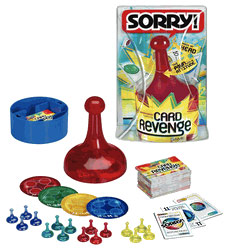
The play at a glance
Clear your hand, mark your progress
Sorry! Card Revenge turns the race home into a card game. The small pawns record completed hands. The large red pawn interrupts with spoken instructions that players carry out themselves.Read the top card before choosing a play
The standard rules allow a numbered card matching the top card’s color, or an ascending sequence continuing its number in any colors. Matching the number alone is not enough. Wild cards have their own instructions.
For an example, suppose the discard is a red 5 and your hand includes a red 9, a blue 6 and a green 7. You could play the red 9 by color, or play the 6 followed by the 7 as a sequence. The same visible hand offers two different routes.
Ask which option leaves fewer cards and which leaves a more useful next possibility. Those are discussion questions, not a promise that one choice will win: the other players and the talking pawn can change what happens next.
The big pawn gives directions
If you cannot play, tap the large pawn and follow its spoken direction. A Sorry! card can also nominate another player to tap it. Players draw or give cards themselves; the unit is not a mechanical card launcher.
A clear tabletop helps separate the draw pile, discard pile, hands and scoring pieces. Before starting, agree who will repeat a missed instruction. Hearing a sound and understanding what to do are different parts of a turn.
After learning the ordinary plays, read the special cards together. The guide includes Slide, Safety Zone and Sorry! cards, plus effects attached to certain numbers. Treat the worked example above as one ordinary choice, not a replacement for those rules.
What “Home” means here
Playing your last card lets you move one small pawn onto your Home board. Draw a new five-card hand to continue. Getting your fourth pawn Home wins. The pawns are progress markers; there is no route around a traditional Sorry! board.
For a first explanation, put the scoring board beside the cards and point to each in turn: the hand is the current challenge, while the Home board records earlier successes. That distinction helps make sense of why a player can empty a hand without ending the entire game.
A short Toysit practice activity is to discuss a face-up sample hand before dealing for real. Let each player suggest a move and explain its basis. Keep this cooperative rehearsal separate from the competitive game and its hidden hands.
Identify a complete set
Hasbro identifies this version as 42016, with a giant electronic pawn, cards, sixteen small pawns and four Home boards. Compare the actual deck and accessories with the manual’s contents list; the large pawn by itself is not the whole game.
For a stored set, check the product label, battery compartment and readable card instructions before play. Follow the matching guide for power and storage. If a used listing describes a “card shooter,” ask for clear photographs of the mechanism and components rather than assuming that description belongs to this product.
The historical record
Original Toysit coverage
Both original paragraphs remain below. The later paragraph’s card-shooter and board-movement description conflicts with Hasbro’s 42016 instructions. The verified game uses a talking pawn, a draw pile and small pawns that mark completed hands on Home boards.
Easy-to-learn, electronic card game edition in which players must match colors or follow a numerical sequence
Takes the classic game of sweet revenge to the next level in an easy-to-learn, electronic card game edition. Players start with five cards and follow the directions from the host - a fast-talking, oversized, electronic Sorry pawn with an attitude - as they try to play out their hand of cards onto the discard pile. To discard, a player must match the card color, or play a sequence of cards in numerical order. When a player discards a Sorry card on an opponent, that player must tap the pawn, which will direct him or her draw cards or, if lucky, discard. The first player to play out his or her hand of cards onto the discard pile four times wins.
The game of "Sorry! Card Revenge" is a twist on the classic board game "Sorry!" which many families have enjoyed for generations. Unlike the original game, which utilizes a board and pawns, "Sorry! Card Revenge" relies on cards to dictate gameplay. Players still aim to get their four pawns safely home, but instead of rolling dice, they draw and play cards to move their pawns or interfere with opponents. What sets "Sorry! Card Revenge" apart is the electronic talking card shooter that adds a dynamic and unexpected element to the game. The card shooter randomly shoots cards out, adding an element of surprise and excitement. The game combines strategy, luck, and a bit of sabotage, capturing the essence of the original "Sorry!" while offering a new, fast-paced experience. Its unpredictable nature and the quick decision-making it demands make it a hit across age groups, perfect for family game nights or casual gatherings.
Sources and editorial notes
Hasbro’s 42016 product record and complete instruction scan support this explanation. The example follows the standard ascending-sequence rules, not the separate quick-play variation. Historical identifiers are preserved without a retail offer. No physical testing was performed.
- Hasbro: Sorry! Card Revenge 42016 — Official product identity and contents.
- Hasbro: Sorry! Card Revenge rules (PDF) — Standard play, special cards, spoken orders, completed hands and Home scoring.
Images and descriptions are retained as historical material. How Toysit covers toys.
Created for Toysit by Tabbloza — the artwork in our header.