
From the Toysit archive
Spherical 3D Jigsaw Puzzle Globe
Explore Buffalo Games Antique Globe as a curved jigsaw and an antique-style map, with a compare-two-maps activity that separates construction from geography.
The play at a glance
A curved puzzle with an old-fashioned map
Buffalo Games Antique Globe turns jigsaw assembly into a curved construction challenge. Its image is also a particular kind of map: the manufacturer’s period catalog describes artwork based on antique sailing charts. Building the sphere and interpreting that artwork are related experiences, but they answer different questions.
Notice the construction question
A flat jigsaw rests on a surface; a spherical one must form a curved object. Buffalo’s catalog presents this series as self-supporting, without an interior framework. That is a manufacturer description of the design, not a condition guarantee for an old set.
The original review reports two routes through assembly: printed guide marks on the backs or picture clues on the fronts. Without the exact instructions, this page does not prescribe a starting point, closing move or amount of pressure. Follow the guide for the actual set rather than a modern plastic globe puzzle.
Printed detail is not raised terrain
The sphere provides a curved surface, but that does not establish raised mountain ranges or sculpted ocean basins. The old essay confuses the shape of the globe with physical geographic relief. Keep that distinction in mind when describing what someone could learn by touch.
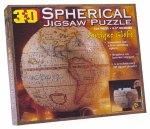
The retained image is packaging, not a new photograph of an assembled or tested model. Its antique appearance also does not tell us the date or cartographer of every source chart.
Read antique artwork as a historical interpretation
Decorative lettering, symbols and coastline drawings invite close looking. They should not be treated as current borders, navigation instructions or a complete record of how the world is understood today.
Compare one visible place with a current map. Ask what each image emphasizes and what is left out. If a small label cannot be read confidently, record that uncertainty rather than supplying a name from memory.
Compare two maps of one place
Choose a readable historical map and a current reference showing the same region. Write three headings on paper: labels, symbols and missing details. Record one observation under each, including the date of each map if supplied.
Then choose one question the comparison raises. An observation such as “this name is different” can become a research question without guessing why it changed. This independent Toysit activity needs no spherical puzzle.
The historical record
Original Toysit coverage
The complete original product description and globe-learning essay remain below. The essay’s suggestion that users can feel geographic contours is not established for this printed puzzle. Its broad educational claims and use as a modern reference should not be read as verified properties of Antique Globe.
Spherical 3D Jigsaw Puzzle: Antique Globe by Buffalo Games, Inc.
No ordinary jigsaw, this puzzle assembles into a 9.5-inch globe with a surface image created from old mariner's charts. To enable freestanding rigidity, the extra-thick cardboard pieces are designed to fit together a mite more snugly than typical puzzle pieces. There are two construction methods: tough (use the numbers and arrows on the back of each piece as a guide) and really, really tough (just use the map image on the front). The specially designed trap door at the north pole allows you to master the fiddly but oh-so-satisfying last piece. Cardboard base and full instructions are included. A recreation of antique sailing charts, capturing the spirit of adventure of a time gone by.
A spherical 3D jigsaw puzzle of the globe serves as an exciting and multifaceted educational tool. Beyond the basic joy and challenge of solving a puzzle, this unique format allows children and adults alike to gain a tangible understanding of Earth's geography. Users can physically feel the contours of continents and oceans, and often the puzzles are designed with additional details such as country borders, capitals, and major landmarks. This hands-on experience provides a more memorable way to learn about our planet than simply looking at a flat map. Moreover, the act of piecing together the globe can improve spatial reasoning, hand-eye coordination, and problem-solving skills. The completed 3D globe also serves as a great visual reference point for discussions about world cultures, geopolitics, and environmental issues.
Sources and editorial notes
The retained package and Buffalo Games’ 2001 catalog identify Antique Globe, item 153. The manufacturer-authored catalog was read through its archived PDF text; direct downloads from the archival hosts returned 403, so the catalog artwork was not visually checked. No exact assembly sheet was secured. Back-of-piece numbers, arrows and north-pole closure details remain original-review claims, not a reconstructed procedure. No physical puzzle was tested.
- Buffalo Games 2001 product catalog — Manufacturer catalog on an archival host; Antique Globe item 153. PDF text inspected; direct download returned 403.
Images and descriptions are retained as historical material. How Toysit covers toys.
Created for Toysit by Tabbloza — the artwork in our header.