
From the Toysit archive
Spider-Man Puzzle Maze
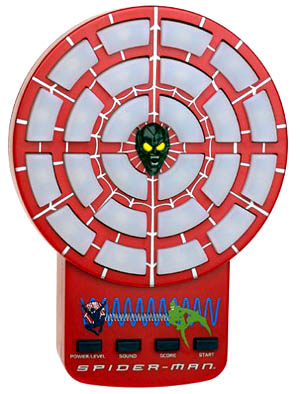
Explore the red web design of the pictured Spider-Man maze, then draw a three-landmark route for an imaginary superhero message.
The play at a glance
A web of paths around a green face
Red rings and spokes surround a green villain face in this Spider-Man puzzle’s circular web. Silver-colored panels fill the spaces between the red paths, and a row of four buttons sits below the web beside Spider-Man and Green Goblin artwork.
The design turns a maze into a superhero scene: the eye follows a ring, finds a connecting spoke and moves toward the middle. It is also a lively starting point for drawing a route and imagining why a hero needs to travel it.
Look at how the web is arranged
The circular layout supplies two kinds of lines to follow: rings going around the center and spokes linking one ring to another. The red framework and pale panels make those changes of direction easy to pick out in the photograph.
Look first at an outer section, then choose a nearby junction and describe where it leads in the picture. Words such as around, inward and outward help a partner follow the same visual route. For play on an original electronic unit, use instructions that match its model and control layout.
Try a web-route message
This original Toysit paper activity uses the web motif to create a small adventure.
- Draw three large rings and several spokes joining them. Leave enough room to trace a path with a pencil.
- Mark three landmarks: a rooftop mailbox, a clock tower and a meeting point. Give each a simple symbol.
- Invent a message that needs to travel from the mailbox to the meeting point by way of the clock tower.
- Trace a continuous route along your drawn web. Tell a short story at each landmark as the message moves.
- Mark one section as temporarily closed. Find a second route, or redraw a connection if your map needs another way through.
The landmarks, message and route rules belong to this paper activity. A partner can design the next map and choose the destination.
Make the route easy to explain
Try giving directions while a partner follows with a finger on the paper: move around the outer ring, take the next spoke inward, then stop at the clock tower. Change one direction and see how it changes the journey. Finish by giving the completed map an adventure title.
The historical record
Original Toysit coverage
The original product account and commentary are preserved below as historical coverage.
A great toy for a spiderman fan.
A great way to spend time on a long car trip, this spider-man maze puzzle will keep you busy for hours.
An electronic maze puzzle offers a modern twist on the classic labyrinth game, delivering an engaging and stimulating experience for players of all ages. The electronic elements can include lights, sounds, and even vibrating feedback, enhancing the overall sensory experience and making each level or stage more immersive. The digital format often allows for multiple difficulty settings and can feature obstacles that move or change, requiring strategic thinking and hand-eye coordination to navigate successfully. Moreover, some electronic maze puzzles come with built-in timers or scoreboards, adding a competitive edge that encourages players to improve their skills. The feeling of accomplishment upon successfully completing a challenging course adds to the enjoyment. Overall, the combination of tactile engagement, strategic problem-solving, and digital enhancements make electronic maze puzzles a highly entertaining activity.
Sources and editorial notes
This profile is based on the original Toysit photograph and text. The visible labels POWER/LEVEL, SOUND, SCORE and START are transcribed from the photograph; a matching operating manual, maker/model identification and exact function sequence were not recovered. The RadioShack 60-2707 3D-game guide found during research describes a different game and was excluded. Both original ASIN values remain preserved. The archive’s discussion of vibrating feedback, moving obstacles and timers describes electronic mazes generally and is not established for this unit. No battery, repair or gameplay procedure is inferred from the image. The paper route is an original editorial activity, with no physical testing claimed.
- Original Toysit image — Existing same-site photograph reviewed and retained unchanged.
- Original Toysit coverage — Complete original product account and historical commentary preserved.

Images and descriptions are retained as historical material. How Toysit covers toys.
Created for Toysit by Tabbloza — the artwork in our header.