
From the Toysit archive
Spy Pen
A silver pen and fitted case of attachments invite a pretend investigation, with an original museum label mystery.
The play at a glance
The first clue fits on a little label
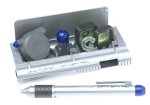
A silver pen lies beside an open fitted case, with tiny tools tucked into their own places. It looks like a miniature investigator’s desk folded into a pocket kit. The pen gives a pretend mission something satisfyingly ordinary to begin with: a written note about an object right in front of you.
A case of tools and a page of observations
The original packaging presents the XP-4 as a working pen with attachable viewing and light tools. The fitted case makes arranging the pieces part of the appeal: a player can imagine choosing equipment for a small investigation, then returning it to its place.
Keep the mission on an agreed tabletop in ordinary room light. An adult should check the pieces and matching instructions before fitting attachments. The package reserves bulb installation and replacement for adults because of sharp points, and warns against looking at the sun through the optics.
Make a museum label mystery
Choose three familiar objects, such as a wooden spoon, a toy car and a large smooth block. Pretend they belong in a tiny museum. Give them invented exhibit names: “The Soup Explorer’s Paddle,” “The Midnight Delivery Van” and “A Stone from the Square Mountain.”
Write one short clue on a separate label for each object. Include a visible detail alongside the imaginary history: “Its four wheels carried letters through the rain.” A willing partner reads the clues and pairs each label with an exhibit. If a matching, checked viewing attachment is available, try it on an agreed object before describing a detail.
After the labels are matched, write a two-sentence curator’s report. One sentence records something you really saw; the other adds a made-up adventure. Exchange roles and invent a new exhibit title for the same object. An ordinary pen or pencil works for the whole mystery, too.
The historical record
Original Toysit coverage
The complete earlier product account and commentary are preserved below as historical coverage.
Converts from ordinary pen into cool spy tools.
Converts from ordinary pen into cool spy tools! This is no ordinary pen! It's actually a top-secret spy tool kit! Scope snaps onto pen for spying long-distance or magnifying close-up. Light sensor motion alarm protects stuff from intruders. Light tube bends light to read and write or use the flashlight to snoop in the dark. Spy tools all fit into the pocket-sized case.
A spy pen adds an element of intrigue and excitement to the ordinary act of writing, blending everyday functionality with the allure of espionage. These pens often feature built-in cameras, audio recorders, or other high-tech functionalities that allow kids to play the role of a secret agent, gathering "intelligence" in a discreet manner. The pen's dual purpose as a writing instrument and a spy gadget makes it a versatile toy that can be used in various scenarios, from classroom note-taking to secret backyard missions. This unique combination captivates children's imaginations, encouraging them to think creatively and strategically while having fun. The spy pen exemplifies how a simple object can become a gateway to a world of adventure and exploration.
Sources and editorial notes
Front and back photographs of original XP-4 Spy Pen 70035 packaging match the pen, case and attachments shown here. They document the scope, light-sensor alarm, flashlight and light tube, and mark ages 6 and up. The complete instruction sheet was not recovered. The later historical essay’s camera and audio-recording generalization is not established for this XP-4 toy. Packaging claims about protecting belongings are play marketing, not verified security. The label mystery is an original Toysit activity; no physical testing was performed.
- Original Toysit image — Existing same-site image reviewed and retained unchanged.
- Original XP-4 Spy Pen packaging photographs — Manufacturer-printed front and back of item 70035 reviewed in a collector listing; package evidence, not seller specifications or a complete manual.
- Original Toysit coverage — Complete historical account retained, including its original claims and wording.

Images and descriptions are retained as historical material. How Toysit covers toys.
Created for Toysit by Tabbloza — the artwork in our header.