
Play ideas to start with
Make a mystery with willing players, visible clues and an ending you invent together. These historical profiles offer observation reports, paper puzzles and shared performances that keep the scene inside the agreed game.
Explore earlier toys through their play ideas and historical context. Each article explains its evidence and edition limits; these selections are reading routes, not a current buying list.
Notice a detail and make a clue
Historical profile and play idea
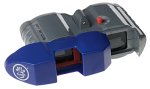
Send a tabletop lookout report
Arrange three paper landmarks in an agreed scene, sketch a visible detail from each, and let a partner change one detail for the next report.
Spy Binoculars
Historical profile and play idea
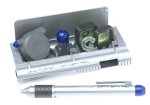
Solve a museum label mystery
Give three familiar objects invented exhibit names, match their clue labels with a willing partner, and separate an observed detail from its imaginary history.
Spy Pen
Give the mission a friendly ending
Historical profile and play idea

Draw an imaginary mission debrief
Make Path, Sound and Code boxes on paper, invent a ticket-delivery mystery, and label the report as an imaginary mission.
Spy Gear Safe Cracker
Historical profile and play idea
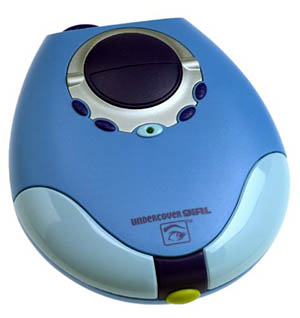
Write a two-agent radio play
Trade spoken clues and written replies about a missing picnic invitation, then perform the fictional dialogue together in ordinary voices.
Undercover Girl Secret Listener
Explore the collection
Find a closer look at each toy, activity or historical report, grouped by what you would like to explore. The original index remains below with its earlier titles and wording.
Optical observation histories
Clues, alarms and game stations
Listening-device histories and shared performance
Make the mystery a shared game
The most useful starting point for spy play is a mission everyone has agreed to: find a paper clue, decode a message or identify an object from a drawing. Choose the activity first, then decide whether a prop adds anything. A notebook and a few clue cards can support a whole afternoon’s story.
Keep the mystery inside the game. Agree on the play area, who is participating and which objects may be handled. Private conversations, belongings and rooms are outside the mission. A toy marketed for spying is not permission to listen to, photograph or record someone without their agreement.
Compare the kinds of detective play
| Type | Play to look for | Questions to ask |
|---|---|---|
| Pretend props | Badges, notebooks, cases and role-play equipment. | Can the child carry, open and put away the pieces? |
| Codes and puzzles | Matching symbols, sequences and clue trails. | Does the reading level fit? Can someone offer a hint? |
| Observation tools | Looking closely at agreed objects or a prepared scene. | What do the optics actually do, and what do the instructions prohibit? |
| Electronic gadgets | Alarms, lights or communication within a planned game. | Does it record, transmit or require an app? What works without a service? |
Check the exact model’s age label, parts, battery compartment and instructions. A “night vision” or “smart” name does not establish how a device works. Identify its actual light source, sensor and functions. Do not substitute household chemicals, lasers or improvised traps for a manufacturer’s activity instructions.
Try a paper clue trail
- Choose three visible places in one agreed room. Keep exits and walking routes clear.
- Draw a different symbol on three cards. Make a separate key matching each symbol to a place.
- Put a clue at each place that points to the next. End with a drawing or a message from a fictional character.
- Take turns being the clue maker and detective. Offer a hint whenever someone wants one.
For a younger participant, use pictures and solve together. For a reader who wants a challenge, add a simple substitution code with the full key supplied. Change one part at a time so you can tell whether the puzzle is enjoyable or just confusing. Everyone should be able to stop or change roles.
Explore Puzzles for more matching and reasoning activities, or Board Games for a mystery with shared rules. For observation and experiment kits, see Science Toys.
Check what a gadget collects
Before introducing a microphone, camera or connected app, determine whether it merely plays sounds, records locally or sends information elsewhere. Read the current privacy information and find the controls for accounts, permissions and deletion. Ask what remains usable if the app disappears or the network is unavailable. A simple prop may suit the same story without setup.
The FTC’s guide to children’s online privacy explains parental choices about information collected by covered sites and services. Toysit’s Kids Electronics guide covers everyday device choices, while AI Toy Guide separates connected features from claims about artificial intelligence.
Read the archive in its original context
The older collection includes listening devices, optical toys, alarms and books. Their original descriptions are preserved below, including dated promotional language about eavesdropping and safety. Those words document how the products were presented; they are not instructions for today’s play.
Use an exact model number to find current instructions before using an older gadget. Missing instructions, unknown light sources or an unsupported app are reasons to choose a simpler activity while you investigate. Keep personal photographs, real passwords and other people’s information out of a pretend mission.
From the Toysit archive
Earlier coverage, with original titles and descriptions preserved as historical material. These descriptions include the promotional wording and claims of their time; they are not current operating instructions, safety assurances or product recommendations. Availability, pricing and app support have not been reverified. Identify the exact model and consult its current instructions and recall information.
- Clue Secrets and Spies - Six agents with one mission: stop Agent Black - decode secret messages and get text messages on your phone.
- Night Vision Goggles - Spy Vision for kids.
- Password Journal - Girl Tech : Excellent toy for a girl with a diary
- Spy Gear Safe Cracker Wild Planet interactive electronic game system that challenges matching skills, hand steadiness, and patience.
- Spy Binoculars - Sleek binoculars with 3X power optics.
- Spy Listener Eavesdropping Toy - Secretly hear up to 30 feet away.
- Spy Pen - Converts from ordinary pen into cool spy tools.
- Night Vision 2.0 - Binocular night vision goggles that enable you to see up to fifty feet in total darkness.
- Night Vision Infrared Stealth Binoculars -Spynet surveillance goggles.
- Spy Gear Laser Tripwire Wild Planet Spygear lazer trip wire protects your stuff with the kind of light beam system that banks and museums use.
- Spy Vision Scope - Head-mounted telescope and light have tools that automatically spring into position with a push of a button.
- Supersonic Ear - Electronic listening device with detachable microphone.
- Undercover Girl Secret Listener - Room Gear Secret Listener Spy Gear by Wild Planet.
Earlier product and book descriptions
These four descriptions are retained in full as historical coverage. Their promotional claims about safety, performance and eavesdropping are not present-day advice.
Spy Case with Rear-view Glasses: Everything for the super sleuth on the go. Sleek black nylon case contains binoculars, magnifying glass, fingerprint powder, brush, flashlight, secret marker pen set and a printed spy guide. This exclusive Imaginarium.com version also includes a cool pair of rearview glasses with specially treated lenses that allow you to see what is behind you without turning around. Can be carried by the handle or looped through the belt.
Spy Pen: This spy pen set will please young secret agent wannabes with its sleek silver design and multiple functions that transform a working pen into a light-activated motion alarm, a flashlight, or a magnifying glass with both long-distance and close-up magnification lenses. The set includes a sturdy, silver plastic case to hold all the different components, including the large pen that slides into the side of the case. The end of the pen unlocks the storage case, providing another secret function that kids will like. The pen's motion alarm is its best feature, with a nonthreatening beeping sound that won't be too loud for the parents or younger siblings. A clearly written instruction sheet explains all the secret spy functions, augmented with diagrams that will help even the nonmechanical parent outfitting a junior spy.
Spy Science: 40 Secret-Sleuthing, Code-Cracking, Spy-Catching Activities for Kids - From invisible ink to listening devices, super projects for playing spy. Here's the book that shows kids how science is involved in the fascinating field of espionage. Spy Science contains 40 scientifically sound activities kids can do to explore the world of spies, from building a periscope to learning Morse Code -- and even visiting the CIA's home page on the Internet! Whether they're mastering spy tricks and techniques, making special spy gadgets, or sending secret messages, kids will have fun learning science. All activities are safe, easy to do, and require only common household materials Includes tons of delightful illustrations and dozens of ideas for More Fun Stuff to Do Spy Science in Action sections show kids how the science they've learned is used in real-life.
Spy Tool Kit: This handy blue briefcase contains every tool a budding agent needs to root out any secret. The most vital piece of equipment is a listening device that amplifies distant sounds, perfect for eavesdropping. Simply plug in the earphones, unfold the microphone, and point it at your target. Press the button, and you can hear every whisper. The kit also includes a penlight and a combination telescope/microscope that can be attached to the listening device for more advanced espionage activities. Agents can keep track of everything they see and hear in the included notebook.
A guide to evaluating toys, not a hands-on product test. Read our editorial approach.
Created for Toysit by Tabbloza — the artwork in our header.