
From the Toysit archive
Tekno Dinkies
Explore Tekno Dinkies through their expressive displays, sounds and movement, with the original 2003 coverage and a face-symbol story activity.
The play at a glance
A small display can give a robot a big personality
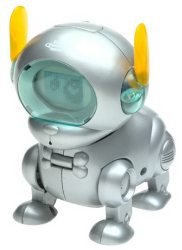
Tekno Dinkies combines a moving character with changing screen expressions and sounds. The dog-shaped member in Toysit’s original photograph belongs to a family whose different bodies give the same broad idea several forms.
The interesting play sits between what the toy shows and what the player imagines. A pair of sleepy eyes can suggest the next scene in a story, while still being a programmed display.
Observe three different things
- The display
- Describe the visible shapes before assigning an emotion: open eyes, narrow eyes, a symbol or an animation.
- The action
- Record movement or sound separately. A face and a motion can contribute different clues.
- The story
- Decide what those clues could mean for the character in an invented scene.
Keeping these layers separate makes room for more than one interpretation. Two players might see the same expression and imagine different reasons for it.
What the controls and sensors contribute
The guide identifies sound and motion sensors, an LCD, menu buttons and a walking switch. It describes status, energy and “anti-virus” activities within the toy’s game. Those changing displays represent designed play states, not evidence of genuine illness or malicious software.
A status number can help drive a character’s performance without measuring a real feeling. Likewise, responding to a noise does not by itself show that the words were understood.
Read the old internet feature in its own time
The manual’s web interaction used sound from a computer’s speakers for the nearby toy to hear. That description is different from a robot having its own internet connection.
The old service is historical context. An expression game or an invented conversation does not depend on recovering it, signing in anywhere or making an old robot communicate with a modern app.
Make an expression diary
- Draw three small faces using only eyes, eyebrows and a mouth.
- Label three columns: visible display, accompanying action, and invented story.
- Choose one face and describe its shapes in the first column.
- Add an imagined action, such as a pause or a turn, in the second column.
- Let two people write different story explanations for the same face and action.
These are your own symbols, not a replacement Dinkie display chart. Ask which small change makes an expression easier to read, and whether every viewer agrees.
The historical record
Original Toysit coverage
The complete September 16, 2003 coverage remains below, including its repeated descriptions and family-member labels. Claims about intelligence, feelings and two languages reflect the original presentation. The guide describes a progression from the robot’s own sounds to recognizable words; it does not establish fluency in two human languages or learning a child’s vocabulary. The family’s movements are not identical: the guide distinguishes the baby’s rocking from the walking members.
Tekno Dinkies
The Tekno Dinkie robot walks along with turning its head and moving its arms. Each robot has a unique personality. The Tekno Dinkie robot comes with artificial intellgence that allows it to speak two languages interact with other Dinkie robots.
Tekno Dinkie Robot: Dog - The Tekno Dinkie robot walks along with turning its head amd moving its arms. Each robot has a unique personality. The Tekno Dinkie robot comes with artificial intellgence that allows it to speak two languages interact with other Dinkie robots. The Dinkie Robots are a family (a real, traditional family with a father, mother, three children, and the requisite family dog) of walking and talking robots. Designed by the same team that created the popular Tekno the Robotic Puppy, each member of this diminutive troupe of battery-powered characters is equipped with a micromotor drive to animate their head and limbs, an array of audio and visual sensors, and its own specific "artificial intelligence software tendencies." The result of all this advanced digital technology and microcircuitry is a set of moving, interactive toys that respond and react to how they are being played with by walking, moving their arms, turning their heads from side to side, and occasionally singing or speaking aloud. There are literally hundreds of functions, expressions (appearing on each unit's animated LCD screen), and movements that can be triggered, many of which are not even revealed within the multipage owner's manual. As a result, more than half the fun of these interactive robots is just waiting to see what will happen next.
Tekno Dinkie Robot: Boy
Tekno Dinkie Robot: Girl
Tekno Dinkie Robot: Baby
Sources and editorial notes
The twelve-page PDF of the Toy Quest Dinkie owner’s manual was visually reviewed in full. Its dog diagram matches the family member in the original photograph; family-level descriptions are kept separate from body-specific movement. The historical website interaction is not presented as a working current service. No toy, expression sequence, sensor or language ability was tested. The expression diary is an independent drawing and storytelling activity.
- Toy Quest Dinkie owner’s manual — Manufacturer scan preserved by The Old Robots; family diagrams, displays, sensors and play modes.
Images and descriptions are retained as historical material. How Toysit covers toys.
Created for Toysit by Tabbloza — the artwork in our header.