
From the Toysit archive
Tyco Terrain Twister
Understand Terrain Twister’s corkscrew pontoons, sideways driving and surface-dependent movement in the original Tyco design.
The play at a glance
A sideways move can be the intended move
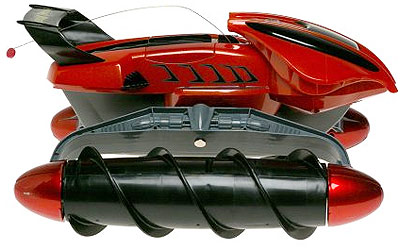
Terrain Twister replaces ordinary wheels with two large corkscrew-shaped pontoons. That changes what a useful driving instruction looks like: on a smooth surface, moving sideways is part of its documented operation.
Begin by identifying the vehicle’s front, the direction control and the pontoon-angle control. Then compare your expected path with one short movement.
Read the two controls as different jobs
The manual gives the left control eight movement directions and the right control the job of changing the PowerScrews’ angle. Its diagrams show how these inputs combine.
- Left control
- Select the direction shown in the driving diagram.
- Right control
- Change the pontoon angle rather than treating this as an ordinary steering wheel.
- Both together
- Consult the combined-control diagrams after the separate inputs are familiar.
Point to the intended direction before driving. Keep the vehicle’s front in mind even when you stand beside it. An observer can sketch the path while the driver concentrates on the controls.
Let the surface explain the result
The guide says smooth surfaces such as tile, pavement and hard flooring do not give the screws enough traction for straight-ahead driving. It directs the player to sideways driving there. Low-pile carpet can also produce some drift.
For a first observation, choose a clear, permitted surface and make one short sideways move using the guide. Stop before changing the input. Describe the direction the vehicle actually traveled, rather than treating every unexpected angle as a fault.
Record the surface with the result. Comparing a remembered movement from another floor without noting the floor can hide the most useful difference.
Try a direction sketch
Draw the vehicle from above and mark its front. Add an arrow for the path you want to try. After the run, draw the observed path next to it. Keep the two drawings even if they disagree.
Try the same short input from the same starting position before changing several things at once. Ask whether the difference was in your chosen control, the vehicle’s orientation or its contact with the surface. This is an observation activity, not a measured test of all-terrain performance.
A useful finish is being able to explain one movement to another player. There is no need to add a difficult transition between surfaces.
Keep water claims in their original context
The guide permits water operation only under its stated conditions, including calm fresh water, a properly latched compartment and a dry transmitter. It also specifies draining and drying after use. Those instructions do not establish the condition of an old seal or latch.
The dry-surface activity above is enough to explore the mechanism. Before any other use, read the full operating guidance and the instructions belonging to the actual battery pack and charger. Match the equipment rather than transferring assumptions from a newer Terrain Twister.
The historical record
Original Toysit coverage
The original product description and general all-terrain RC essay remain below. Their absolute terrain and water-tightness language is historical promotional copy, not a guarantee about a surviving vehicle. The matching-era guide describes surface-dependent behavior and specific limits; later Hot Wheels versions are not the basis for this profile.
Tyco RC vehicle with corkscrew treads and pivoting pontoons treks through grass, dirt, sand, water, and snow
This awesome vehicle features Power Scew Technology. Go through all terrains from dirt to sand over grass shreds through snow and water too. And spins into any direction. In all seasons, Tyco RC's newest radio control vehicle can tackle any terrain. Featuring sleek pivoting pontoons with unique corkscrew treads, the Terrain Twister vehicle makes its way over almost any surface. Grass, sand, pavement, water and even snow can't stop Terrain Twister, so whether kids are at the beach or in a snowy backyard, the fun never stops. The Terrain Twister vehicle's special corkscrew design allows it to churn straight through even the toughest terrains while also allowing it to glide quickly sideways across most surfaces. In addition, the Terrain Twister is water tight for aquatic driving. The transmitter has been designed for easy maneuvering in all directions.
All-terrain R/C (Remote Control) vehicles are an exhilarating way to explore the outdoors and satisfy the inner adventurer in both kids and adults. These rugged machines are designed to tackle a variety of terrains, from rocky trails to muddy paths, sandy beaches, or even snow-covered landscapes. Their powerful motors, sturdy tires, and advanced suspension systems provide exceptional stability and control, making them capable of conquering challenging environments. The thrill of maneuvering these vehicles over rough terrain or through obstacles, performing daring tricks, and racing with friends amplifies the enjoyment. Additionally, the remote control aspect allows for skill development and fosters a sense of excitement as you navigate your R/C vehicle through diverse landscapes, making it a perfect pastime for those who crave outdoor adventure and hands-on fun.
Sources and editorial notes
Reviewed October 16, 2026 against the original photograph, retained ASIN B00027P7RC and Mattel’s B5119 support record. Its linked 2004 Tyco manual bears document number B5118-0720 and depicts the matching pontoon design; operating diagrams were visually reviewed. The photograph does not establish an exact frequency variant. No vehicle, seal or power system was physically tested.
- Mattel: original Tyco Terrain Twister instructions (PDF) — B5118-0720 guide linked from the B5119 product record; controls, surface behavior and care.
- Mattel: Tyco Terrain Twister B5119 product record — Identifies the 2004 Tyco edition and links its instruction sheet.
Images and descriptions are retained as historical material. How Toysit covers toys.
Created for Toysit by Tabbloza — the artwork in our header.