
From the Toysit archive
Trivial Pursuit Millennium Edition
A circular board, colored wedges and photograph questions give Millennium Trivial Pursuit a tableful of subjects to explore.
The play at a glance
A question can send the conversation somewhere new
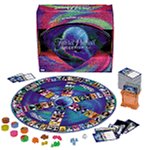
Millennium Trivial Pursuit lays out a circular route with spokes leading to a central hub. Colored wedges collect in the scoring pieces, while cards and a transparent holder sit beside the board. The retained photograph shows the set’s bright rainbow accents; the original review describes its collectible wedge-shaped tin.
Imagine a table moving from a place to an invention, then to a remembered performance. Each question offers a fresh subject, and a photograph card gives everyone answering something to look at together.
Six subjects around the circle
The booklet’s categories are People & Places, Arts & Entertainment, History, Science & Nature, Sports & Leisure, and Wild Card. Players or teams roll the die and move toward category headquarters, where a correct answer earns the matching colored wedge.
A correct answer continues the turn. With all six colors collected, a player returns to the hub by exact count for a final question in a category chosen by the other players.
Let the picture join the question
For photograph cards, the reader holds the card so the people answering can see the image. The booklet places the answer beside the question; text-only cards use the opposite side. Keeping the image visible makes the shared viewing part of the turn.
The rules invite players to agree on answer timing and how precise an answer must be. They also offer a shorter game using four or five wedges. Those choices let a group settle the evening’s format before the first roll.
Try it: our table’s mini-millennium
After the boxed game, create a small original Toysit question round. Each person chooses an event, invention or place and checks a reliable source, such as a museum, library or official reference page.
- Write one question in your own words, with an answer supported by that source.
- Add a gentle hint and record the source title or link.
- Read the questions aloud, then share each answer and its source.
Use a separate homemade score sheet, or simply collect a tableful of interesting discoveries. If a question concerns something that can change, add the year it describes. A few thoughtfully chosen questions can become a keepsake of what interested your group.
The historical record
Original Toysit coverage
The original product account and commentary are preserved below as historical coverage.
Great version of trivial persuit.
For the true Trivial Pursuit connoisseur! This fantastic version of the tremendously popular original celebrates the facts and follies of the past 1,000 years. Moving around a circular track, players collect wedges for correct answers to questions such as: What island do most of the North Atlantic icebergs come from? What South African described meeting the Spice Girls as one of the greatest moments of my life? How many men have walked on the moon? The remaining 3,597 questions (including those on 105 full-color photo cards) are housed in a collectible wedge-shaped tin package (10 inches by 13 inches)--along with the folding game board (18.5 inches in diameter), die, colorful transparent card holder, scoring wedges, and wedge holder. Players make their way to the hub through six categories of queries in hopes of answering the game-winning question. Don't wait till the next millennium for fun like this! For two to six players or teams.
Trivial Pursuit, first introduced in 1979, achieved unprecedented success that turned it into a cultural phenomenon. Its ingenious combination of general knowledge questions spread across various categories appealed to a broad audience, fostering social interaction and a competitive spirit. Unlike traditional board games that often relied on luck, Trivial Pursuit required a combination of knowledge, memory, and strategy, giving players a sense of intellectual accomplishment when they succeeded. The game's versatility—offering editions tailored to specific themes, age groups, and interests—has helped sustain its popularity over the decades. Moreover, the game's integration into digital platforms and collaborations with pop culture franchises have kept it relevant. Its wild success can be attributed to its capacity to entertain while also stimulating the mind, and its adaptability to the changing tastes and technologies of society.
Sources and editorial notes
All five pages of Hasbro’s Millennium booklet, marked 40928-1, were reviewed. It confirms the categories, photo-card handling and two-to-six-player/team format. The 3,600-question total, 105 photo cards, tin material and dimensions are retained claims from Toysit’s original review, not independently confirmed by this booklet. Historical answers reflect their edition; the original 1979 origin claim was not independently established. The mini-millennium activity is editorial; no physical testing was performed.
- Original Toysit image — Existing same-site photograph reviewed and retained unchanged.
- Hasbro Trivial Pursuit Millennium rules (PDF) — All five pages visually reviewed, including categories, photo questions, winning and shorter-game guidance.
- Original Toysit coverage — Complete original product account and historical commentary preserved.

Images and descriptions are retained as historical material. How Toysit covers toys.
Created for Toysit by Tabbloza — the artwork in our header.