
From the Toysit archive
Playskool VideoNow Jr.
Meet Playskool VideoNow Jr.’s large colored buttons and PVD viewing pattern, with an original stop-go puppet-show activity.
The play at a glance
Big colored buttons around a little show
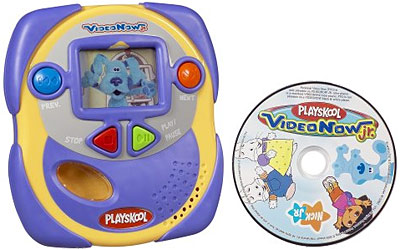
A yellow frame surrounds the screen, while blue, orange, green and red buttons make a bright border around the action. The pictured VideoNow Jr. has the rounded shape of a little carrying case. Its large playback controls give the viewer a clear set of choices: begin, pause, revisit or finish a show.
A different color for each viewing choice
The manufacturer’s guide identifies green as Play/Pause, red as Stop, blue as Previous and orange as Next. Two Open switches slide outward to release the player. With a suitable PVD seated and the case closed, the green button starts playback and can pause it for a moment.
Previous can bring the current track back to its beginning; pressing it twice goes to the preceding track. Next moves ahead. The guide includes both color and black-and-white VideoNow discs in the player’s repertoire, with older monochrome pictures retaining that appearance.
That pause-and-return pattern can become a shared conversation. A companion might ask, “What was the character looking for?” or “Which object did you notice by the door?” Let the child’s observation set the direction. Follow the matching guide for the actual player; an adult should supervise headphone use, including keeping its cord away from a child’s neck.
Direct a stop-go puppet show
Bring the four-button idea into a small live performance. This original Toysit activity uses drawings or ordinary puppets and large paper cue cards.
- Make four cards: green for play or pause, red for finish, blue for revisit and orange for move ahead. Add words or symbols alongside the colors.
- Invent three short scenes: a rabbit loses a picnic basket, asks a neighbor, then discovers the basket beside a tree.
- One person acts as the performer and another holds up the cue cards. Agree that showing green during the action means freeze; showing it again means continue.
- Use blue to repeat the current scene from its beginning. Use orange to jump to the next scene. Let red bring the performance to a friendly close.
- Swap jobs and change the missing object. A repeat might reveal a clue the audience overlooked the first time.
These are rules for the paper performance, inspired by the player’s colored controls. The director and performer supply the story, its timing and its funny surprises.
The historical record
Original Toysit coverage
The complete earlier product account and commentary are preserved below as historical coverage.
Junior version of the popular Playskool portable video disc player has big buttons for ease of use by preschoolers
A portable full-color personal video player. Entertains and educates kids while on the go, anytime, anywhere. Video Now Jr. has big chunky buttons and is tough enough to withstand the bumps of daily preschool use. Junior, a friendly on-screen character, instructs kids on how to use their player.
Personal video players have come a long way since their inception. The journey began with the introduction of the Sony Walkman in 1979, which revolutionized portable audio playback. However, it wasn't until the late 1980s that personal video players started to emerge.
In 1988, Sony introduced the Watchman, a handheld television that allowed users to watch broadcast television on a small, built-in screen. This marked the early days of portable video entertainment.
Fast forward to the early 2000s, and we witnessed the rise of DVD players designed for personal use. Devices like the Panasonic DVD-L10 and the Archos Jukebox Multimedia paved the way for on-the-go video playback. These early models had limited screen sizes and battery life but hinted at the potential for portable video consumption.
With the advent of smartphones in the late 2000s, personal video players evolved drastically. Devices like the iPod Touch and later smartphones with larger screens allowed users to carry their entire video libraries in their pockets. Streaming services like Netflix and YouTube further transformed the landscape, enabling users to access a vast array of content on the go.
Today, personal video players have merged with smartphones and tablets, offering high-resolution screens, extended battery life, and access to a multitude of streaming platforms. The evolution continues with advancements in display technology, virtual reality, and augmented reality, promising even more immersive and portable video experiences in the future.
Sources and editorial notes
The full four-page Playskool/Hasbro 74407 guide, P/N 6366580200, and its control diagram were reviewed. It describes Jr. and other VideoNow PVD playback in this player; that statement does not establish the reverse compatibility of every other model. The original account’s Junior helper and durability claims remain attributed to that account. Its portable-TV chronology is also retained: a museum record dates Sony’s FD-200, described as a Watchman forerunner, to 1982, earlier than the archive’s 1988 starting point. No physical testing was performed.
- Original Toysit image — Existing same-site image reviewed and retained unchanged.
- Hasbro: Playskool VideoNow Jr. instructions (PDF) — Four-page 74407 guide; full text and control diagram reviewed.
- Cultural Heritage Online: Sony FD-200 — Shizuoka University museum collection record, in Japanese, dates this Watchman forerunner to 1982; context for the preserved chronology.
- Original Toysit coverage — Complete historical account retained, including its original claims and wording.

Images and descriptions are retained as historical material. How Toysit covers toys.
Created for Toysit by Tabbloza — the artwork in our header.