
From the Toysit archive
Water Radio
Explore the Water Radio’s yellow control unit and separate speaker, its historical Aqua Radio context, and an original Harbor Radio storytelling broadcast.
The play at a glance
A yellow sound station with a second speaker
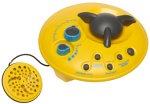
The Water Radio looks like a small yellow control deck. Two blue controls sit on one side, a row of little buttons curves around the front, and a separate round yellow speaker connects by a dark lead. The original account presents music and deep-sea sound effects as ways to give a pool scene its own soundtrack.
Music and effects as scene setters
A contemporary U.S. Customs description of Wild Planet’s Aqua Radio documents a battery-operated FM receiver with an above-water speaker and an underwater speaker. It also lists four effects: Marco Polo, submarine sonar, a race start and dolphins. That record helps explain the older toy’s sound-play premise, while leaving the exact controls and instructions of the photographed example unresolved.
A short sound can change an imagined setting. A soft “whoosh” suggests waves; a gentle “ding” might announce a boat’s arrival. A presenter supplies the place and the characters, and a sound-maker decides when the next cue belongs. This turns listening into a shared little performance.
Try Harbor Radio
Draw three cue cards: waves, a boat arriving and a gull. One player is the presenter and another makes quiet sounds with their voice. Begin with a station greeting such as “Welcome to Harbor Radio, where the picnic boat is arriving at Lemon Pier.” The sound-maker shows a card and adds its sound after the presenter’s sentence.
Let the broadcast last about a minute. Include an arrival, a small surprise and a friendly sign-off. Perhaps the gull has brought a ribbon for the pier’s opening ceremony. All characters and events belong to your invented harbor.
Swap roles and change the order of the cards. A gull heard before the boat might become a lookout; heard afterward, it could be welcoming the visitors. The whole broadcast uses paper and quiet voices on dry land.
Reading the older water-use claims
Treat an unidentified older electrical toy as a historical object until its own instructions and condition are checked. This page supplies no immersion, charging or underwater-listening procedure. Water supervision remains a separate adult responsibility; an audio device should never be relied on for swimming direction or safety.
The historical record
Original Toysit coverage
The complete earlier account follows as a historical record. Its later essay makes unverified immersion, technology and swimming-safety claims; these are not operating guidance or established features of the pictured radio.
Radio that can float and go underwater.
Hear music above and below the water with top and underwater speakers. Floating radio allows you to bring music into the pool with you. Create your own underwater world with fun games and deep-sea sound effects.
Waterproof music players that float have become an invaluable accessory for aquatic activities and workouts. With water resistance and buoyancy, these compact devices free swimmers, surfers, and beachgoers to enjoy music anywhere without worry. Just clip the lightweight player to goggles, a swim cap, or board shorts and dive in without fear of water damage. The waterproof design ensures crisp audio even when submerged. Some versions even boast bone-conduction tech to transmit sound through cheekbones, bypassing earbuds altogether. Floatable players increase safety, bobbing atop the waves to remain visible. They also prevent headphones from getting tangled during laps. For open water swimming, floating music players provide a sense of security and direction to stay oriented. Their versatility extends poolside for upbeat entertainment at beach bashes or pool parties. As technology improves, waterproof floating music keeps getting better with Bluetooth compatibility, onboard storage, and lengthy battery life. Aquatic adventurers can now soundtrack every watersport or swim session thanks to these buoyant, carefree audio devices.
Sources and editorial notes
CBP ruling H87849, dated January 28, 2002 in its text, describes Wild Planet’s Aqua Radio with two speakers and four effects. This closely fits the old account; the photograph’s exact model label and matching operating manual remain unrecovered. Collector packaging leads were not used as operating instructions. Waterproofing, battery type and present condition are unverified. Bone conduction, Bluetooth, storage and navigation/safety claims in the later historical essay are not established features of this radio. Harbor Radio is an original voice-and-paper activity.
- Original Toysit image — Existing same-site image reviewed and retained unchanged.
- CBP: official text of Aqua Radio ruling H87849 — Contemporary primary product description recovered from CBP’s public text endpoint. Supports the Wild Planet name, FM reception, two speakers and named effects; not a manual or present-condition assessment.
- CPSC Pool Safely: safety tips — General guidance on attentive adult supervision around water. Official text reviewed through the web reader; direct automated access returned HTTP 403. Not product instructions.
- Original Toysit coverage — Complete historical account retained, including its original claims and wording.

Images and descriptions are retained as historical material. How Toysit covers toys.
Created for Toysit by Tabbloza — the artwork in our header.