
From the Toysit archive
Capsela Weather Station
Watch changing conditions, distinguish an indicator from a measurement and keep a short weather log with this modular science toy.
The play at a glance
Give each observation a time and a place
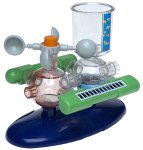
Weather play becomes more interesting when yesterday’s observation can be compared with today’s. The archived Capsela photograph shows a small modular station with wind cups, a collecting cup and a temperature strip.
Begin by finding out what each fitted part can actually show. A spinning cup can make wind visible without providing a calibrated speed reading. Recording that distinction is part of the activity.
Separate movement from measurement
Before writing down a number, look for a scale and its unit. A marked collecting cup may allow a reading; wind cups that merely spin give a different kind of information. In Adafruit’s inspection of Capsela 90, the wind assembly responded to movement of air without providing a numerical wind-speed measurement.
For an uncalibrated indicator, words such as still, turning slowly and turning quickly are more honest than an invented speed. Read any temperature or rain scale using the directions for the actual configuration.
Keep a small, repeatable log
Choose one accessible observation spot and a regular time. Use the kit only in conditions allowed by its instructions. On paper, record:
- Date and time.
- Location and setup: include a sketch if the parts were rearranged.
- What the instrument showed: a reading with its unit, or a plain-language observation.
- What else you noticed: clouds, moving leaves or visible rain.
- What changed: for example, the station was moved or the collecting cup was emptied.
Keep the same setup when comparing days. If you change locations, label that as a different comparison. For a rain reading, note the collection interval so one hour is not mistaken for a whole day.
One arrangement may not do every job
Adafruit’s reviewer found that the Capsela 90 parts had to be rearranged to use some features, including the rain collector and sundial. A box picture therefore should not be treated as proof that every activity can run at once.
Use the matching assembly booklet to identify the intended configuration. Do not assume this station needs a motor or batteries because the original paragraph discusses powered Capsela projects in general.
A weather diary is a beginning
A few entries can show how conditions changed during your observations. They do not establish a local climate trend or make this toy a forecasting system. NOAA distinguishes weather from climate by the time span involved: climate describes longer-term patterns.
End the week by choosing one observation you can support with your notes and one question you would need more observations to answer.
The historical record
Original Toysit coverage
Both original paragraphs remain below. The first describes the wider Capsela system, including motors, batteries, school grades and a warranty. Those claims are not treated as verified specifications or current support terms for this particular station. The later paragraph discusses backyard weather learning generally.
Capsela Weather Station by Educational Insights
The Capsela modular science system provides hands-on learning experiences. Young minds come alive as they improve problem-solving and developmental skills. Instead of just reading about energy or forces, kids discover the fun of science in motion as they actually handle batteries, create motors, and see for themselves how energy changes with the help of visible gears and wheels. Children have fun exploring concepts they use and observe for themselves with Capsela. Each kit contains an easy-to-follow activity booklet that introduces basic science concepts. Step-by-step full-color illustrated assembly instructions make it easy for children in grades 2 and up to quickly master basic science principles while they create fascinating motorized projects. And every Capsela product comes with a full two-year warranty! Grades 2 and up.
Maintaining a backyard weather station provides an engaging hands-on way to teach children about meteorology and the physics behind weather. They learn how various instruments like thermometers, rain gauges, and anemometers work by assembling and monitoring the station daily. Seeing firsthand how temperature and precipitation vary day to day reinforces weather concepts. Recording and tracking the data lets kids analyze patterns, like how winds shift before a storm. Experimenting by placing instruments in sunny versus shady areas or elevated spots introduces variables. Budding meteorologists also get a kick out of creating their own forecasts and seeing how accurate they are. With guidance from parents, maintaining a home weather station fosters curiosity about the natural world. It transforms children into scientists actively applying math and technology to observe and understand the climate in their own backyard.
Sources and editorial notes
The original photograph and text were reviewed on October 15, 2026. Anne Barela’s firsthand Adafruit account of a Capsela 90 Weather Station describes qualitative wind response and the need to reconfigure parts for some activities. It provides a useful comparison, not a matching instruction sheet or proof of this pictured unit’s exact revision. NOAA supplies the weather/climate distinction. No station was physically tested.
- Adafruit: Scholastic Capsela Kits — Firsthand Capsela 90 inspection within Anne Barela’s Automation with Crickit and Capsela guide.
- NOAA NCEI: Weather and Climate — Explains short-term weather observations and longer-term climate records.
Images and descriptions are retained as historical material. How Toysit covers toys.
Created for Toysit by Tabbloza — the artwork in our header.