
From the Toysit archive
Wheels on the Bus Game
Roll a musical yellow bus around town, match its picture cues and invent new stops with an original announcement activity.
The play at a glance
A yellow bus with a song for each stop
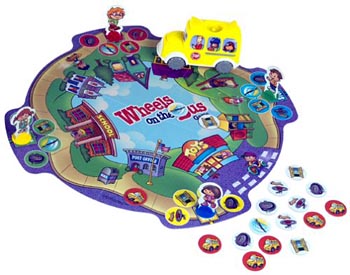
A yellow bus waits on a rounded board full of roads, buildings and colorful stopping places. Small round tokens show parts of the bus, while character pawns mark the players’ stops. Together they make a town-sized journey small enough for the table.
Players roll the bus around the board by hand. At a stop, a press on the hood brings a song cue for a wheel, horn, wiper or door. Everyone can join the movement before the player searches for the matching picture.
A song becomes a picture to find
The reviewed rules give the active player up to two chances to find the requested token. A matching token goes on that player’s bus stop and ends the turn. The first player to collect all four different bus parts wins.
The guide also offers a face-up collecting version for younger players. Keeping the pictures visible makes the song cue and matching picture the focus of the turn. Use your edition’s instructions for repeat requests and the full winning celebration.
Try a new stop announcement
Between rounds, imagine where the bus might go next. This original Toysit activity adds a small town story alongside the boxed game.
- Draw a library, a garden and a playground on three large cards. Add one distinctive detail to each, such as a book return, a tall sunflower or a swing.
- Choose a card and announce the stop in a friendly bus-driver voice.
- Let another player become a passenger. Mime the activity awaiting them: carrying books, smelling a flower or climbing an imaginary ladder.
- Switch roles and rearrange the stops. Give the trip a final destination where all the passengers meet.
A paper bus and spoken sound cues make a fully pretend version. Move the bus from card to card, pause for the announcement and invite a new passenger aboard.
Keep the town ready for another trip
Set the board on a floor or table with room to roll the bus around its edge. An adult can prepare its three AA batteries using the matching guide. Keep the game dry and gather the tokens into the box after play.
The historical record
Original Toysit coverage
The original product account and commentary are preserved below as historical coverage.
Wheels on the Bus Board Game by Hasbro.
The Wheels on the Bus Game will probably drive adults 'round and 'round the bend, with its all-talking, all-singing action, powered by three AA batteries (not included). But designed for 3- to 6-year-olds, this combination of memory game, play-acting, and sing-along fits nicely into Milton Bradley's My First Games portfolio. Players take turns rolling the musical yellow bus to their space on the board. Pressing the hood tells them which of the four tokens (door, wiper, horn, or wheel) to locate by turning over any two of the 20 face-down tokens. Make a match, and keep the token; collect all four, and it's an express ride to the winner's circle.
With its distinctive yellow paint, long rounded shape, and rows of bench seats, the yellow school bus has become an enduring American cultural icon. For generations of kids, the school bus was their first experience of transportation independence from parents, a vessel to adventure and a rite of passage. The yellow color screams caution and visibility, while the bus's utilitarian design speaks to dutiful service transporting children safely.
The yellow bus vividly captures the excitement and anxieties of school activities from field trips to competitive sporting events. The rituals of getting on the bus, choosing a favorite seat, and waving goodbye create shared nostalgia. Songs, stories, and toys have celebrated the iconic bus ride. Images of yellow buses decorated with school pride and kids peering out windows remain a visual shorthand for the American school experience. The yellow bus has even become a symbol of access to education and opportunity. While styles evolve with new designs, the yellow school bus remains a beloved tradition connecting communities and an integral part of the fabric of childhood.
Sources and editorial notes
Hasbro’s 2000 guide, 40396, was reviewed in full: three PDF pages containing four printed pages. The bus, pawns, board and twenty tokens align with the pictured My First Games design. The search uses up to two attempts, ending early on a match; the earlier “any two” wording is preserved below. A later 2011 Spanish sheet was excluded from the operating basis. The new-stop activity is editorial play; no physical testing was performed.
- Original Toysit image — Existing same-site photograph reviewed and retained unchanged.
- Milton Bradley / Hasbro: Wheels on the Bus instructions — 40396, 2000; all three PDF pages visually reviewed, including four printed pages of setup, play and care.
- Original Toysit coverage — Complete original product account and historical commentary preserved.

Images and descriptions are retained as historical material. How Toysit covers toys.
Created for Toysit by Tabbloza — the artwork in our header.