
From the Toysit archive
Musical Hands Mat
Picture a long musical mat with bright handprint keys, then make a short echo path with colored cards and gentle hand presses.
The play at a glance
A row of handprints waiting for a pattern
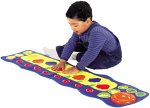
Bright handprints stretch across a long, narrow mat, with little red lights above the playing areas and an orange control section at one end. The original photograph shows a child seated beside the mat, reaching toward its keys with both hands.
Toysit’s earlier account describes the Musical Hands Mat as a portable electronic keyboard with musical and animal sounds, complete tunes and light-guided play. Its visible handprint layout also offers a simple invitation: choose a few places to press, listen, and leave room for a pause.
Follow the handprint shapes
Look along the mat before starting a pattern. Choose two or three handprints that are easy to distinguish by color or position. A player can name them “this end,” “the middle” and “the far one,” or point to them while a partner watches.
Use the mat according to the guidance supplied with the particular unit. Keep the activity to gentle hand play beside the mat, with space for everyone to reach comfortably. Begin with one sound at a time so each player has a clear turn.
Try a handprint echo path
This original Toysit activity puts the pattern on paper before anyone plays it. Use three large cards and crayons.
- Draw one handprint on each card, choosing colors or position marks that correspond to three areas of the mat.
- Arrange the cards in a short path. Point to each one slowly and say its color or position.
- Ask a partner to follow that path with gentle presses on the corresponding handprint areas.
- Leave a pause at the end. Then change just one card and try the new order.
- Swap the jobs of path-maker and player. Let the new path-maker choose where a longer pause belongs.
For a paper version, put large handprint drawings on a clear table and give each one a player-made sound. Touching a picture can cue a hum, a spoken syllable or a gentle clap.
Make a beginning and an ending
Add a small drawn sun beside the first card and a moon beside the last. These become the players’ start and finish signs. A listener can close their eyes for a short pattern, then point to the card they think came last.
Keep favorite paths on a sheet titled “Our handprint tunes.” They can be replayed, rearranged or performed with voices another day.
The historical record
Original Toysit coverage
The original product account and commentary are preserved below as historical coverage.
The Musical Hands Mat helps develop coordination and teaches cause-effect principles.
Toddlers love to hear their favorite nursery rhyme songs, and of course they love anything with sound effects and flashing lights. This electronic musical toy is 45 inches long and 11 inches wide, with a large, one-octave keyboard sporting a plastic handprint on each key and a red button above that flashes when the key is played. The keyboard can be played in five different tones: piano, bells, doggie barks, kitty meows, or birdie tweets, and in several modes: complete songs, free-play mode, or preprogrammed mode. The preprogrammed mode is an interesting feature that will help preschoolers (or their parents) learn to play the eight familiar songs. The tiny red light flashes, you play that handprint, and follow along until--hey, you're making music! The musical mat has a wipe-clean plastic surface, and it requires two AA batteries (not included). --Marcie Bovetz, mother and former children's librarian. This portable mat is also a piano! This mat features eight brightly-colored, tactile stimulating handprints that act as piano keys. Press each handprint and a different note is sounded either in piano, bell, dog, chick, or cat sounds. Press the demo button to hear a complete tune or the light button to play songs by following the flashing lights above the keys. Little ones are sure to have fun while they refine their musical ear and motor skills.
A pressure-sensitive mat that plays different sounds and music provides an immersive and interactive play experience that captivates children's imagination and senses. As children step, jump, or dance on the various zones of the mat, they are rewarded with a variety of auditory responses, ranging from musical notes to animal sounds. This instant feedback encourages them to explore further and experiment with movement and pressure, making each interaction both a game and a learning experience. The mat not only stimulates their auditory senses but also enhances their motor skills and coordination, as they learn to associate specific movements with certain sounds. Many of these mats come with a selection of pre-set tunes or learning games, offering educational benefits like teaching numbers, letters, or musical scales. The inclusion of colorful graphics or LED lights in some designs adds another layer of sensory stimulation, making it visually appealing. Because the mat is pressure-sensitive, even the youngest children can engage by simply crawling or sitting, making it accessible to various age groups. This type of play mat turns physical activity into a multi-sensory exploration, combining fun and education in a delightful, engaging way.
Sources and editorial notes
This profile uses the original Toysit account and 150-by-108 photograph. Trade-directory searches point to International Playthings/iPlay G02201, but a matching manufacturer guide or package was not recovered. Exact tones, dimensions and modes remain claims of the original account, including its attributed Marcie Bovetz review. The generic stepping and jumping discussion is historical commentary, not operating guidance for this hand-play profile. No developmental or therapeutic benefit is claimed.
- Original Toysit image — Existing same-site photograph reviewed and retained unchanged.
- Original Toysit coverage — Complete original product account and historical commentary preserved.

Images and descriptions are retained as historical material. How Toysit covers toys.
Created for Toysit by Tabbloza — the artwork in our header.