
From the Toysit archive
Winnie the Pooh ABC Singing Wagon: letters on a rolling journey
Explore Winnie the Pooh’s ABC Singing Wagon, its wooden letter blocks and song buttons, with an original Hundred Acre delivery-route activity.
The play at a glance
Letters ready for a little journey
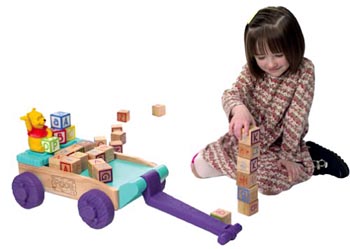
Pooh rides at one end of a wooden wagon with purple wheels and a long pull handle. Three colorful plastic letter buttons sit beside him, while loose wooden blocks fill the tray or become a stack on the floor. The combination makes room for carrying, arranging and singing during the same play session.Blocks to arrange, buttons to press
Mattel describes 24 wooden alphabet blocks, with three letters and Pooh-character artwork on each. The fixed plastic ABC blocks are the song controls: pressing them plays sections of the alphabet melody. Pressing Pooh prompts play, and pulling the wagon triggers the melody with flashing lights.
That gives a player several ways to pause during a journey. Take a loose block from the tray, turn it to another face, then decide where it belongs in a row or tower. The three plastic buttons remain part of the wagon’s musical display.
Try a Hundred Acre delivery route
This is an original Toysit play idea. Draw two or three large destination cards, perhaps a tree house, a garden gate and a picnic blanket. Place them along a clear floor route.
- Choose a few wooden blocks as a pretend delivery and put them in the tray.
- Stop at a destination. Select one visible letter or character face and invent a short message for the recipient.
- Arrange the delivered blocks beside the card, then continue to the next stop.
A letter might become a shop’s initial, while a character picture suggests who is waiting. Matching a face, naming it or simply choosing a favorite color can all guide the delivery. Keep the number of stops small enough to enjoy the story.
Finish with a small display
At the last destination, line up the delivered blocks or make a low stack. Retell where the wagon went and what each stop received. The route and messages are player-made additions to the toy’s recorded songs and prompts.
The Fisher-Price instruction sheet identifies the wagon as a toy for pulling and block play, not riding. An adult should follow the matching assembly instructions before play.
The historical record
Original Toysit coverage
The original product account and commentary are preserved below as historical coverage.
The wagon comes with 24 wood alphabet blocks with 3 letters and a character on each one.
Pooh says about 12 phrases like, "Let's find my friend Piglet" or "Let's sing the ABC melody" The plastic blocks are also a button. Each time you press the blocks, Pooh will sing a section of the ABC melody. The wagon comes with 24 wood alphabet blocks with 3 letters and a character on each one.
Winnie the Pooh, created by A.A. Milne, has become an enduring symbol of innocence and friendship, captivating audiences of all ages. The charm of Winnie the Pooh lies in its whimsical characters, each with distinct personalities and quirks, and the simple yet profound life lessons woven into the stories. Set in the idyllic Hundred Acre Wood, the tales follow Pooh Bear and his friends, including Piglet, Tigger, and Eeyore, as they embark on adventures filled with imagination, humor, and heart. The timeless appeal of Winnie the Pooh is further enhanced by the gentle illustrations of E.H. Shepard, which bring the characters and setting to life. Whether through books, animated films, or merchandise, Winnie the Pooh continues to be a beloved icon, symbolizing the joy and wonder of childhood.
Sources and editorial notes
Mattel’s official support record for model 94114 and its complete one-page instruction scan were reviewed. The scan has cropped text along part of its left edge; the matching assembly drawing and ride-on caution are readable. The support record supplies the control descriptions and 24-block count. Historical literary commentary is preserved separately. No physical testing was performed.
- Original Toysit image — Existing same-site photograph reviewed and retained unchanged.
- Mattel support: ABC Singing Wagon 94114 — Official product description; distinguishes the loose blocks, Pooh prompt and song buttons.
- Fisher-Price ABC Singing Wagon instructions — Complete one-page scan visually reviewed; assembly drawing and ride-on caution, with some left-edge scan cropping.
- Original Toysit coverage — Complete original product account and historical commentary preserved.

Images and descriptions are retained as historical material. How Toysit covers toys.
Created for Toysit by Tabbloza — the artwork in our header.