
From the Toysit archive
Wooden Knob Puzzles
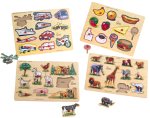
Look at the outline, turn the piece and find its place in the illustrated inset puzzles from Toysit’s archive.
The play at a glance
A small turn can make the picture fit
A knob gives a player a place to grasp a puzzle piece while comparing it with a space in the board. Look at the outline, hold the piece above a possible home and turn it until the shapes line up.
The pictured puzzles use individual pieces fitted into a tray. The older essay below switches to “knot” puzzles and interlocking constructions; that describes a different kind of puzzle, not the boards shown here.
Begin with one empty space
Leave most pieces in the board and take out one. Put it nearby with its picture facing up. This offers a clear starting point without presenting a whole pile of possible answers.
On a later turn, remove two or three pieces. Compare their outlines with the empty spaces. The picture can be a clue, but the outline and orientation decide whether a piece sits in its recess.
Describe the movement
Try a small phrase such as “turn it a little” or “move it beside that space,” then leave time for the player to act. If a piece does not settle into place, lift it and try another orientation instead of pushing harder.
NAEYC’s spatial-thinking guidance includes puzzles and positional words among everyday play ideas. Here, those words can describe an action the child can see, rather than becoming another test to pass.
Give each picture a tiny story
Once a piece is in place, name something happening in its picture. An animal might be returning home; a vehicle might be ready for a trip. Let the child add a sound, a name or the next event.
Keep the board and its pieces together. Similar-looking pieces from a different puzzle may tell a good story but still fail to fit the same recess.
Offer a hint before an answer
If the player wants help, point to a feature or demonstrate a turn with another piece. Let them finish the move when they want to. Stop with a few successful fits if completing the whole board is no longer interesting.
For an older set, an adult should check the board, pieces and attached knobs before play and follow its own age and care markings. The archive photograph cannot establish the condition of a set now.
The historical record
Original Toysit coverage
The original theme description, paragraphs and complete list remain below. The later text mistakenly calls these knot puzzles and discusses interlocking pieces. That category error is preserved as part of the record and corrected in the new explanation above. Its broad learning claims were not tested.
Transport, Farm, Jungle Animals and Food Knob Puzzles
Transport, Farm, Jungle Animals and Food Knob Puzzles
Wooden knot puzzles provide engaging hands-on play for young children while building spatial reasoning and problem solving skills.
- The simple act of manipulating and linking the wooden pieces to form shapes helps develop fine motor control and coordination.
- Completing the puzzles demands focus, logic, and sequential thinking as children connect interlocking knots step-by-step.
- The cause and effect of seeing a shape emerge as pieces click together builds critical cognitive connections.
- Vibrant colors and approachable animal or object themes stimulate growing minds.
- Puzzles can be incorporated into interactive play like "zoos" and "farms" as children learn and reinforce animal names.
- The tactile, hands-on nature makes absorbing abstract concepts such as patterns, spatial organization and problem solving more engaging and concrete.
With their blend of fun imagery, manipulatives, and intellectual stimulation, wooden knot puzzles delight and develop minds at an early age.
Sources and editorial notes
The original boards and prose were reviewed on October 15, 2026. The image supports an inset-puzzle description, but the manufacturer, exact collection, piece counts and age markings were not established. NAEYC’s family guidance supports patient puzzle play and spatial language generally; it does not evaluate these particular boards. No physical set was tested.
- NAEYC: How to Support Children’s Approaches to Learning? Play with Them! — Discusses giving children room to try, turn pieces and work through puzzles.
- NAEYC: Developing Your Preschooler’s Spatial Thinking — General guidance on puzzles and words that describe position and direction.
Images and descriptions are retained as historical material. How Toysit covers toys.
Created for Toysit by Tabbloza — the artwork in our header.