
From the Toysit archive
Fuzzy Farm Puzzle
Meet the four animals of the Fuzzy Farm Puzzle, explore their shapes and textured surfaces, and invent a little procession of farm visitors.
The play at a glance
Four animals with their own places on the farm
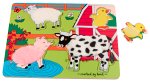
A spotted cow stands beside a pink pig, a pale sheep fills the upper corner, and a yellow chick appears by a red barn. The Fuzzy Farm Puzzle gathers four animal shapes into one bright farmyard. In the original photograph, the chick piece sits beside the board, ready to return to its place.
The raised animals give the scene a simple rhythm: choose an animal, lift it, look at its outline and find its place again. Melissa & Doug’s company history shows a closely matching board with textured animal surfaces. The cow’s patches, the pig’s round body and the sheep’s pale coat give each visitor something distinctive to talk about.
Follow an animal’s outline
Start with a detail that catches the eye. The cow has a long body and a face at one end; the chick has a much smaller outline. Turn a chosen piece slowly to see how its edges line up with its opening. Looking from the animal to the board makes the fitting part of the play easy to describe.
A player can supply a small greeting as each animal returns: “Here comes the cow,” or “The chick is visiting the barn.” Those words and voices belong to the player’s story. The puzzle provides the animals and their setting.
Make the farmyard a meeting place
Imagine the animals gathering for a picnic beside the barn. Perhaps the pig arrives with a pretend basket, while the sheep has heard about a new patch of flowers. Choose one visible detail to begin, then let the next player add an event.
The same scene can happen in a different order each time. Start with the smallest visitor on one turn, or let someone choose their favorite animal to arrive first. A drawn invitation gives the meeting a name.
Try a farm visitor relay
- Draw a large card for each of the four animals.
- Place the cards in an arrival order beside a drawing of a barn.
- Choose the first animal and say one sentence about its visit.
- If using the puzzle, return that animal to its place as the next visitor arrives.
- Change the card order and tell a new version of the gathering.
This original Toysit activity works with paper animal drawings, suitable toy animals or the puzzle. A grown-up can draw the cards or help tell the story.
The historical record
Original Toysit coverage
The original product account and commentary are preserved below as historical coverage.
Fuzzy farm puzzle.
Four tactile pieces help develop sensory awareness and matching skills. Raised pieces are easy to remove and have matching pieces underneath. It's a child's perfect first puzzle! Quality wood construction will last a lifetime.
Puzzles play a vital role in the development of young children, offering a fun and engaging way to build essential skills. By working with puzzles, children enhance their hand-eye coordination, fine motor skills, and spatial awareness. Puzzles also promote cognitive development by challenging children to recognize patterns, shapes, and colors, and to think critically to find solutions. The process of fitting pieces together fosters problem-solving skills and encourages perseverance and patience. Additionally, completing a puzzle provides a sense of accomplishment and boosts self-confidence. Puzzles can also be a social activity, teaching children collaboration and communication skills as they work together with peers or family members. Overall, puzzles are a valuable educational tool that supports the holistic growth of young children in a playful and stimulating way.
Sources and editorial notes
The original Toysit photograph was compared with the Fuzzy Farm image in Melissa & Doug’s September 6, 2023 company history. The four-animal layout and textured surfaces correspond closely. That history places the product line in 1991; it does not date this particular example. Exact materials, under-piece illustrations and care directions remain unverified beyond the original account. The recorded August 12, 2023 update is retained. The activity is original; no physical toy or learning outcome was tested.
- Original Toysit image — Existing same-site photograph reviewed and retained unchanged.
- Melissa & Doug: 35-year company history — Manufacturer text and the pictured Fuzzy Farm board reviewed; product-line history and visual comparison.
- Original Toysit coverage — Complete original product account and historical commentary preserved.

Images and descriptions are retained as historical material. How Toysit covers toys.
Created for Toysit by Tabbloza — the artwork in our header.