
From the Toysit archive
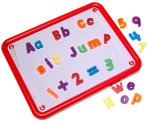
Alphabet Magnets Board
Use a few magnetic letters to match cases, build a familiar name and explore how one changed letter can make a new word.
The play at a glance
Begin with a name the player recognizes
A magnetic alphabet board gives letters a place to be moved, compared and rearranged. A familiar name makes a useful starting point: it has a reason to be on the board before any spelling challenge begins.
Choose a few letters and leave the rest aside. One match or one small change can make a complete activity.
Match a letter before building a word
Put one uppercase letter on the board and offer two lowercase choices. Compare the forms together. Some pairs, such as C and c, look similar; others, such as A and a, look quite different. Color alone is not a reliable way to decide whether two letters belong together.
Say the letter’s name as you place the pair. A letter name and a speech sound are different things: the name of M is “em,” while the first sound in “map” is /m/. Keep naming and sound play as separate prompts so the task is clear.
If a match is difficult, put the pair together and let the player copy it. There is no need to turn every turn into a question.
Try three small activities
- Build a familiar name
- Make a model to copy, then find the letters in order. Start with an uppercase initial and lowercase letters if those pieces are available.
- Find the same beginning
- Choose a familiar word and say it aloud. Match its first written letter with another word you supply.
- Change one letter
- Build “cat,” replace c with h to make “hat,” then replace t with m to make “ham.” Read each word together.
- Leave a short message
- Choose a word the player wants someone else to see. Build it together and let that person read it.
Use a sequence that fits the letters you have. If a name needs two copies of a letter and only one is available, choose a different word or keep a written model beside the board. A missing piece is a limitation of the set, not a spelling mistake.
Let the player choose the next step
Copying a word, completing a word with one gap and choosing all its letters are different tasks. Start with the one that feels manageable. A partner can say the word while the player moves the pieces, then swap roles.
Keep a completed word visible long enough to read and enjoy it before clearing the board. For a brief session, making a name and finding its first letter elsewhere may be enough.
Numbers can have their own turn: put a numeral beside that many drawn marks on a separate sheet. Keep this distinct from letter matching so there is only one rule to follow at a time.
Keep the set ready for another session
Check each letter and number for damage or a loose magnet, and put all pieces away together after use. Follow the age and small-parts guidance on the actual set. The manufacturer catalog flags small parts and excludes children under three.
The original photograph cannot verify all pieces in a box. Nor does a board’s appearance establish which pens are suitable for it: use a marker only if the instructions for that board permit it. A small selection of intact letters is enough for the activities here.
The historical record
Original Toysit coverage
The brief original product description and full list of claimed learning benefits remain below. These claims are preserved as historical writing; the new activities do not promise particular learning outcomes or repeat the old car-trip recommendation.
Magnetic Alphaboard by Educational Insights
Great for car trips, includes upper case and lower case letters, as numbers, a great way to learn.
A magnetic whiteboard equipped with alphabet and number magnets offers a multitude of educational benefits, especially for young learners:
- Multisensory Learning: By manipulating magnetic letters and numbers, children engage in tactile learning, which reinforces visual and kinesthetic memory pathways.
- Literacy Skills: Alphabet magnets can be used to teach letter recognition, phonetic sounds, and word formation. Children can practice spelling, create simple words, or even form sentences, enhancing their vocabulary and grammar skills.
- Numeracy Skills: Number magnets facilitate understanding of basic mathematical concepts. Children can practice counting, learn number sequences, and even start on basic arithmetic operations like addition or subtraction.
- Motor Skill Development: Picking up, placing, and rearranging the magnets refines fine motor skills and hand-eye coordination.
- Creativity and Storytelling: Beyond just letters and numbers, the whiteboard can be a canvas for children to weave stories, create patterns, or even draw using erasable markers, fostering their creative expression.
- Interactive Learning: The board can be a collaborative tool where educators or parents engage with children, guiding them, or even playing educational games.
- Immediate Feedback: Children can easily rearrange letters or numbers, allowing them to correct mistakes on the fly, promoting a positive learning experience without the fear of making errors.
- Organization and Structure: The process of categorizing letters or numbers, grouping them, or even segregating vowels from consonants can introduce kids to the concepts of classification and organization.
- Durability and Reusability: Magnetic boards are long-lasting, allowing for continuous learning and adaptation to the child's evolving educational needs.
- Engagement and Fun: The interactive nature of the magnetic board and the tactile pleasure of using magnets make learning more appealing and enjoyable for children.
Sources and editorial notes
Reviewed October 16, 2026 against the original red-framed board photograph and Educational Insights’ 2020 catalog entry for Magnetic AlphaBoard Kit EI-1782. The catalog confirms the named product family; its later package counts do not establish exactly what the earlier photographed set contained. The activities use available letters rather than requiring a complete kit. No physical magnets or board were tested.
- Educational Insights: 2020 catalog, Magnetic AlphaBoard Kit — Manufacturer listing for EI-1782, including upper- and lowercase letters, numbers and symbols. Later catalog evidence is distinguished from the original package.
Images and descriptions are retained as historical material. How Toysit covers toys.
Created for Toysit by Tabbloza — the artwork in our header.