
From the Toysit archive
Rescue Heroes Aquatic Rescue Command Center
Explore the Rescue Heroes Aquatic Rescue Command Center through mission cards, a crane and a hand-operated elevator, then invent a paper rescue mission.
The play at a glance
A headquarters for stories about helping
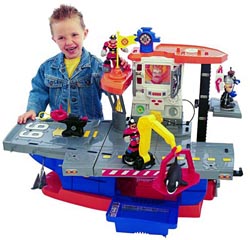
The Aquatic Rescue Command Center gives a rescue team a place to gather, receive a mission and set out. Its ship-shaped setting combines hands-on play areas with card-based electronic scenes.
The aquatic theme describes the setting. Fisher-Price’s instructions explicitly say the toy is not designed for use in water. Plan the ocean on paper or in the story, with the headquarters kept dry.
Let the headquarters organize the action
The guide shows a pivoting crane and rescue platform, a hand-moved elevator and storage areas. These give a story several places to pause: gathering the crew, moving equipment, helping someone and returning supplies.
Choose a role for each area before starting. One player can receive the request while another decides what the team needs. A headquarters becomes more than scenery when it gives the players a reason to meet and exchange information.
Understand the two kinds of cards
The guide lists three two-sided Voice Tech Video Cards for six missions. Separately sold Talking Mission Cards provide another way to select a mission, with a backpack reader used for figure exchanges. Only one type of card goes into the message center at a time.
The branded “Virtual Video” wording belongs to this early electronic toy system. It describes prepared mission scenes, not streaming video, networking or a character that can answer any question.
Make room for the players’ mission
A story can begin with a simple request: help a stranded traveler, recover an imaginary supply box or find a route to a meeting point. Give each crew member one useful task, then decide how they will know the mission is finished.
If a card or accessory is missing, a drawn story can still use the headquarters idea. Paper prompts belong beside the toy; they are not replacement electronic cards and should not be inserted into its reader.
Make a mission card
- Draw a place where a story will happen.
- Add one problem the crew can help solve.
- Assign a team role, such as driver, lookout or supply carrier.
- Tell the journey from headquarters to the scene.
- Turn the paper over and draw the completed mission.
This independent paper prompt works without the original playset. It is a storytelling card, not a manufacturer accessory or an emergency-training exercise.
The historical record
Original Toysit coverage
The complete original description and general imaginative-play essay remain below. The August 19, 2023 date is retained as an earlier page update. References to separately sold figures and equipment are historical product context, and broad educational claims were not tested.
This Aquatic Rescue Command Center is the central gathering place for Rescue Heroes awaiting their next task.
Calling all Rescue Heroes. This Aquatic Rescue Command Center is the central gathering place for Rescue Heroes awaiting their next task. Sitting at the top of the vessel is a battery-operated message center with a virtual video screen. Insert the included video card to see and hear commander Warren Waters assign the Rescue Heroes (sold separately) one of six missions. Rescue Hero Mission Command figures (sold separately) can talk with Warren Waters by inserting a talking mission card (sold separately). Other areas of the structure allow for creative and imaginative play without the use of electronics, such as the pivoting rescue crane and whale figurine, elevator, buoy and life preserver launcher, backpack storage area, and hidden living quarters. Made of sturdy plastic.
Rescue Heroes playsets captivate young minds through their embodiment of heroism, adventure, and community service. Centered around a team of emergency responders who tackle disasters and save those in peril, these playsets introduce children to the valiant roles of firefighters, police officers, paramedics, and other first responders. The action figures, often exaggerated in their design with bold features and powerful tools, amplify the sense of might and righteousness associated with these professions. Playing with these sets allows children to engage in imaginative role-playing scenarios, fostering empathy, problem-solving skills, and a sense of responsibility. The various tools, vehicles, and action-packed environments included in the playsets enable kids to recreate daring rescues, nurturing their storytelling abilities. Moreover, while the adventures are thrilling, the underlying themes of teamwork, safety, and helping others shine through, making Rescue Heroes not only entertaining but also subtly educational and morally uplifting.
Sources and editorial notes
Fisher-Price’s 78157 instructions were reviewed through text and page images, including the crane, elevator, card slots and message-center controls. The revised 78157b guide includes the rear power switch also covered by the separate supplement. The card system presents predefined missions and figure responses; it is not a live communication service. No surviving electronics or accessories were tested. The paper mission is an independent Toysit activity.
- Fisher-Price Aquatic Rescue Command Center instructions — Revised guide with play features, mission-card details, power switch and dry-use guidance.
- Fisher-Price message-center supplement — Power-switch information supplied separately with an earlier guide.
Images and descriptions are retained as historical material. How Toysit covers toys.
Created for Toysit by Tabbloza — the artwork in our header.