
From the Toysit archive
Barbie Fashion Blast Electronic Party Game
Discover Barbie Fashion Blast’s talking purse and timed accessory hunt, then create a shared paper costume for an imaginary festival guest.
The play at a glance
A talking purse starts the party
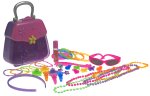
A purple-and-pink purse stands in the center of the original photograph, its tall handle rising above a scatter of colorful accessories. In Barbie Fashion Blast, that purse supplies the voice and the countdown. A player listens for an accessory, finds it inside, puts it on and closes the purse before passing play along. The costume builds a piece at a time as the party moves around the group.
Listen, find, close and pass
The purse makes the accessory search part of a timed sequence. Its original instructions ask players to put the accessories inside, select the group-size setting and start play. When the voice names an item, the current player looks for it, puts it on and closes the purse during the countdown. The next prompt tells the group when to pass it.
Other calls can change who wears an accessory, giving the costume collection a little surprise. At the end, the game names a winning accessory and its wearer wins. That makes listening to the final announcement part of the game, rather than simply counting everything a player has collected.
The linked sheet supplies the complete rules and adult battery setup for three AA cells. For an imaginative costume session with a different rhythm, the paper version below lets everyone contribute without a timer.
Try this: the shared costume clue
Invent a guest on the way to a friendly festival. Draw the guest on a large sheet and make separate paper cards showing accessories: a hat, scarf, bracelet, glasses or a decorated bag. This original Toysit activity builds one costume and one story together.
- Choose the festival’s setting. It might be a garden full of paper flowers, a lantern parade or a storytelling afternoon beside an imaginary lake.
- The first player chooses an accessory card and places it beside the guest. Add a purpose sentence: “This bag holds the invitations.”
- The next player adds a second card and connects it to the scene. “The scarf has stars because the parade begins at dusk.”
- A third contribution completes the costume. Let that accessory solve a small story problem, such as finding a friend in the crowd.
Playing with two people, take turns until three cards are placed. Playing alone, invent three different voices for the suggestions. Read the purpose sentences together, then describe the guest arriving at the festival.
For a second scene, change the destination but keep two accessories. Which third card would help the guest on a beach walk, a library visit or a pretend train journey? Everyone shares the choice; the pleasure comes from making the pieces belong to the same character.
The historical record
Original Toysit coverage
The complete earlier product account and commentary are preserved below as historical coverage.
Fast-paced, interactive fashion game.
A fast-paced, interactive fashion game that challenges girls to think fast, choose carefully and accessorize quickly. The only way to win the ultimate beauty makeover, is to find the right accessory in time and pass the purse quickly. With over 30 pieces of hip fashion, bracelets, necklaces, rings, sunglasses, body glitter and more, girls will have a fashion blast.
Fashion games that feature play jewelry and body glitter offer a unique blend of self-expression, creativity, and a touch of glam, enabling children to explore and express their individuality. Here's a dive into the exhilarating world of play jewelry and body glitter fashion games:
- Self-Expression: With an array of bracelets, necklaces, rings, and other accessories, children can mix and match to create looks that resonate with their personal style, allowing them to communicate their identity through fashion.
- Role Play: Fashion games can transport children into various roles. Whether they're pretending to be a fashion-forward celebrity, a powerful queen, or a magical fairy, play jewelry adds authenticity and flair to their imaginative scenarios.
- Creative Exploration: Designing unique jewelry combinations or experimenting with body glitter placements lets children harness their creativity. It encourages them to think outside the box and envision new, bold fashion possibilities.
- Social Interaction: Fashion games are often more fun with friends. Children can host fashion shows, swap jewelry pieces, or even collaborate on jewelry-making projects, fostering teamwork and strengthening social bonds.
- Boosted Confidence: Donning glittering necklaces, sparkling rings, or shimmering body glitter can boost a child's confidence. It allows them to feel beautiful and special, fostering a positive self-image.
- Motor Skills Development: Manipulating small jewelry clasps or applying body glitter with precision can aid in refining a child's fine motor skills and hand-eye coordination.
- Understanding Aesthetics: By arranging jewelry and experimenting with color combinations or patterns, children develop an aesthetic sense, understanding balance, symmetry, and design.
- Sensory Stimulation: The textures of different jewelry materials, combined with the visual appeal of shimmering body glitter, provide sensory stimulation, enhancing a child's sensory perception and appreciation.
Fashion games featuring play jewelry and body glitter not only offer hours of entertainment but also cultivate creativity, confidence, and various skills. They allow children to playfully experiment with fashion, encouraging them to embrace their unique style and vision.
Sources and editorial notes
Mattel’s 26918 product photograph matches the pictured purse; its record lists release in 2000 and discontinuation in 2001. All four instruction pages were visually reviewed. The instructions describe the closing-and-passing sequence and a winning-accessory announcement; they do not make the winner simply the player wearing the most pieces. The old accessory-count, body-glitter and developmental claims remain historical. The cooperative paper activity above is original editorial play, not an official mode or a tested outcome.
- Original Toysit image — Existing same-site image reviewed and retained unchanged.
- Mattel: Barbie Fashion Blast, 26918 — Manufacturer record and purse photograph reviewed; historical release and discontinuation dates retained as product context.
- Mattel: Fashion Blast instructions (PDF) — All four pages visually reviewed, including accessory setup, group-size setting, timed turns, fashion-emergency calls and winning-accessory announcement.
- Original Toysit coverage — Complete historical account retained, including its original claims and wording.

Images and descriptions are retained as historical material. How Toysit covers toys.
Created for Toysit by Tabbloza — the artwork in our header.