
From the Toysit archive
Barbie Says Electronic Game
Explore Barbie Says’ flower-shaped electronic tabletop game, its colored buttons and jewelry tokens, then invent a cooperative paper pattern chorus.
The play at a glance
Listen, remember and answer the flower
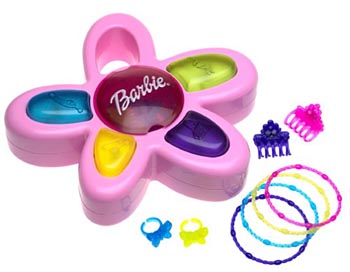
A bright pink flower holds four colored buttons around a Barbie center, with an open petal forming a handle. Jewelry accessories lie beside it, ready to become the game’s tokens. The pictured Barbie Says is a tabletop listening-and-memory game: players hear a pattern, watch for the right instruction and respond at the flower-shaped unit.
Four buttons, three ways to listen
The buttons pair colors with familiar pictures: a blue telephone, green shoes, yellow sunglasses and a purple purse. In Level 1, players hear a color sequence and wait for it to finish before responding. The instruction to act matters too: the game distinguishes commands introduced by “Barbie Says” from ones that are not.
Level 2 brings the pictured objects into the commands as well as the colors. Friendship mode assigns buttons to players and uses jewelry accessories as tokens that are returned after mistakes. The original sheet explains the mode choices, scoring and setup; the flower stays at the center of the group as everyone listens for the next cue.
The full instructions also show the lid and accessory storage and specify adult handling of the three-AAA battery setup. Keep that matched guide with the actual game. The paper activity below has its own cooperative rules and needs no electronic unit or small jewelry pieces.
Try this: the flower-pattern chorus
Draw a large five-petaled flower. Give each petal a different color and a clear symbol, such as a sun, leaf, star, wave or heart. This original Toysit activity uses all five drawn petals and asks the group to build one shared pattern.
- The first caller points to two symbols and says their names: “leaf, star.” Everyone repeats the pattern together by pointing or speaking.
- The next caller keeps those two symbols and adds one more. Repeat the new pattern as a group.
- If someone loses the pattern, pause and rebuild it together from the beginning. A player can point while another supplies the words.
- After a few additions, give the pattern a title and perform it once more as the flower’s chorus.
Try saying the symbols in a whisper, a storyteller’s voice or a gentle sing-song rhythm. Keep the order the same while changing the delivery. Another round can begin with a new pair of symbols and a new caller.
The shared aim is a pattern everyone can join. Draw a short row of the symbols beneath the flower if the group would like a visible reminder; cover it only when the players choose to try from memory.
The historical record
Original Toysit coverage
The complete earlier account is preserved below. Its later description of a 1970s talking doll does not match the pictured tabletop game, which Mattel identifies as Barbie Says 43492, released in 2002.
Winning real Barbie jewelery and glamming it up with your friends.
The new Barbie game from Mattel where you win Barbie jewelery and glam it up with your friends.
Barbie Sez is a memory game that was introduced in the 1970s by Mattel, the company behind the Barbie doll. The game features a plastic Barbie doll that gives players commands to follow, similar to the classic Simon Says game. Players must mimic the actions that Barbie instructs them to perform. If Barbie says, "Barbie sez touch your toes," players must touch their toes, but if Barbie gives a command without saying "Barbie sez," players should not follow the command.
The game is designed to entertain children and promote memory skills, listening comprehension, and following instructions. It's a way to engage children in interactive play and stimulate their cognitive abilities in a fun and entertaining manner.
Sources and editorial notes
Mattel identifies this tabletop product as 43492, released in 2002; its photograph matches Toysit’s image. All three instruction pages were visually reviewed. The earlier account’s 1970s talking-doll description refers to a different kind of toy and does not describe the pictured game. The manual supports three modes and setup for one to four players, whereas the product page says two to four. Level 2 turn-order wording is inconsistent within the manual, so no fixed order is asserted here. No physical operation or developmental outcome was tested.
- Original Toysit image — Existing same-site image reviewed and retained unchanged.
- Mattel: Barbie Says, 43492 — Manufacturer record lists 2002 release; product image matches the flower-shaped tabletop game.
- Mattel: Barbie Says instructions (PDF) — All three pages visually reviewed, including button symbols, three modes, jewelry tokens and battery setup. Original rules are distinct from the cooperative paper activity above.
- Original Toysit coverage — Complete historical account retained, including its original claims and wording.

Images and descriptions are retained as historical material. How Toysit covers toys.
Created for Toysit by Tabbloza — the artwork in our header.