
From the Toysit archive
Barbie Shop With Me Cash Register
Set up a small shop with the pink-and-purple Barbie Shop With Me Cash Register, then make price cards and receipts for a three-item shopping trip.
The play at a glance
A checkout counter for a shop of your own
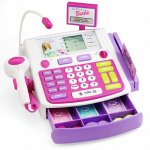
The open purple drawer has compartments for pretend money, while a bright keypad and raised display give the cashier a place to work. Barbie Shop With Me Cash Register makes a small tabletop shop feel ready for its first customer. A few toy groceries, a shopping list and a greeting are enough to begin the scene.
Give the shopper something specific to find
Toysit’s earlier description names noodles, yogurt and toilet paper: ordinary shopping items that suggest a small household errand. For a player-created version, choose three objects or draw them on cards. Arrange them on a shelf, add simple prices and give the customer a list.
The cashier can greet the shopper, name each item and arrange it beside the register. Then the players trade roles. A second visit might be for a picnic, a doll's party or supplies for the kitchen next door. Changing the reason for shopping gives the same few objects a fresh story.
A drawer, a display and a place to count
The original photograph shows a divided drawer, number keys, a raised display and attached checkout accessories. These visible details give players distinct jobs: collect the purchases, organize pretend money and prepare a receipt. The British Museum's own Shop With Me example also includes a toy credit card, showing how the playset borrowed familiar checkout objects.
Try setting prices at one, two and three pretend coins. With handwritten cards, players can count a total together and decide which items fit a small shopping budget. Keeping the amounts on paper makes the choices easy to follow during the story.
Run a three-item shop
- Choose three toy items or draw three product cards.
- Give each a price of one, two or three pretend coins.
- Write a shopping list and let the customer choose two items.
- Make a receipt with the item names, prices and total.
- Trade roles and change one price or one item for the next visit.
This original activity works with a toy register or a drawn checkout. The paper prices and totals belong to the game you create. Add a welcome sign and a closing-time announcement for a complete little shop.
The historical record
Original Toysit coverage
The original toy description and broader play discussion are preserved below as historical coverage.
Barbie cash register.
The Barbie Shop With Me Cash Register is made durably and in Barbie's trademark colors (pink, hot pink, purple, white), this is a sleek number that can be operated on the floor, bed, or tabletop. It features four realistic ways to buy noodles, yogurt, and toilet paper.
A cash register toy like this provides a rich, interactive learning experience. Here's an exploration of both the fun and educational dimensions of this classic toy:
- Role Play and Imagination: A cash register paves the way for a myriad of imaginative scenarios. Children can play storekeepers, restaurant owners, or bank tellers, enabling them to step into various roles and mimic real-life situations, fostering social skills and creativity.
- Math Skills: Using play money, kids get to practice basic arithmetic like addition, subtraction, and multiplication. Counting change, understanding prices, and calculating totals can solidify foundational math concepts in a playful setting.
- Money Management: By simulating transactions, children gain an introductory understanding of money's value. They learn about different denominations, how change works, and the importance of budgeting and saving.
- Cognitive Development: Operating a cash register requires attention to detail, memory recall (remembering prices), and problem-solving (giving the correct change). This enhances cognitive functions and logical thinking.
- Fine Motor Skills: Handling coins, bills, and pressing buttons on the register help children develop dexterity and coordination in their fingers and hands.
- Social Interaction: Playing with a cash register often involves peers or family members, promoting social interactions, communication skills, and understanding of roles in a transaction (buyer and seller dynamics).
- Understanding of Commerce: Through play, children get a basic grasp of commerce principles like the exchange of goods and services for money, supply and demand, and the concept of profit and loss.
- Sensory Stimulation: Many modern cash register toys come equipped with sound effects, lights, and interactive features that engage and stimulate a child's senses, enhancing the play experience.
A cash register toy is a multifaceted tool that seamlessly blends fun with education. It offers a hands-on, playful introduction to vital life skills and concepts, making it a cherished asset in both classrooms and playrooms alike.
Sources and editorial notes
The original image and complete Toysit text are preserved. Page 121 of the British Museum Money Gallery large-print PDF was reviewed visually; it records a Shop With Me register and toy credit card made for KIDesigns and retailed in the UK in 2003. That is the museum object’s context, rather than a release date for every edition. The exact operating guide and the original account’s four payment methods remain unconfirmed. The receipt activity is an original paper exercise; no physical testing was performed.
- British Museum Money Gallery guide (PDF), page 121 — Museum documentation of a Shop With Me register, its toy card and UK retail context; this entry was reviewed.
- Original Toysit coverage — Original description and broader learning discussion preserved.
Images and descriptions are retained as historical material. How Toysit covers toys.
Created for Toysit by Tabbloza — the artwork in our header.