
From the Toysit archive
Barbie Talking Townhouse
Explore Barbie Talking Townhouse’s welcome sounds, kitchen and shower scenes, folding furniture and access-card play, then draw a room-by-room sound map.
The play at a glance
A homecoming starts at the front door
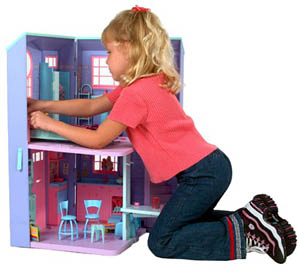
Barbie’s Talking Townhouse turns a familiar journey through a home into a sequence of sounds. A card at the door starts a welcome, a light comes on by the entrance, and kitchen and shower actions bring more recorded exchanges. Around those moments, two levels of rooms provide places to cook, sit and get ready for bed.
Three places to start a sound
The guide shows a card slot and button at the entrance, another card slot and button in the kitchen, and a pad under the doll in the shower. Those physical actions trigger the house’s sounds. Mattel’s product description adds the scene: a welcome home, cooking noises and a shower exchange about the water temperature, with recorded Barbie replies.
A player can build a visit around these cues. Imagine a friend arriving for a meal, setting out plates and choosing a place to sit. The recorded lines punctuate the action while the player supplies the characters’ plans and conversation.
Rooms that change as the day unfolds
The television slides upward to reveal a keyboard, the bed lowers into place, and the sofa back swings up. The kitchen includes opening oven and dishwasher fronts, plus a lowering table with stools. These moving furnishings make ordinary household routines visible in miniature.
Try imagining one room at two times of day. In the afternoon, a character might sit at the keyboard to write an invitation. Later, the same household gathers for supper and prepares a place to sleep. Moving a plate or lowering a bed gives the story its next step.
Draw a three-room sound map
- Draw an entrance, kitchen and bathroom on a sheet of paper.
- Give each space a sound symbol: a bell, a cooking pot or falling water.
- Invent a greeting for each room.
- Take turns playing the visitor and the house, speaking your own lines as a paper character moves.
- Add a quiet room and decide what happens there.
This original activity uses player-created dialogue. A small arrow between rooms can show the route of a morning or an evening at home.
The historical record
Original Toysit coverage
The original toy description and broader play discussion are preserved below as historical coverage.
This is the Barbie house of the future.
Who wouldn't want to live here? When Barbie walks in the front door, the house welcomes her home and asks about the temperature. How modern. She responds with phrases like, "It's great to be home." Wow, this beautiful talking house is great.
The Allure of a Talking Dollhouse
A talking dollhouse is not just a toy; it's an interactive experience that taps into various facets of a child's imagination, emotional development, and cognitive abilities. The charm and allure of such a dollhouse extend beyond the realm of ordinary play. Here's why a talking dollhouse holds special appeal:
- Interactive Engagement: The mere fact that the dollhouse can "talk" makes it a dynamic entity. Children can interact with it, await its responses, and thus, become more deeply engaged in play. It transforms passive play into an active dialogue.
- Stimulates Imagination: A talking dollhouse can present scenarios, tell stories, or ask questions. This can prompt children to create imaginative narratives, expanding their play beyond the physical boundaries of the house.
- Educational Element: Many talking dollhouses come equipped with educational themes. They might teach about daily routines, family roles, or even basic concepts like colors, numbers, or shapes through conversation.
- Emotional Development: Interacting with a talking dollhouse can help children process and express emotions. They might comfort a "sad" house, celebrate its "happiness," or navigate pretend conflicts, all of which are pivotal in understanding and managing emotions.
- Enhances Language Skills: Exposure to language is crucial for its acquisition. A talking dollhouse provides children with additional dialogue, vocabulary, and conversational cues, reinforcing language development.
- Companionship: For some children, especially those who might be introverted or shy, a talking dollhouse can serve as a friend. It offers a non-judgmental, always-there entity to converse with.
- Sense of Control: Being able to interact with, and often control, the responses or actions of a talking entity gives children a sense of empowerment. This autonomy in play is crucial for building confidence and a sense of agency.
- Mirroring Real-world Tech: In an age of smart homes and AI assistants, a talking dollhouse can also be seen as a reflection of modern technology. Children often mimic adult behaviors, and interacting with a "smart" dollhouse mirrors the way adults interact with their voice-activated devices.
A talking dollhouse is a gateway to a richer, multifaceted play experience that can shape a child's development in numerous positive ways.
Sources and editorial notes
Mattel identifies this Talking Townhouse as model 53967, released in 2002. Its complete four-page guide was visually reviewed alongside the product record. The record describes a microwave and porch light; the guide labels the kitchen sound point an oven and locates the light inside by the door. This profile uses the guide for controls and room layout, and the record for recorded exchanges. The sound-map activity is original; no physical testing was performed.
- Mattel Talking Townhouse record — Model 53967 and recorded homecoming, cooking and shower scenes.
- Talking Townhouse instructions (PDF) — All four pages reviewed for controls, furniture and setup.
- Original Toysit coverage — Earlier description preserved.
Images and descriptions are retained as historical material. How Toysit covers toys.
Created for Toysit by Tabbloza — the artwork in our header.