
From the Toysit archive
Barbie Wireless Video Camera
A pink-and-white camera, microphone and television receiver suggest a home studio and a tiny museum interview.
The play at a glance
A small studio in pink and white
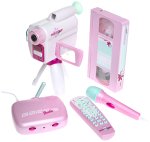
The Barbie Wireless Video Camera looks ready for a presenter: a pink-and-white camera sits on a little tripod, with a microphone, remote and pink base nearby. A toy on the table can become the star exhibit, while a friend supplies the questions and introduces the show.
From the camera to the television
The BE-278 instructions describe a wireless camera sending sound and pictures to a base connected to a television. A separate VCR makes the recording onto videotape. That arrangement gives the set its home-studio character: one person frames the subject while the picture appears on the family screen.
The manufacturer’s filing also shows a wired handheld microphone and describes plugging it into the camera. Holding a microphone gives the interviewer a visible role. The little tripod offers a fixed place for the camera while the presenter introduces the next exhibit.
Try a tiny museum interview
Choose an ordinary toy as the museum’s newest arrival. Place it beside a handwritten label with a made-up exhibit name: “The Moon Gardener’s Watering Can” or “The Train That Delivered One Button.” One player becomes the curator and invents its history; another becomes the interviewer.
Draw an opening view of the whole exhibit, then a closer view of one interesting detail. Ask two questions: “What should a visitor notice first?” and “What happened just before this arrived at the museum?” Let the curator’s answers turn that detail into a small story.
A paper viewfinder and two drawings make a finished program. Introduce the exhibit, show the detail and end with a thank-you to the curator. If an available camera is used, agree who wants to appear and ask permission before recording or sharing. The drawings can become the program’s opening and closing cards.
Revisiting a receiver-based camera
An adult should check the actual model, its matching instructions, power supply and television connections before using vintage equipment. The original system’s recording arrangement belongs to the VCR era; the museum story can also be performed live for an audience at the table.
The historical record
Original Toysit coverage
The complete earlier product account and commentary are preserved below as historical coverage.
Barbie Video Magic: Wireless Camera by KIDdesigns, Inc
Camcorder design plus wireless universal remote function makes recording and playback of videos a breeze. Includes built-in and handheld mics, adjustable focus, tripod and instructional/demo video.
The Evolution of Features in Video Cameras
From bulky film reels to pocket-sized digital wonders, video cameras have undergone significant changes over the decades. The evolution of these devices is marked not only by a reduction in size but also by the inclusion of a plethora of innovative features that enhance user experience and video quality. Here's an overview of how video camera features have evolved:
-
Size and Portability:
- Early video cameras, used primarily in the film industry, were large and required multiple operators.
- By the 1980s, camcorders became popular, combining the camera and recorder into a single portable device.
- Today, cameras have shrunk to the point where high-quality video can be captured on smartphones and action cameras like GoPros.
-
Recording Medium:
- Initially, cameras recorded on film reels, which were then developed and processed.
- The advent of videotape formats like VHS, Betamax, and later, MiniDV tapes, revolutionized recording.
- DVDs and hard drives made brief appearances as recording mediums.
- Today, most cameras record digitally, storing footage on SD cards or internal SSDs, making data transfer and editing more efficient.
-
Resolution:
- Early video cameras had limited resolution and often produced grainy footage.
- The transition to digital led to the introduction of Standard Definition (SD), followed by High Definition (HD), Full HD, 4K, and now even 8K resolutions.
-
Image Stabilization:
- Originally, camera operators needed steady hands or stabilizing equipment to avoid shaky footage.
- Optical and digital image stabilization technologies now minimize camera shake, leading to smoother video capture.
-
Audio:
- While early video cameras had mono and often low-quality sound recording, modern cameras incorporate stereo or even surround sound microphones.
- Advanced cameras now offer input options for external microphones, ensuring better audio quality.
-
Connectivity:
- Earlier models required cables or physical media transfers to view footage on other devices.
- Modern cameras often include Wi-Fi, Bluetooth, or NFC for wireless transfer and streaming, as well as USB-C for faster wired data transfers.
-
Features and Functions:
- Advanced autofocus, face detection, and low-light recording capabilities have enhanced video quality across conditions.
- Features such as time-lapse, slow motion, and filters have expanded the creative possibilities for videographers.
- Touchscreen interfaces, live-streaming capabilities, and integration with mobile apps provide added flexibility and functionality.
-
Battery Life:
- Early video cameras often suffered from limited battery life. Today's cameras, with more energy-efficient technologies and better batteries, can record for longer periods without needing a recharge.
The journey of video camera evolution reflects the broader narrative of technological advancement—devices have become more user-friendly, more feature-rich, and more accessible to the general public. From capturing family moments to creating cinematic masterpieces, the modern video camera accommodates a range of needs, reflecting decades of innovation and progress.
Sources and editorial notes
KIDdesigns’ BE-278 manufacturer filing contains a two-page manual and two pages of external photos, all reviewed. The camera shape and wired microphone match the pictured family; decorative and accessory differences mean the filing does not establish every retail-bundle detail. The handheld microphone is functional in that manual, despite a conflicting retailer description. Universal-remote and demo-video claims remain in the original account. The preserved general camera essay mixes film and video history and describes later features; it is not this toy’s specification. No equipment or current-TV compatibility was tested.
- Original Toysit image — Existing same-site image reviewed and retained unchanged.
- KIDdesigns BE-278 instructions (PDF) — Complete two-page manufacturer manual preserved in an FCC filing mirror.
- BE-278 filing photographs (PDF) — Both pages reviewed for camera shape and wired microphone; retail-bundle qualification applies.
- Original Toysit coverage — Complete historical account retained, including its original claims and wording.

Images and descriptions are retained as historical material. How Toysit covers toys.
Created for Toysit by Tabbloza — the artwork in our header.