
From the Toysit archive
Bop It Extreme 2
Learn the five controls, compare voice and musical cues, and choose solo, passing or shared-handle play in the original Extreme 2.
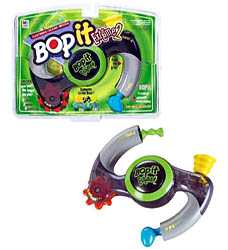
The play at a glance
Hear the cue, find the control, make the move
Bop It Extreme 2 turns listening into an immediate physical response. Its five actions are bop, twist, pull, spin and flick. The challenge is keeping those actions distinct when the next cue arrives.
Start by locating the controls before trying to keep a score. Then choose how the people around you will take part: one at a time, passing the unit, or sharing it in a two-player contest.
Find each action before the beat starts
Compare your unit with the guide’s control diagram. Find each labeled control and notice the movement it asks for. A twist, a spin and a flick use different parts; knowing the words is only part of knowing where to put your hand.
For a relaxed familiarization activity, leave scored play aside and take turns naming a control for the other person to point to. Pointing is enough. There is no need to operate the toy repeatedly or force a part while working out the layout.
Ask which pair of controls is easiest to confuse. Keep that observation in mind for a first short attempt, without making a target score the condition for enjoying it.
Choose a cue and a way to join in
The guide distinguishes Vox Bop’s spoken commands from Beat Bop’s musical cues. Solo gives one player an attempt; Pass It hands play to another person at the passing cue; One-on-One divides controls between two players holding the unit.
For a first session, spoken cues make the requested action explicit. Musical cues add the task of recognizing a sound. Listen to the guide’s sound descriptions before treating the two formats as interchangeable.
Choose the format before starting. Taking turns at solo attempts can suit a group that wants to watch and learn without an elimination round. Use the full instructions for selection, scoring and the particular responsibilities in shared-handle play.
Make the first attempt useful
After an attempt, ask one concrete question: was the cue unclear, was the control hard to find, or did the movement arrive too late? Those are different experiences and suggest different things to notice next time.
An observer can describe what they saw after play stops rather than shouting extra instructions during the run. Swap players and give each person a fresh attempt. Compare personal experiences before comparing scores.
Understand the audio connection
The documented jack under Twist It is an output for headphones or suitable amplified audio equipment. It does not import a playlist. The manual starts connected listening at low volume and includes cable precautions, particularly for passing games.
Use the complete matching instructions before connecting equipment. An ordinary speaker session is enough to explore the game; adding a cable changes how comfortably people can move around it. Check the actual unit’s condition and controls rather than assuming every product called Bop It works the same way.
The historical record
Original Toysit coverage
Both original paragraphs remain below, including the audio-connection claim. The 2002 guide confirms an output jack. Descriptions of reflex and memory challenges are historical commentary, not evidence of lasting improvements from playing.
Version 2 of Bop It Extreme
The popular Bop It now with 5 actions and a one-on-one game: Bop it. Twist it. Pull it. Spin it. Flick it. Compete to the beat as spoken and musical commands test your refexes. Connects to your stereo or headphones.
Designed to test reflexes and memory, Bop It has become a favorite among both kids and adults. The game's essence is to obey the spoken directives as swiftly and accurately as possible, with the challenge increasing as the tempo accelerates, offering endless hours of frenetic fun.
Sources and editorial notes
Reviewed October 16, 2026 using the original image, ASIN B000087BH4 and Hasbro’s 2002 Extreme 2 instructions, model 40940. The control layout matches the pictured unit. All four PDF pages were visually reviewed. The guide confirms voice/musical cues, three participation formats and an audio output. Practice ideas are editorial suggestions; no physical unit or audio connection was tested.
- Hasbro: Bop It Extreme 2 instructions (PDF) — Original 40940 guide, including controls, games, volume and audio connections.
Images and descriptions are retained as historical material. How Toysit covers toys.
Created for Toysit by Tabbloza — the artwork in our header.